Center for Healthy Minds, University of Wisconsin - Madison, 625 W. Washington Avenue, Madison, WI, 53703, USA; Department of Psychology, University of Wisconsin - Madison, 1202 W. Johnson Street, Madison, WI, 53706, USA; Waisman Laboratory for Brain Imaging and Behavior, University of Wisconsin - Madison, 1500 Highland Avenue, Madison, WI, 53705, USA.
Center for Healthy Minds, University of Wisconsin - Madison, 625 W. Washington Avenue, Madison, WI, 53703, USA; Waisman Laboratory for Brain Imaging and Behavior, University of Wisconsin - Madison, 1500 Highland Avenue, Madison, WI, 53705, USA.
Neuroimage. 2018 Nov 1;181:301-313. doi: 10.1016/j.neuroimage.2018.07.013. Epub 2018 Jul 7.
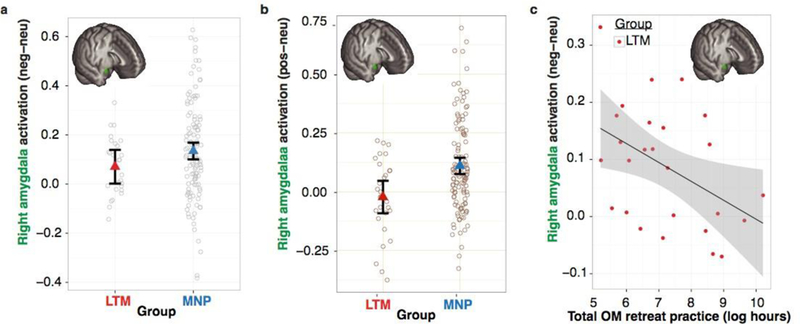
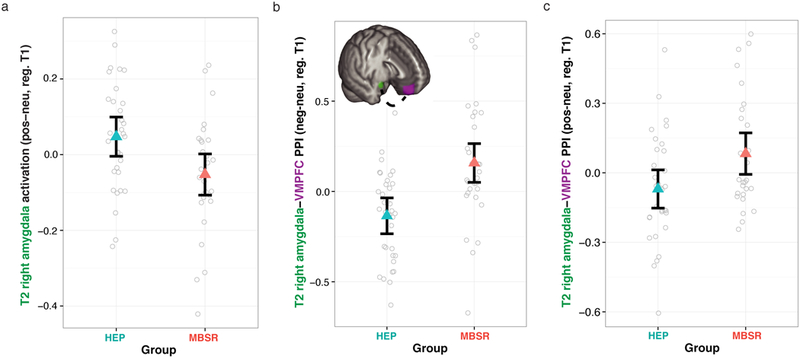
Meditation training can improve mood and emotion regulation, yet the neural mechanisms of these affective changes have yet to be fully elucidated. We evaluated the impact of long- and short-term mindfulness meditation training on the amygdala response to emotional pictures in a healthy, non-clinical population of adults using blood-oxygen level dependent functional magnetic resonance imaging. Long-term meditators (N = 30, 16 female) had 9081 h of lifetime practice on average, primarily in mindfulness meditation. Short-term training consisted of an 8-week Mindfulness- Based Stress Reduction course (N = 32, 22 female), which was compared to an active control condition (N = 35, 19 female) in a randomized controlled trial. Meditation training was associated with less amygdala reactivity to positive pictures relative to controls, but there were no group differences in response to negative pictures. Reductions in reactivity to negative stimuli may require more practice experience or concentrated practice, as hours of retreat practice in long-term meditators was associated with lower amygdala reactivity to negative pictures - yet we did not see this relationship for practice time with MBSR. Short-term training, compared to the control intervention, also led to increased functional connectivity between the amygdala and a region implicated in emotion regulation - ventromedial prefrontal cortex (VMPFC) - during affective pictures. Thus, meditation training may improve affective responding through reduced amygdala reactivity, and heightened amygdala-VMPFC connectivity during affective stimuli may reflect a potential mechanism by which MBSR exerts salutary effects on emotion regulation ability.
冥想训练可以改善情绪和情绪调节,但这些情感变化的神经机制尚未完全阐明。我们使用血氧水平依赖功能磁共振成像评估了长期和短期正念冥想训练对健康非临床成年人对情绪图片的杏仁核反应的影响。长期冥想者(N=30,16 名女性)平均一生有 9081 小时的练习时间,主要是在正念冥想中。短期训练包括为期 8 周的正念减压课程(N=32,22 名女性),并在一项随机对照试验中与积极对照组(N=35,19 名女性)进行比较。与对照组相比,冥想训练与对正性图片的杏仁核反应性降低有关,但对负性图片的反应没有组间差异。对负性刺激的反应减少可能需要更多的练习经验或集中练习,因为长期冥想者的静修练习时间与对负性图片的杏仁核反应性降低有关——但我们在 MBSR 的练习时间上没有看到这种关系。与对照组干预相比,短期训练还导致在情绪图片期间,杏仁核与情绪调节中涉及的区域——腹内侧前额叶皮层(VMPFC)之间的功能连接增加。因此,冥想训练可能通过降低杏仁核反应性来改善情绪反应,并且在情绪刺激期间杏仁核-VMPFC 连接的增加可能反映了 MBSR 对情绪调节能力产生有益影响的潜在机制。