He Dian, Yu YunLi, Wu Shan, Tian ShuFen, Yu Hui, Xu Shu, Chu Lan
Department of Neurology, Affiliated Hospital of Guizhou Medical University, Guiyang, Guizhou Province, China.
Department of Radiology, Affiliated Hospital of Guizhou Medical University, Guiyang, Guizhou Province, China.
BMC Neurol. 2019 Feb 12;19(1):26. doi: 10.1186/s12883-019-1248-z.
Mixed cerebrovascular disease is a diagnostic entity that presents with hemorrhagic and ischemic stroke clinically and/or subclinically. Here, we report a patient with mixed vascular risk factors, who presented with multiple intracerebral hemorrhages and a simultaneously occurring cerebral infarction with hemorrhagic transformation.
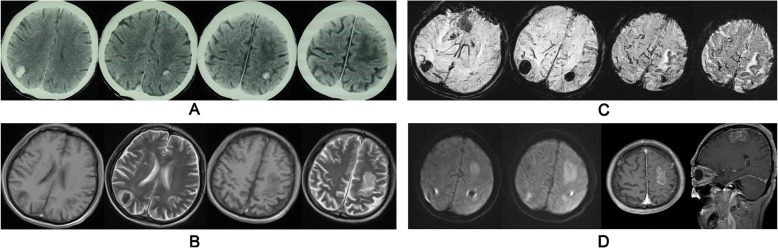
A 63-year-old male with no history of trauma or prior neurological disease presented with a sudden onset of weakness in his right limbs, followed by an episode of focal seizure without impaired awareness. The patient had a 4-year history of deep vein thrombosis in the lower limbs, and a 2-year history of Raynaud's phenomenon in the hands. He also had a family history of hypertension and thrombophilia. Head computed tomography plain scans showed two high densities in the bilateral parietal lobes and one mixed density in the left frontal lobe. The patient was diagnosed with mixed cerebrovascular disease. In this report, we make a systematic clinical reasoning regarding the etiological diagnosis, and discuss the possible pathogenic mechanisms leading to mixed cerebrovascular disease. We exclude coagulopathy, endocarditis, atrial fibrillation, patent foramen ovale, brain tumor, cerebral venous thrombosis, cerebral vascular malformation, cerebral amyloid angiopathy and vasculitis as causative factors. We identify hypertension, hereditary protein S deficiency, hypercholesteremia and hyperhomocysteinemia as contributing etiologies in this case.
This case presents complex underlying mechanisms of mixed cerebrovascular disease, in which hypertension and hyperhomocysteinemia are considered to play a central role.
混合性脑血管疾病是一种诊断实体,在临床和/或亚临床层面表现为出血性和缺血性卒中。在此,我们报告一名具有多种血管危险因素的患者,其出现多处脑内出血以及同时发生的伴有出血转化的脑梗死。
一名63岁男性,无创伤史或既往神经疾病史,突发右肢无力,随后出现一次意识未受损的局灶性癫痫发作。该患者有4年下肢深静脉血栓形成病史,双手雷诺现象病史2年。他还有高血压和易栓症家族史。头部计算机断层扫描平扫显示双侧顶叶有两处高密度影,左侧额叶有一处混合密度影。该患者被诊断为混合性脑血管疾病。在本报告中,我们对病因诊断进行了系统的临床推理,并讨论了导致混合性脑血管疾病的可能致病机制。我们排除了凝血障碍、心内膜炎、心房颤动、卵圆孔未闭、脑肿瘤、脑静脉血栓形成、脑血管畸形、脑淀粉样血管病和血管炎作为致病因素。我们确定高血压、遗传性蛋白S缺乏、高胆固醇血症和高同型半胱氨酸血症是该病例的促成病因。
本病例呈现了混合性脑血管疾病复杂的潜在机制,其中高血压和高同型半胱氨酸血症被认为起核心作用。