
抑制致癌性Src 会通过激活 PPARγ 诱导 FABP4 介导的脂解作用,从而发挥抑制肿瘤生长的作用。
Inhibition of oncogenic Src induces FABP4-mediated lipolysis via PPARγ activation exerting cancer growth suppression.
机构信息
Department of Biochemistry, Wonju College of Medicine, Yonsei University, Wonju, Gangwon-do 26426, Republic of Korea; Department of Global Medical Science, Wonju College of Medicine, Yonsei University, Wonju, Gangwon-do 26426, Republic of Korea; Mitohormesis Research Center, Wonju College of Medicine, Yonsei University, Wonju, Gangwon-do 26426, Republic of Korea.
Department of Biochemistry, Wonju College of Medicine, Yonsei University, Wonju, Gangwon-do 26426, Republic of Korea.
出版信息
EBioMedicine. 2019 Mar;41:134-145. doi: 10.1016/j.ebiom.2019.02.015. Epub 2019 Feb 10.
BACKGROUND
c-Src is a driver oncogene well-known for tumorigenic signaling, but little for metabolic function. Previous reports about c-Src regulation of glucose metabolism prompted us to investigate its function in other nutrient modulation, particularly in lipid metabolism.
METHODS
Oil-red O staining, cell growth assay, and tumor volume measurement were performed to determine lipid amount and growth inhibitory effect of treatments in lung cancer cells and xenograft model. Gene expression was evaluated by immunoblotting and relative RT-PCR. Transcriptional activity of peroxisome proliferator-activated receptor gamma (PPARγ) was assessed by luciferase assay. Reactive oxygen species (ROS) was measured using ROS sensing dye. Oxygen consumption rate was evaluated by Seahorse XF Mito Stress Test. Clinical relevance of candidate proteins was examined using patient samples and public database analysis.
FINDINGS
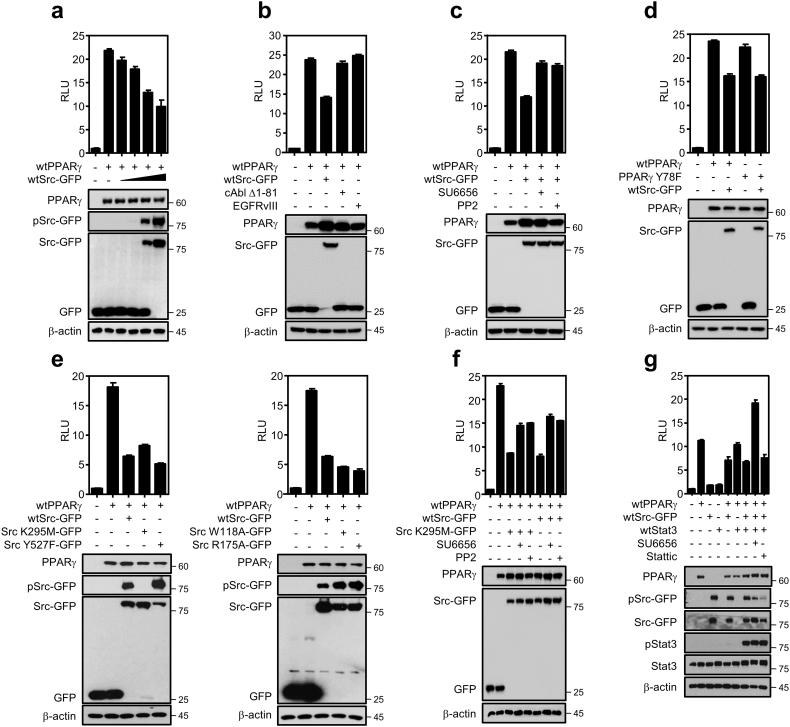
Inhibition of Src induced lipolysis and increased intracellular ROS. Src inhibition derepressed PPARγ transcriptional activity leading to induced expression of lipolytic gene fatty acid binding protein (FABP) 4 which accompanies reduced lipid droplets and decreased tumor growth. The reverse correlation of Src and FABP4 was confirmed in pair-matched lung cancer patient samples, and further analysis using public datasets revealed upregulation of lipolytic genes is associated with better prognosis of cancer patients.
INTERPRETATION
This study provides an insight of how oncogenic factor Src concurrently regulates both cellular signaling pathways and metabolic plasticity to drive cancer progression. FUND: National Research Foundation of Korea and Korea Health Industry Development Institute.
背景
c-Src 是一种众所周知的致癌基因,其主要功能与肿瘤发生信号转导有关,但与代谢功能的关系研究较少。先前关于 c-Src 调节葡萄糖代谢的报道促使我们研究其在其他营养物质调节中的作用,特别是在脂代谢方面。
方法
采用油红 O 染色、细胞生长测定和肿瘤体积测量方法,检测肺癌细胞和异种移植模型中处理物的脂质含量和生长抑制作用。通过免疫印迹和相对 RT-PCR 评估基因表达。通过荧光素酶测定评估过氧化物酶体增殖物激活受体 γ(PPARγ)的转录活性。使用 ROS 感应染料测量活性氧(ROS)。通过 Seahorse XF Mito Stress Test 评估耗氧量。使用患者样本和公共数据库分析来检验候选蛋白的临床相关性。
发现
Src 抑制诱导脂肪分解并增加细胞内 ROS。Src 抑制使 PPARγ 的转录活性去抑制,导致脂肪分解基因脂肪酸结合蛋白 4(FABP4)的表达诱导,伴随着脂质滴减少和肿瘤生长减少。配对的肺癌患者样本中证实了 Src 和 FABP4 的反向相关性,进一步使用公共数据集进行的分析表明,脂肪分解基因的上调与癌症患者的更好预后相关。
解释
这项研究提供了一个深入了解致癌因子 Src 如何同时调节细胞信号通路和代谢可塑性以推动癌症进展的机会。
资助
韩国国家研究基金会和韩国健康产业发展研究所。




 Zotero 插件