Guo Jing, Chen Yang, Li Zhengjie, Cheng Shirui, Tang Chenjian, Dong Xiaohui, He Wenhua, Huang Yong, Yin Bao, Sheng Yu, Zhou Jun, Li Aijia, Zeng Fang, Lan Lei, Liang Fanrong
Acupuncture and Tuina School/The 3rd Teaching Hospital, Chengdu University of Traditional Chinese Medicine, 37# Shierqiao Road, Chengdu, 610075, Sichuan, China.
The 1st Teaching Hospital of Chengdu University of Traditional Chinese Medicine, Chengdu, Sichuan, China.
Trials. 2019 Feb 13;20(1):126. doi: 10.1186/s13063-019-3233-7.
Acupuncture is safe and effective for reducing the symptoms of knee osteoarthritis (KOA), but the underlying mechanisms of acupuncture for treating KOA are not fully understood.
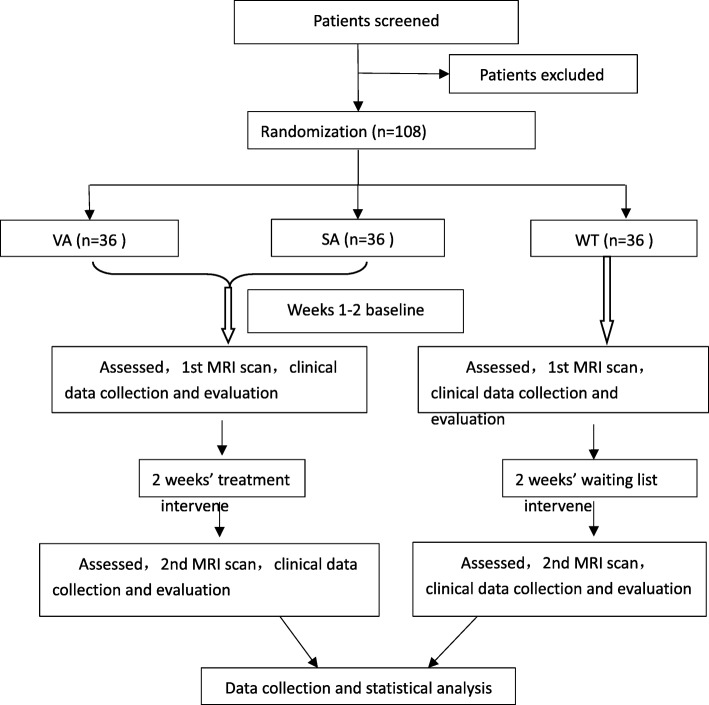
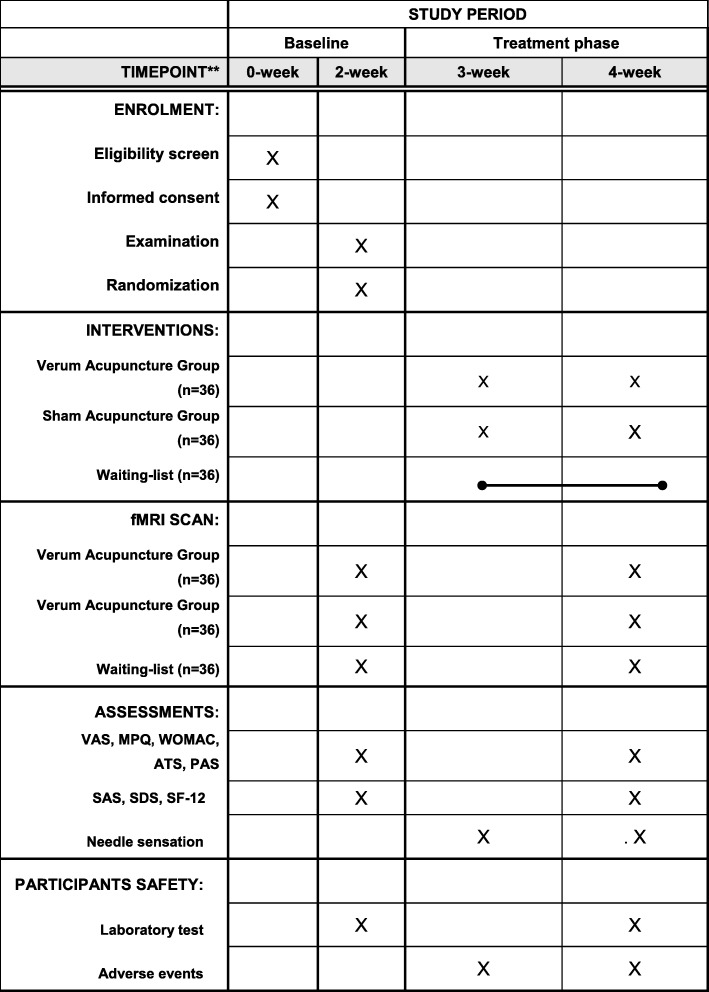
METHODS/DESIGN: In total, 108 participants diagnosed with KOA will be recruited. They will be blinded to group assignment and randomized to either verum acupuncture, sham acupuncture or waiting-list groups with 36 patients in each group. Each patient in the acupuncture group will receive five treatments per week for 2 weeks. This study will focus on detecting the cerebral functional connectivity changes elicited by acupuncture treatment. The Visual Analog Scale and the short form of the McGill Pain Questionnaire, the Western Ontario and McMaster Universities Osteoarthritis Index, the Attention Test Scale, the Pain Assessment of Sphygmomanometer and the 12-Item Short Form Health Survey will be used to evaluate the symptoms and quality of life improvement at the baseline and the end of treatment. The Self-rating Anxiety Scale and the Self-rating Depression Scale will be used at the baseline and the end of treatment to investigate the influence of emotional state on brain activity and clinical variable. To ensure the consistency of acupuncture manipulation, the deqi scale will be performed after each acupuncture treatment. During the procedure of outcome evaluation and data analysis, the evaluators and statisticians will be blinded to the group allocation. The repeated measures analysis of variance (3 groups × 2 time points ANOVA) will be employed to analyze numerical variables of the clinical and neuroimaging data generated in the study, then the t test will be used in the post-hoc analysis.
The results of this randomized, sham- and waiting-list-controlled functional magnetic resonance imaging (fMRI) study will help to investigate the influence of verum acupuncture treatment on the brain activities of patients with KOA, which might provide evidence for the clinical application of verum acupuncture for KOA management.
Chinese Clinical Trial Registry, ID: ChiCT-IOR-17012364 . Registered on 14 August 2017.
针刺对于减轻膝关节骨关节炎(KOA)症状安全有效,但针刺治疗KOA的潜在机制尚未完全明确。
方法/设计:总共将招募108名被诊断为KOA的参与者。他们将对分组情况不知情,并随机分为真针刺组、假针刺组或等待列表组,每组36例患者。针刺组的每位患者每周接受5次治疗,共2周。本研究将聚焦于检测针刺治疗引起的脑功能连接变化。将使用视觉模拟量表、麦吉尔疼痛问卷简表、西安大略和麦克马斯特大学骨关节炎指数、注意力测试量表、血压计疼痛评估以及简明健康状况调查12项量表来评估基线和治疗结束时的症状及生活质量改善情况。将在基线和治疗结束时使用自评焦虑量表和自评抑郁量表来研究情绪状态对脑活动和临床变量的影响。为确保针刺操作的一致性,每次针刺治疗后将进行得气量表评估。在结果评估和数据分析过程中,评估者和统计人员将对分组情况不知情。将采用重复测量方差分析(3组×2个时间点方差分析)来分析研究中产生的临床和神经影像数据的数值变量,然后在事后分析中使用t检验。
这项随机、假针刺和等待列表对照的功能磁共振成像(fMRI)研究结果将有助于探究真针刺治疗对KOA患者脑活动的影响,这可能为真针刺在KOA管理中的临床应用提供证据。
中国临床试验注册中心,注册号:ChiCT-IOR-17012364 。于2017年8月14日注册。