Department of Twin Research and Genetic Epidemiology, School of Life Course Sciences, King's College London, London, UK.
Department of Biomedical Sciences, Chang Gung University, Taoyuan, Taiwan.
Clin Epigenetics. 2019 Feb 13;11(1):27. doi: 10.1186/s13148-019-0614-4.
Genetic and environmental risk factors contribute to periodontal disease, but the underlying susceptibility pathways are not fully understood. Epigenetic mechanisms are malleable regulators of gene function that can change in response to genetic and environmental stimuli, thereby providing a potential mechanism for mediating risk effects in periodontitis. The aim of this study is to identify epigenetic changes across tissues that are associated with periodontal disease.
Self-reported gingival bleeding and history of gum disease, or tooth mobility, were used as indicators of periodontal disease. DNA methylation profiles were generated using the Infinium HumanMethylation450 BeadChip in whole blood, buccal, and adipose tissue samples from predominantly older female twins (mean age 58) from the TwinsUK cohort. Epigenome-wide association scans (EWAS) of gingival bleeding and tooth mobility were conducted in whole blood in 528 and 492 twins, respectively. Subsequently, targeted candidate gene analysis at 28 genomic regions was carried out testing for phenotype-methylation associations in 41 (tooth mobility) and 43 (gingival bleeding) buccal, and 501 (tooth mobility) and 556 (gingival bleeding) adipose DNA samples.
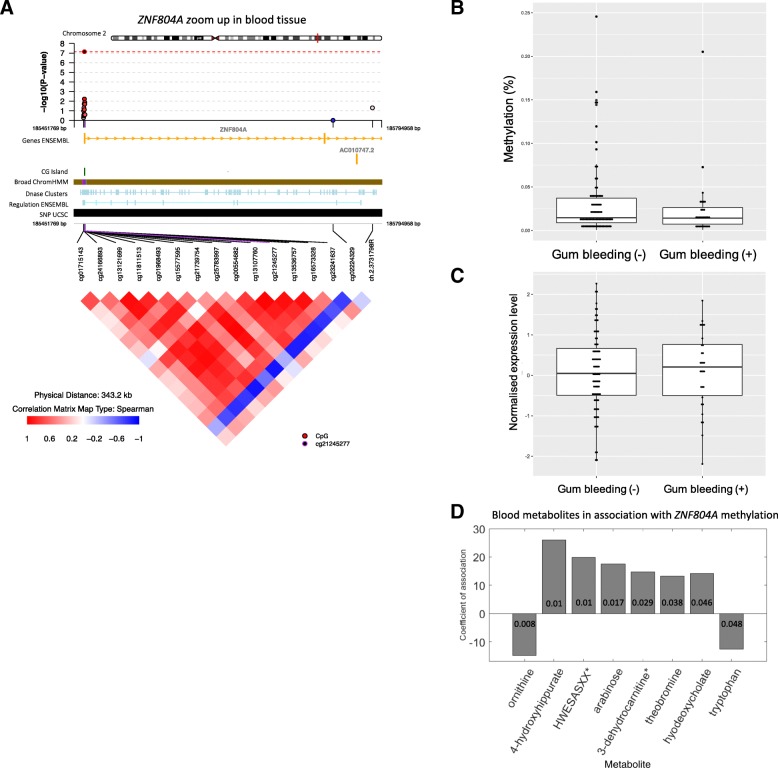
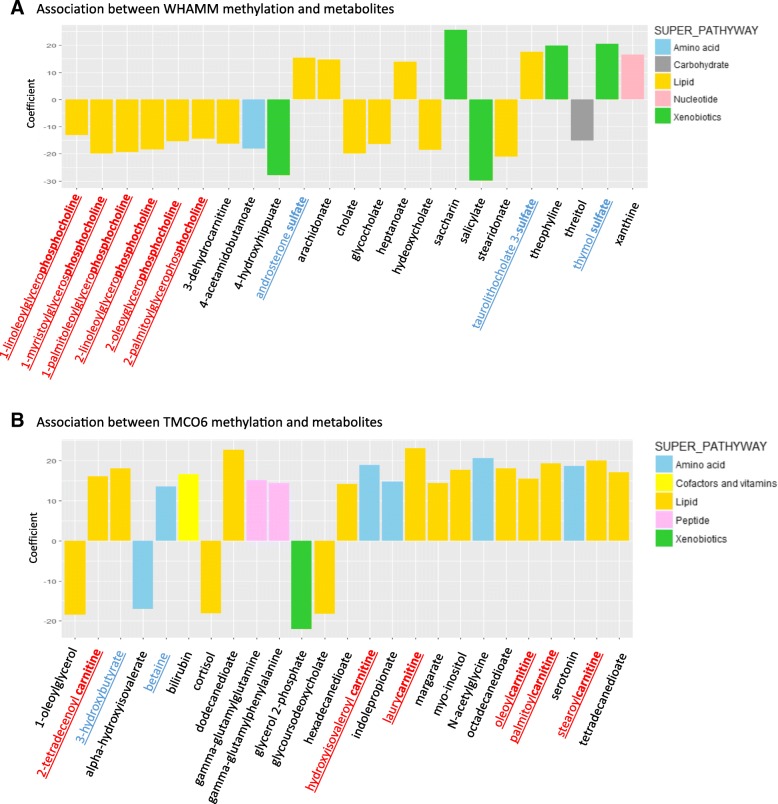
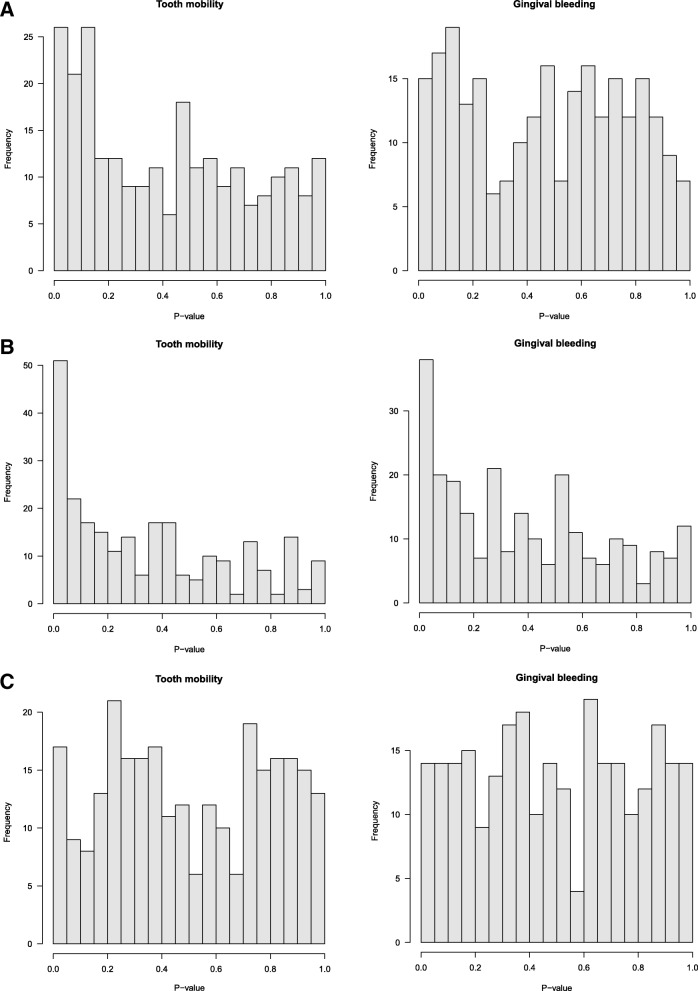
Epigenome-wide analyses in blood identified one CpG-site (cg21245277 in ZNF804A) associated with gingival bleeding (FDR = 0.03, nominal p value = 7.17e-8) and 58 sites associated with tooth mobility (FDR < 0.05) with the top signals in IQCE and XKR6. Epigenetic variation at 28 candidate regions (247 CpG-sites) for chronic periodontitis showed an enrichment for association with periodontal traits, and signals in eight genes (VDR, IL6ST, TMCO6, IL1RN, CD44, IL1B, WHAMM, and CXCL1) were significant in both traits. The methylation-phenotype association signals validated in buccal samples, and a subset (25%) also validated in adipose tissue.
Epigenome-wide analyses in adult female twins identified specific DNA methylation changes linked to self-reported periodontal disease. Future work will explore the environmental basis and functional impact of these results to infer potential for strategic personalized treatments and prevention of chronic periodontitis.
遗传和环境风险因素导致牙周病,但潜在的易感性途径尚不完全清楚。表观遗传机制是基因功能的可塑调节剂,可响应遗传和环境刺激而发生变化,从而为介导牙周炎的风险效应提供了一种潜在机制。本研究的目的是确定与牙周病相关的跨组织的表观遗传变化。
自我报告的牙龈出血和牙龈疾病史或牙齿松动被用作牙周病的指标。使用 Infinium HumanMethylation450 BeadChip 在来自 TwinsUK 队列的主要为老年女性双胞胎(平均年龄 58 岁)的全血、颊和脂肪组织样本中生成 DNA 甲基化图谱。在 528 名和 492 名双胞胎的全血中进行了牙龈出血和牙齿松动的全基因组关联扫描(EWAS)。随后,在 41 个(牙齿松动)和 43 个(牙龈出血)颊部以及 501 个(牙齿松动)和 556 个(牙龈出血)脂肪组织 DNA 样本中进行了 28 个基因组区域的靶向候选基因分析,以检测表型-甲基化关联。
血液中的全基因组分析确定了一个与牙龈出血相关的 CpG 位点(cg21245277 位于 ZNF804A 中)(FDR = 0.03,名义 p 值 = 7.17e-8)和 58 个与牙齿松动相关的位点(FDR < 0.05),IQCE 和 XKR6 中的顶级信号。慢性牙周炎的 28 个候选区域(247 个 CpG 位点)的表观遗传变异与牙周病特征呈富集关联,并且在 8 个基因(VDR、IL6ST、TMCO6、IL1RN、CD44、IL1B、WHAMM 和 CXCL1)中的信号在两种特征中均具有显著性。在颊部样本中验证了甲基化-表型关联信号,其中在脂肪组织中的一个子集(25%)也得到了验证。
在成年女性双胞胎中进行的全基因组分析确定了与自我报告的牙周病相关的特定 DNA 甲基化变化。未来的工作将探索这些结果的环境基础和功能影响,以推断潜在的策略性个体化治疗和预防慢性牙周炎的可能性。