• 文献检索
  • 文档翻译
  • 深度研究
  • 学术资讯
  • Suppr Zotero 插件Zotero 插件
  • 邀请有礼
  • 套餐&价格
  • 历史记录
应用&插件
Suppr Zotero 插件Zotero 插件浏览器插件Mac 客户端Windows 客户端微信小程序
定价
高级版会员购买积分包购买API积分包
服务
文献检索文档翻译深度研究API 文档MCP 服务
关于我们
关于 Suppr公司介绍联系我们用户协议隐私条款
关注我们

Suppr 超能文献

核心技术专利:CN118964589B侵权必究
粤ICP备2023148730 号-1Suppr @ 2026

文献检索

告别复杂PubMed语法,用中文像聊天一样搜索,搜遍4000万医学文献。AI智能推荐,让科研检索更轻松。

立即免费搜索

文件翻译

保留排版,准确专业,支持PDF/Word/PPT等文件格式,支持 12+语言互译。

免费翻译文档

深度研究

AI帮你快速写综述,25分钟生成高质量综述,智能提取关键信息,辅助科研写作。

立即免费体验

MRI 检查在心脏植入式电子设备患者中的应用:“一站式”服务模式简化复杂性。

MRI for patients with cardiac implantable electronic devices: simplifying complexity with a 'one-stop' service model.

机构信息

Department of Cardiac Imaging, Barts Heart Centre, Barts Health NHS Trust, London, UK

Institute of Cardiovascular Sciences, University College London, London, UK.

出版信息

BMJ Qual Saf. 2019 Oct;28(10):853-858. doi: 10.1136/bmjqs-2018-009079. Epub 2019 Feb 13.

DOI:10.1136/bmjqs-2018-009079
PMID:30760606
原文链接:https://pmc.ncbi.nlm.nih.gov/articles/PMC6837254/
Abstract

BACKGROUND

Patients with cardiac pacemakers and defibrillators are disadvantaged because of poor access to MRI scans, leading to late and misdiagnosis particularly for cancer and neurological disease. New technology allied to tested protocols now allows safe MRI scanning of such patients; however, logistical barriers persist.

AIM

To deliver a streamlined sustainable service that provides timely MRI scans to patients with cardiac implantable electronic devices (CIEDs).

METHODS

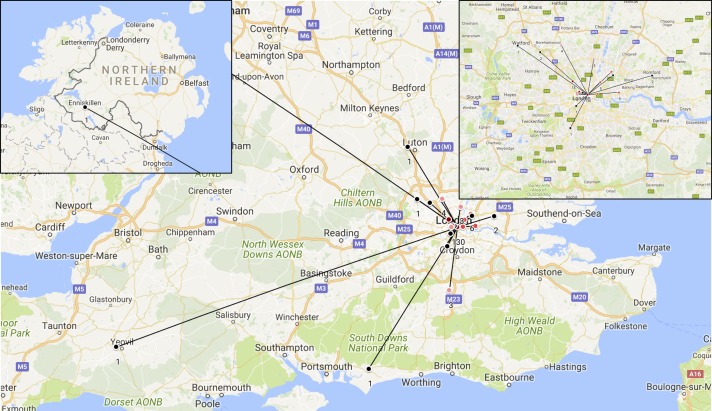
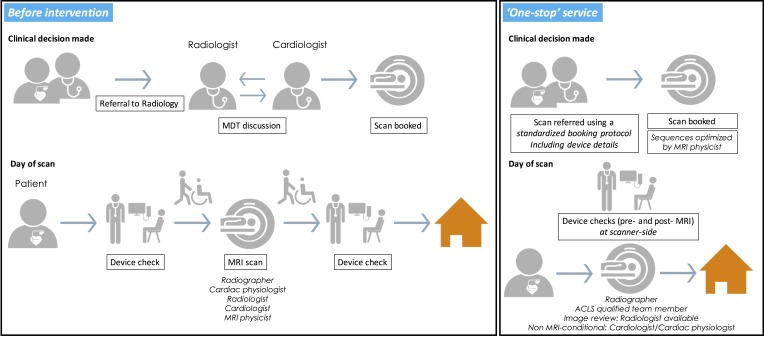
Patients requested a 'one-stop' service for MRI, whereby devices could be reprogrammed and scans acquired at a single location and visit. To provide this 'one-stop' service, we trained a team including administrators, physicians, cardiac physiologists and radiographers. A standard protocol was used to prevent unnecessary request refusals and delays to scheduling. Service volume, waiting time and safety were analysed 6 months before and 2 years after service redesign. Waiting times for internal and external inpatient referrals plus time to treatment for patients on a cancer pathway were analysed.

RESULTS

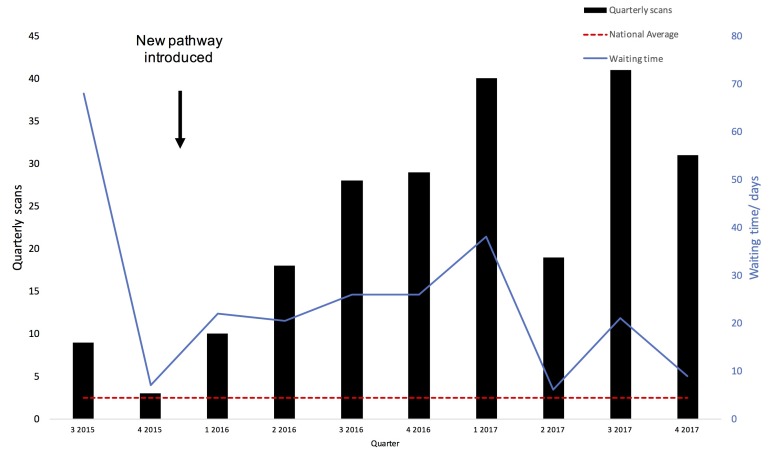
215 MRI scans were performed over 2 years. After service redesign, MRI provision increased six-fold to 20 times the national average with reduced waiting time from 60 to 15 days and no adverse events. Departmental throughput was maintained. 85 (40%) referrals were external. 41 (19%) inpatients were scanned, reducing bed-stay by 3 days for internal referrals. 24 (11%) scans were for suspected cancer, 83% allowed treatment within the national standard of 62 days. There was no preintervention service for either inpatients or suspected cancer investigation.

CONCLUSION

Implementation of a 'one-stop' service model to provide MRI for patients with CIEDs is safe, streamlined, scalable and has reduced delays making economic and clinical sense. Protocols and checklists are available at mrimypacemaker.com.

摘要

背景

由于心脏起搏器和除颤器患者获取磁共振成像(MRI)扫描的机会有限,导致他们往往无法得到及时诊断,尤其是癌症和神经疾病,这种情况并不少见。如今,结合新技术和经过验证的方案,此类患者可安全地进行 MRI 扫描,但仍存在一些实际操作方面的障碍。

目的

建立一个流程简化、可持续的服务体系,为心脏植入式电子设备(CIED)患者提供及时的 MRI 扫描。

方法

我们为患者提供了一站式 MRI 服务,即患者可在同一地点和就诊过程中对设备进行重新编程和扫描。为了提供这项“一站式”服务,我们培训了一支由行政人员、医生、心脏生理学家和放射技师组成的团队。我们使用标准方案来防止不必要的申请被拒绝以及预约流程被延误。我们分析了服务模式改变前后 6 个月和 2 年的服务量、等待时间和安全性。我们还分析了内部和外部住院患者转诊的等待时间以及癌症患者的治疗时间。

结果

在两年内共进行了 215 次 MRI 扫描。在服务模式改变后,MRI 检查次数增加了六倍,达到全国平均水平的 20 倍,同时将等待时间从 60 天缩短至 15 天,并且没有出现不良事件。该部门的流程效率保持不变。85 次(40%)转诊来自外部。41 名(19%)住院患者接受了扫描,内部转诊患者的住院时间减少了 3 天。24 次(11%)扫描用于疑似癌症患者,83%的患者可在国家规定的 62 天内接受治疗。此前,无论是住院患者还是疑似癌症患者都没有相应的服务。

结论

为 CIED 患者实施“一站式”服务模式以提供 MRI 检查是安全、简化、可扩展的,同时减少了延误,具有经济和临床意义。mrimypacemaker.com 上提供了方案和检查表。
https://cdn.ncbi.nlm.nih.gov/pmc/blobs/e80b/6837254/a422b0764aff/bmjqs-2018-009079f03.jpg
https://cdn.ncbi.nlm.nih.gov/pmc/blobs/e80b/6837254/11e7946ee59c/bmjqs-2018-009079f01.jpg
https://cdn.ncbi.nlm.nih.gov/pmc/blobs/e80b/6837254/2ebb31428b27/bmjqs-2018-009079f02.jpg
https://cdn.ncbi.nlm.nih.gov/pmc/blobs/e80b/6837254/a422b0764aff/bmjqs-2018-009079f03.jpg
https://cdn.ncbi.nlm.nih.gov/pmc/blobs/e80b/6837254/11e7946ee59c/bmjqs-2018-009079f01.jpg
https://cdn.ncbi.nlm.nih.gov/pmc/blobs/e80b/6837254/2ebb31428b27/bmjqs-2018-009079f02.jpg
https://cdn.ncbi.nlm.nih.gov/pmc/blobs/e80b/6837254/a422b0764aff/bmjqs-2018-009079f03.jpg

相似文献

1
MRI for patients with cardiac implantable electronic devices: simplifying complexity with a 'one-stop' service model.MRI 检查在心脏植入式电子设备患者中的应用:“一站式”服务模式简化复杂性。
BMJ Qual Saf. 2019 Oct;28(10):853-858. doi: 10.1136/bmjqs-2018-009079. Epub 2019 Feb 13.
2
Making MRI available for patients with cardiac implantable electronic devices: growing need and barriers to change.为患有心脏植入式电子设备的患者提供 MRI 检查:不断增长的需求与变革的障碍。
Eur Radiol. 2020 Mar;30(3):1378-1384. doi: 10.1007/s00330-019-06449-5. Epub 2019 Nov 27.
3
Access to MRI for patients with cardiac pacemakers and implantable cardioverter defibrillators.心脏起搏器和植入式心脏复律除颤器患者的 MRI 检查。
Open Heart. 2021 May;8(1). doi: 10.1136/openhrt-2021-001598.
4
Provision of MR imaging for patients with cardiac implantable electronic devices (CIEDs): a single-center experience and national survey.为患有心脏植入式电子设备 (CIEDs) 的患者提供磁共振成像 (MRI):单中心经验和全国性调查。
Ir J Med Sci. 2019 Aug;188(3):999-1004. doi: 10.1007/s11845-018-1922-y. Epub 2018 Oct 27.
5
The Burden of Cardiac Implantable Electronic Device Checks in the Peri-MRI Setting: The CHECK-MRI Study.心脏植入式电子设备在 MRI 检查围手术期的负担:CHECK-MRI 研究。
Heart Lung Circ. 2023 Feb;32(2):252-260. doi: 10.1016/j.hlc.2022.10.005. Epub 2022 Nov 25.
6
Safety and Quality of 1.5-T MRI in Patients With Conventional and MRI-Conditional Cardiac Implantable Electronic Devices After Implementation of a Standardized Protocol.实施标准化方案后,1.5-T磁共振成像在传统及磁共振成像条件适用的心脏植入式电子设备患者中的安全性和质量
AJR Am J Roentgenol. 2016 Sep;207(3):599-604. doi: 10.2214/AJR.16.16033. Epub 2016 Jun 15.
7
Safety of thoracic magnetic resonance imaging for patients with pacemakers and defibrillators.心脏起搏器和除颤器患者行胸部磁共振成像的安全性。
Heart Rhythm. 2019 Nov;16(11):1645-1651. doi: 10.1016/j.hrthm.2019.05.031. Epub 2019 May 29.
8
Provision of magnetic resonance imaging for patients with 'MR-conditional' cardiac implantable electronic devices: an unmet clinical need.为患有“磁共振成像条件适用型”心脏植入式电子设备的患者提供磁共振成像:一项未得到满足的临床需求。
Europace. 2017 Mar 1;19(3):425-431. doi: 10.1093/europace/euw063.
9
Thoracic versus nonthoracic MR imaging for patients with an MR nonconditional cardiac implantable electronic device.针对植入了磁共振非条件心脏植入式电子设备的患者进行胸部与非胸部磁共振成像对比研究
Pacing Clin Electrophysiol. 2018 Jun;41(6):589-596. doi: 10.1111/pace.13340. Epub 2018 Apr 30.
10
MRI safety management in patients with cardiac implantable electronic devices: Utilizing failure mode and effects analysis for risk optimization.心脏植入式电子设备患者的 MRI 安全管理:利用失效模式和影响分析进行风险优化。
Int J Qual Health Care. 2020 Sep 23;32(7):431-437. doi: 10.1093/intqhc/mzaa067.

引用本文的文献

1
Service-level interventions to reduce waiting time in outpatient and community health settings may be sustained: a systematic review.在门诊和社区卫生环境中减少等待时间的服务层面干预措施可能具有可持续性:一项系统综述。
BMJ Open Qual. 2025 Mar 7;14(1):e003235. doi: 10.1136/bmjoq-2024-003235.
2
Practical strategies to improve MRI operations and workflow in pediatric radiology.改善儿科放射学中MRI操作与工作流程的实用策略。
Pediatr Radiol. 2025 Jan;55(1):12-23. doi: 10.1007/s00247-024-06114-0. Epub 2024 Dec 20.
3
Access to MRI for patients with cardiac pacemakers and implantable cardioverter defibrillators.

本文引用的文献

1
Patients with cardiac devices should not be excluded from MRI scans, say experts.专家表示,装有心脏设备的患者不应被排除在核磁共振成像扫描之外。
BMJ. 2018 Aug 22;362:k3623. doi: 10.1136/bmj.k3623.
2
Safety of Magnetic Resonance Imaging in Patients with Cardiac Devices.心脏植入设备患者的磁共振成像安全性
N Engl J Med. 2017 Dec 28;377(26):2555-2564. doi: 10.1056/NEJMoa1604267.
3
Access to magnetic resonance imaging of patients with magnetic resonance-conditional pacemaker and implantable cardioverter-defibrillator systems: results from the Really ProMRI study.
心脏起搏器和植入式心脏复律除颤器患者的 MRI 检查。
Open Heart. 2021 May;8(1). doi: 10.1136/openhrt-2021-001598.
4
Making MRI available for patients with cardiac implantable electronic devices: growing need and barriers to change.为患有心脏植入式电子设备的患者提供 MRI 检查:不断增长的需求与变革的障碍。
Eur Radiol. 2020 Mar;30(3):1378-1384. doi: 10.1007/s00330-019-06449-5. Epub 2019 Nov 27.
5
[Safe MRI examinations in patients with pacemakers and ICD].[起搏器和植入式心脏除颤器患者的安全磁共振成像检查]
Radiologe. 2019 Oct;59(10):885-893. doi: 10.1007/s00117-019-0567-9.
有磁共振条件性起搏器和植入式心脏复律除颤器系统的患者行磁共振检查的途径:真 PROMRI 研究结果。
Europace. 2018 Jun 1;20(6):1001-1009. doi: 10.1093/europace/eux118.
4
2017 HRS expert consensus statement on magnetic resonance imaging and radiation exposure in patients with cardiovascular implantable electronic devices.2017年心脏节律学会关于心血管植入式电子设备患者磁共振成像与辐射暴露的专家共识声明
Heart Rhythm. 2017 Jul;14(7):e97-e153. doi: 10.1016/j.hrthm.2017.04.025. Epub 2017 May 11.
5
Next steps on the NHS five year forward view.英国国家医疗服务体系(NHS)五年展望的后续举措。
BMJ. 2017 Apr 4;357:j1678. doi: 10.1136/bmj.j1678.
6
Assessing the Risks Associated with MRI in Patients with a Pacemaker or Defibrillator.评估起搏器或除颤器患者进行 MRI 检查的相关风险。
N Engl J Med. 2017 Feb 23;376(8):755-764. doi: 10.1056/NEJMoa1603265.
7
Provision of magnetic resonance imaging for patients with 'MR-conditional' cardiac implantable electronic devices: an unmet clinical need.为患有“磁共振成像条件适用型”心脏植入式电子设备的患者提供磁共振成像:一项未得到满足的临床需求。
Europace. 2017 Mar 1;19(3):425-431. doi: 10.1093/europace/euw063.
8
SQUIRE 2.0 (Standards for QUality Improvement Reporting Excellence): revised publication guidelines from a detailed consensus process.SQUIRE 2.0(卓越质量改进报告标准):通过详细的共识过程制定的修订版出版指南。
BMJ Qual Saf. 2016 Dec;25(12):986-992. doi: 10.1136/bmjqs-2015-004411. Epub 2015 Sep 14.
9
Trends in the incidence and prevalence of cardiac pacemaker insertions in an ageing population.老年人群中心脏起搏器植入的发病率和患病率趋势。
Open Heart. 2014 Dec 10;1(1):e000177. doi: 10.1136/openhrt-2014-000177. eCollection 2014.
10
Clinical utility and safety of a protocol for noncardiac and cardiac magnetic resonance imaging of patients with permanent pacemakers and implantable-cardioverter defibrillators at 1.5 tesla.1.5 特斯拉场强下针对植入永久性起搏器和植入式心脏复律除颤器患者的非心脏及心脏磁共振成像方案的临床效用与安全性
Circulation. 2006 Sep 19;114(12):1277-84. doi: 10.1161/CIRCULATIONAHA.105.607655. Epub 2006 Sep 11.