Institute of Pharmacology and Toxicology, Medical Faculty RWTH-Aachen, 52074, Aachen, Germany.
Medical Research & Development, Air Liquide Santé Internationale, Centre de Recherche Paris-Saclay, 78354, Jouy-en-Josas, France.
Sci Rep. 2019 Feb 13;9(1):1902. doi: 10.1038/s41598-018-38267-y.
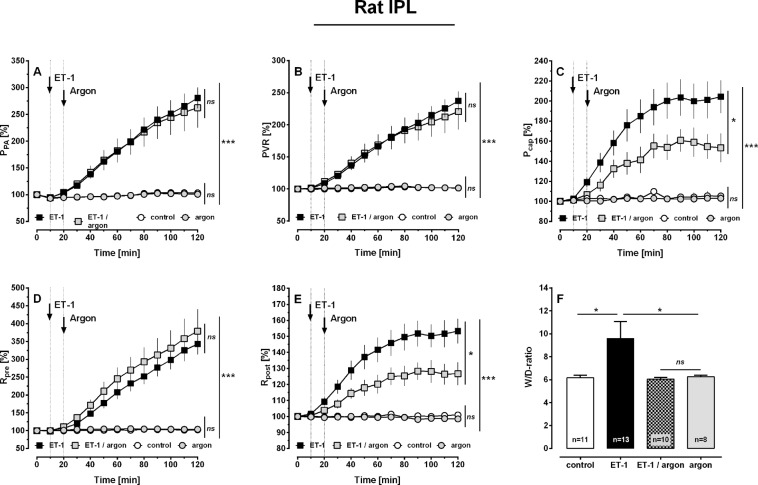
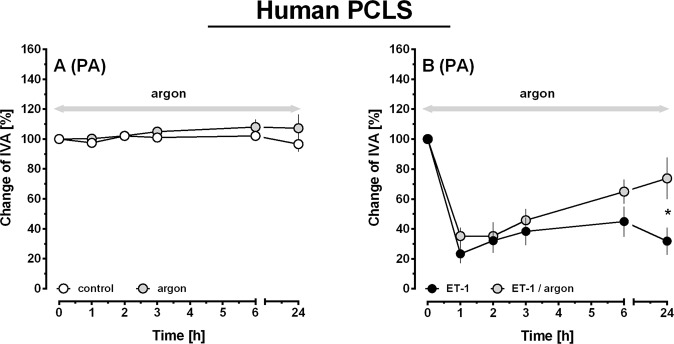
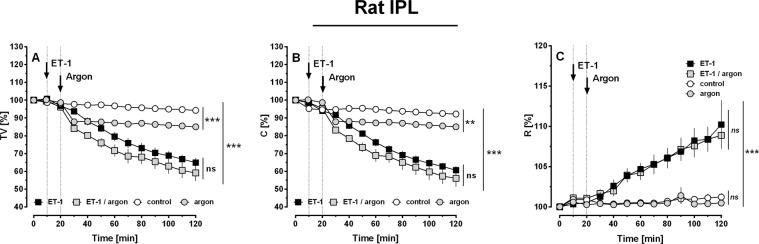
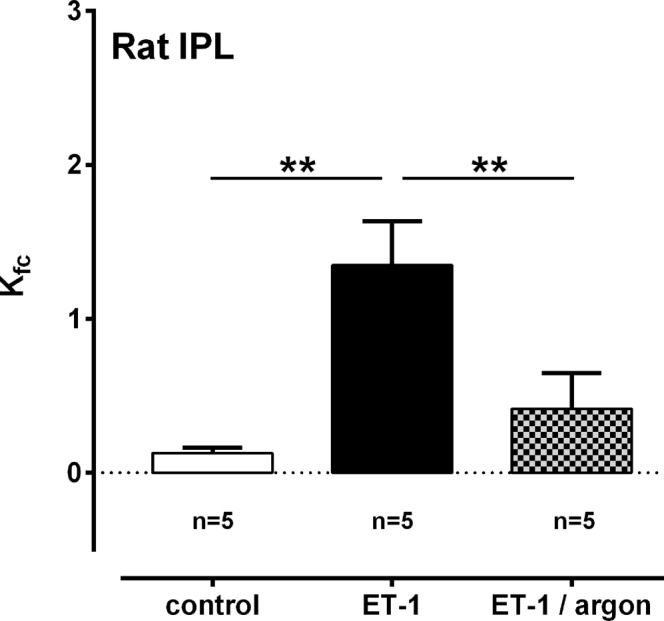
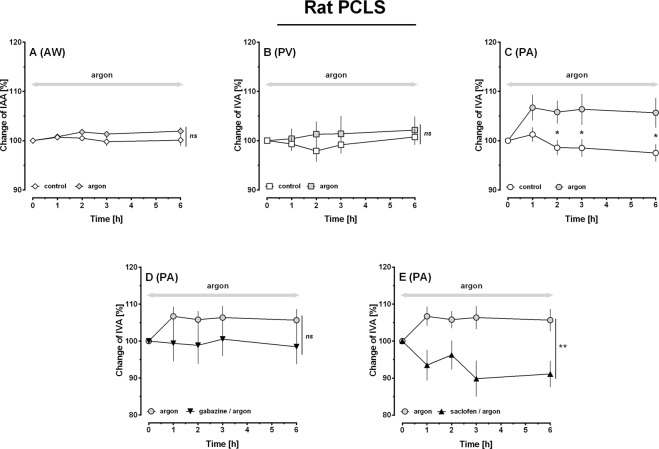
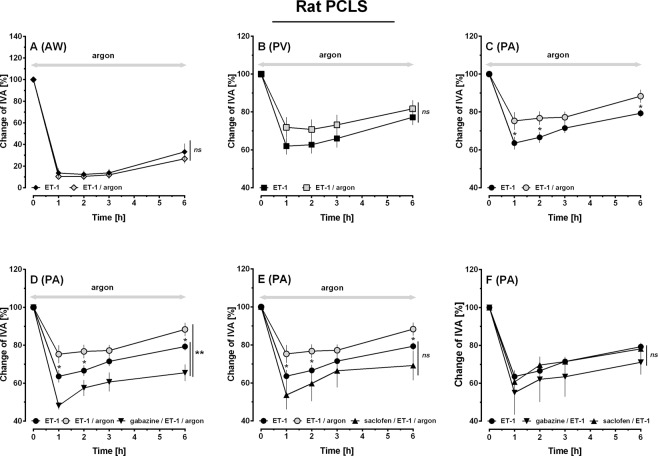
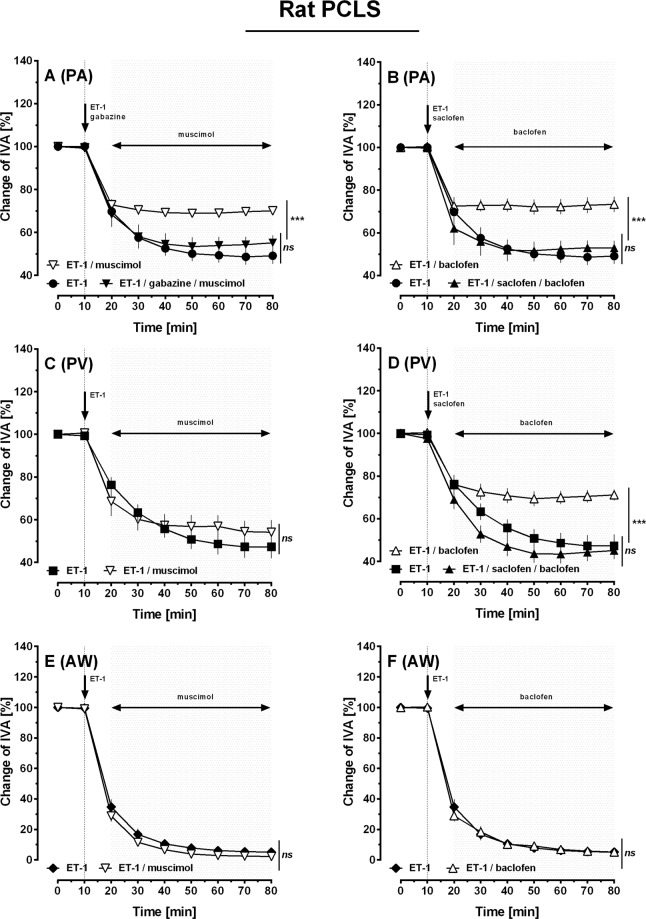
Argon exerts neuroprotection. Thus, it might improve patients' neurological outcome after cerebral disorders or cardiopulmonary resuscitation. However, limited data are available concerning its effect on pulmonary vessel and airways. We used rat isolated perfused lungs (IPL) and precision-cut lung slices (PCLS) of rats and humans to assess this topic. IPL: Airway and perfusion parameters, oedema formation and the pulmonary capillary pressure (P) were measured and the precapillary and postcapillary resistance (R) was calculated. In IPLs and PCLS, the pulmonary vessel tone was enhanced with ET-1 or remained unchanged. IPLs were ventilated and PCLS were gassed with argon-mixture or room-air. IPL: Argon reduced the ET-1-induced increase of P, R and oedema formation (p < 0.05). PCLS (rat): Argon relaxed naïve pulmonary arteries (PAs) (p < 0.05). PCLS (rat/human): Argon attenuated the ET-1-induced contraction in PAs (p < 0.05). Inhibition of GABA-receptors abolished argon-induced relaxation (p < 0.05) in naïve or ET-1-pre-contracted PAs; whereas inhibition of GABA-receptors only affected ET-1-pre-contracted PAs (p < 0.01). GABA-receptor agonists attenuated ET-1-induced contraction in PAs and baclofen (GABA-agonist) even in pulmonary veins (p < 0.001). PLCS (rat): Argon did not affect the airways. Finally, argon decreases the pulmonary vessel tone by activation of GABA-receptors. Hence, argon might be applicable in patients with pulmonary hypertension and right ventricular failure.
氩气具有神经保护作用。因此,它可能改善脑疾病或心肺复苏后患者的神经预后。然而,关于其对肺血管和气道的影响,数据有限。我们使用大鼠离体灌注肺(IPL)和大鼠及人类的离体肺切片(PCLS)来评估这个问题。IPL:测量气道和灌注参数、水肿形成和肺毛细血管压(P),并计算小动脉和小静脉阻力(R)。在 IPL 和 PCLS 中,ET-1 增强了肺血管张力,或保持不变。IPL 通气,PCLS 用氩气混合物或室内空气充气。IPL:氩气降低了 ET-1 引起的 P、R 和水肿形成的增加(p<0.05)。PCLS(大鼠):氩气松弛了未处理的肺动脉(PAs)(p<0.05)。PCLS(大鼠/人):氩气减弱了 ET-1 引起的 PAs 收缩(p<0.05)。GABA 受体抑制剂消除了氩气诱导的未处理或 ET-1 预收缩 PAs 的松弛(p<0.05);而 GABA 受体抑制剂仅影响 ET-1 预收缩 PAs(p<0.01)。GABA 受体激动剂减弱了 ET-1 引起的 PAs 收缩,甚至在肺静脉中(p<0.001)。PCLS(大鼠):氩气不影响气道。最后,氩气通过激活 GABA 受体来降低肺血管张力。因此,氩气可能适用于肺动脉高压和右心衰竭患者。