Grüne Frank, Kazmaier Stephan, Hoeks Sanne Elisabeth, Stolker Robert Jan, Coburn Marc, Weyland Andreas
Department of Anaesthesiology, Erasmus University Medical Centre, Rotterdam, The Netherlands.
Centre of Anaesthesiology, Critical Care, Emergency Medicine and Pain Therapy (ZARI), University-Hospital of Göttingen, Göttingen, Germany.
PLoS One. 2017 Feb 16;12(2):e0171962. doi: 10.1371/journal.pone.0171962. eCollection 2017.
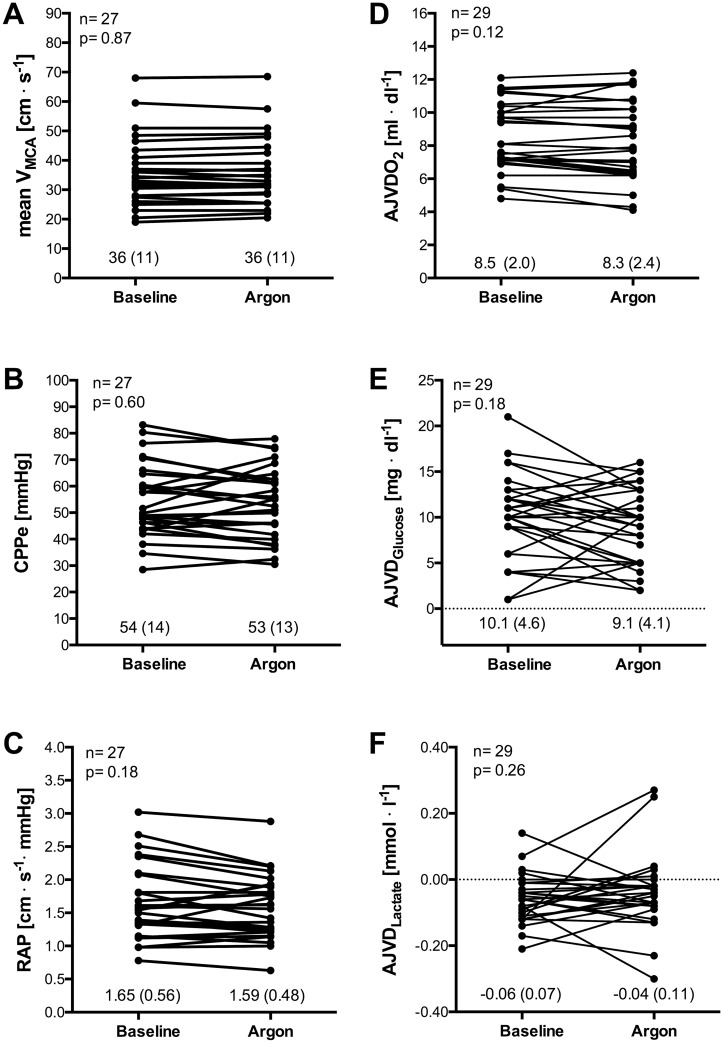
Accumulating data have recently underlined argon´s neuroprotective potential. However, to the best of our knowledge, no data are available on the cerebrovascular effects of argon (Ar) in humans. We hypothesized that argon inhalation does not affect mean blood flow velocity of the middle cerebral artery (Vmca), cerebral flow index (FI), zero flow pressure (ZFP), effective cerebral perfusion pressure (CPPe), resistance area product (RAP) and the arterio-jugular venous content differences of oxygen (AJVDO2), glucose (AJVDG), and lactate (AJVDL) in anesthetized patients.
In a secondary analysis of an earlier controlled cross-over trial we compared parameters of the cerebral circulation under 15 minutes exposure to 70%Ar/30%O2 versus 70%N2/30%O2 in 29 male patients under fentanyl-midazolam anaesthesia before coronary surgery. Vmca was measured by transcranial Doppler sonography. ZFP and RAP were estimated by linear regression analysis of pressure-flow velocity relationships of the middle cerebral artery. CPPe was calculated as the difference between mean arterial pressure and ZFP. AJVDO2, AJVDG and AJVDL were calculated as the differences in contents between arterial and jugular-venous blood of oxygen, glucose, and lactate. Statistical analysis was done by t-tests and ANOVA.
Mechanical ventilation with 70% Ar did not cause any significant changes in mean arterial pressure, Vmca, FI, ZFP, CPPe, RAP, AJVDO2, AJVDG, and AJVDL.
Short-term inhalation of 70% Ar does not affect global cerebral circulation or metabolism in male humans under general anaesthesia.
最近越来越多的数据强调了氩气的神经保护潜力。然而,据我们所知,尚无关于氩气(Ar)对人体脑血管影响的数据。我们假设,吸入氩气不会影响麻醉患者大脑中动脉的平均血流速度(Vmca)、脑血流指数(FI)、零流量压力(ZFP)、有效脑灌注压(CPPe)、阻力面积乘积(RAP)以及氧(AJVDO2)、葡萄糖(AJVDG)和乳酸(AJVDL)的动-颈静脉含量差。
在一项早期对照交叉试验的二次分析中,我们比较了29例接受芬太尼-咪达唑仑麻醉的男性患者在冠状动脉手术前,暴露于70%Ar/30%O2与70%N2/30%O2环境15分钟后脑循环参数。通过经颅多普勒超声测量Vmca。通过对大脑中动脉压力-血流速度关系进行线性回归分析来估计ZFP和RAP。CPPe计算为平均动脉压与ZFP之差。AJVDO2、AJVDG和AJVDL计算为动脉血与颈静脉血中氧、葡萄糖和乳酸含量的差值。采用t检验和方差分析进行统计分析。
用70%Ar进行机械通气并未导致平均动脉压、Vmca、FI、ZFP、CPPe、RAP、AJVDO2、AJVDG和AJVDL出现任何显著变化。
在全身麻醉下,短期吸入70%Ar不会影响男性人体的整体脑循环或代谢。