
植物根系分泌物对KT2440化学感应系统的浓度依赖性效应
Concentration Dependent Effect of Plant Root Exudates on the Chemosensory Systems of KT2440.
作者信息
López-Farfán Diana, Reyes-Darias José A, Matilla Miguel A, Krell Tino
机构信息
Estación Experimental del Zaidín, Department of Environmental Protection, Consejo Superior de Investigaciones Científicas, Granada, Spain.
出版信息
Front Microbiol. 2019 Jan 30;10:78. doi: 10.3389/fmicb.2019.00078. eCollection 2019.
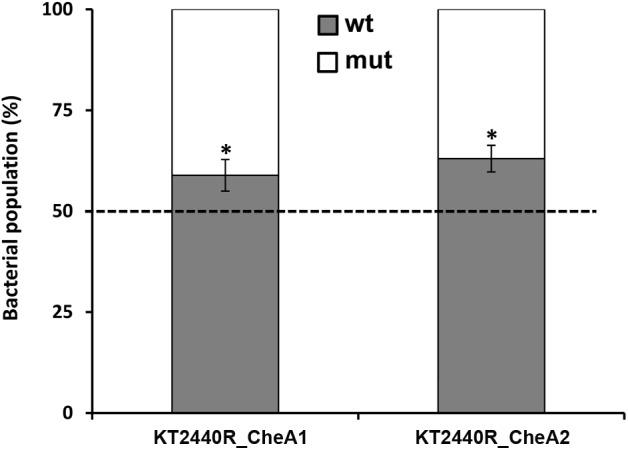
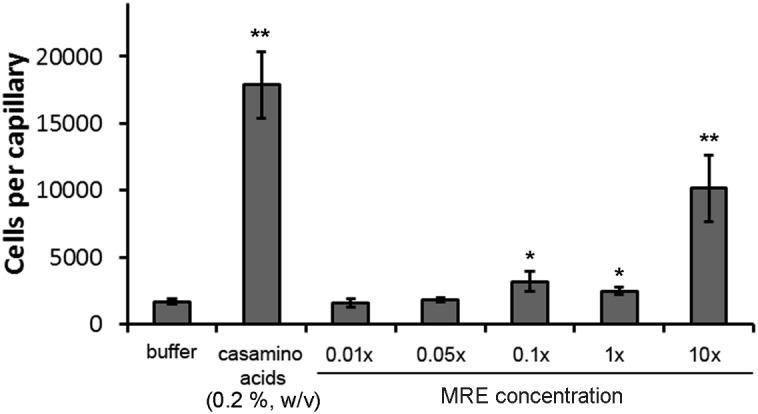
Plant root colonization by rhizobacteria can protect plants against pathogens and promote plant growth, and chemotaxis to root exudates was shown to be an essential prerequisite for efficient root colonization. Since many chemoattractants control the transcript levels of their cognate chemoreceptor genes, we have studied here the transcript levels of the 27 KT2440 chemoreceptor genes in the presence of different maize root exudate (MRE) concentrations. Transcript levels were increased for 10 chemoreceptor genes at low MRE concentrations, whereas almost all receptor genes showed lower transcript levels at high MRE concentrations. The exposure of KT2440 to different MRE concentrations did not alter c-di-GMP levels, indicating that changes in chemoreceptor transcripts are not mediated by this second messenger. Data suggest that rhizosphere colonization unfolds in a temporal fashion. Whereas at a distance to the root, exudates enhance chemoreceptor gene transcript levels promoting in turn chemotaxis, this process is reversed in root vicinity, where the necessity of chemotaxis toward the root may be less important. Insight into KT2440 signaling processes were obtained by analyzing mutants defective in the three paralogous genes. Whereas a mutant in showed reduced c-di-GMP levels and impaired biofilm formation, a mutant was entirely deficient in MRE chemotaxis, indicating the existence of homologs of the and (chemotaxis) pathways. Signaling through both pathways was important for efficient maize root colonization. Future studies will show whether the MRE concentration dependent effect on chemoreceptor gene transcript levels is a feature shared by other species.
根际细菌在植物根部定殖可保护植物抵御病原体并促进植物生长,而对根系分泌物的趋化作用被证明是高效根部定殖的必要前提。由于许多化学引诱剂可控制其同源化学感受器基因的转录水平,我们在此研究了不同玉米根系分泌物(MRE)浓度下27个KT2440化学感受器基因的转录水平。在低MRE浓度下,10个化学感受器基因的转录水平升高,而在高MRE浓度下,几乎所有受体基因的转录水平都较低。将KT2440暴露于不同的MRE浓度下并不会改变环二鸟苷酸(c-di-GMP)水平,这表明化学感受器转录本的变化不是由这种第二信使介导的。数据表明根际定殖以一种时间性方式展开。在距离根部一定距离处,根系分泌物会提高化学感受器基因的转录水平,进而促进趋化作用,而在根部附近这个过程则相反,此时向根部趋化的必要性可能没那么重要。通过分析三个同源基因有缺陷的突变体,我们对KT2440信号传导过程有了深入了解。一个突变体显示c-di-GMP水平降低且生物膜形成受损,而一个突变体在MRE趋化作用方面完全缺失,这表明存在和(趋化作用)途径的同源物。通过这两条途径进行信号传导对于高效定殖于玉米根部很重要。未来的研究将表明MRE浓度对化学感受器基因转录水平的依赖性影响是否是其他物种共有的特征。




 Zotero 插件