Hathurusinghe Sandamali Harshani Kumari, Azizoglu Ugur, Shin Jae-Ho
Department of Applied Biosciences, Kyungpook National University, Daegu 41566, Republic of Korea.
Department of Crop and Animal Production, Safiye Cikrikcioglu Vocational College, Kayseri University, Kayseri 38039, Turkey.
Plants (Basel). 2024 Feb 29;13(5):695. doi: 10.3390/plants13050695.
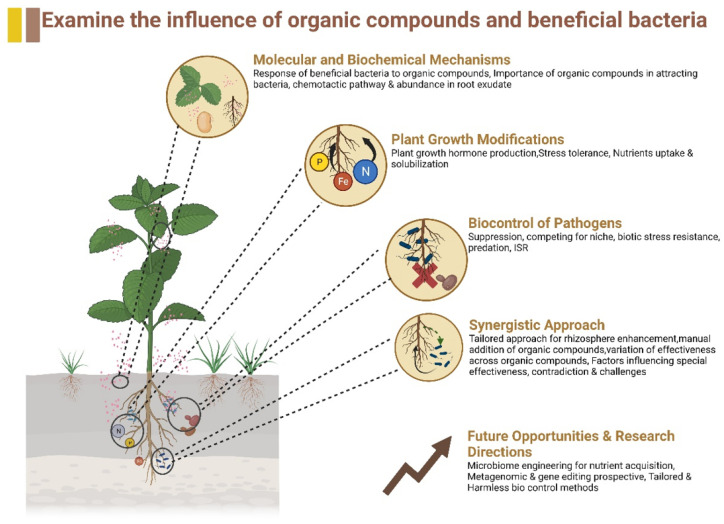
Plants select microorganisms from the surrounding bulk soil, which act as a reservoir of microbial diversity and enrich a rhizosphere microbiome that helps in growth and stress alleviation. Plants use organic compounds that are released through root exudates to shape the rhizosphere microbiome. These organic compounds are of various spectrums and technically gear the interplay between plants and the microbial world. Although plants naturally produce organic compounds that influence the microbial world, numerous efforts have been made to boost the efficiency of the microbiome through the addition of organic compounds. Despite further crucial investigations, synergistic effects from organic compounds and beneficial bacteria combinations have been reported. In this review, we examine the relationship between organic compounds and beneficial bacteria in determining plant growth and biotic and abiotic stress alleviation. We investigate the molecular mechanism and biochemical responses of bacteria to organic compounds, and we discuss the plant growth modifications and stress alleviation done with the help of beneficial bacteria. We then exhibit the synergistic effects of both components to highlight future research directions to dwell on how microbial engineering and metagenomic approaches could be utilized to enhance the use of beneficial microbes and organic compounds.
植物从周围的大量土壤中选择微生物,大量土壤是微生物多样性的储存库,能富集有助于植物生长和缓解胁迫的根际微生物群。植物利用通过根系分泌物释放的有机化合物来塑造根际微生物群。这些有机化合物种类繁多,从技术角度调节着植物与微生物世界之间的相互作用。尽管植物天然会产生影响微生物世界的有机化合物,但人们已做出诸多努力,通过添加有机化合物来提高微生物群的效率。尽管还需要进一步的关键研究,但已有报道称有机化合物与有益细菌组合具有协同效应。在本综述中,我们研究了有机化合物与有益细菌在决定植物生长以及缓解生物和非生物胁迫方面的关系。我们研究了细菌对有机化合物的分子机制和生化反应,并讨论了在有益细菌帮助下实现的植物生长改良和胁迫缓解。然后,我们展示了这两种成分的协同效应,以突出未来的研究方向,即如何利用微生物工程和宏基因组学方法来加强对有益微生物和有机化合物的利用。