Larsen Ture, Beier-Holgersen Randi, Meelby Jette, Dieckmann Peter, Østergaard Doris
Simulation Unit (SimNord), Department of Administration, Nordsjællands Hospital, Denmark.
Department of Gastrointestinal Surgery, Nordsjællands Hospital, Denmark.
Heliyon. 2018 Nov 30;4(11):e00968. doi: 10.1016/j.heliyon.2018.e00968. eCollection 2018 Nov.
This systematic review examines the medical, psychological and educational literature for training in practising leadership of a team leader in emergencies. The objectives of this paper are (1) describe how literature addresses operational training in practising leadership for the emergency medical team-leader (2) enhance understanding of leadership training in the medical environment.
Worldwide, medical supervisors find it difficult to get students to rise to the occasion as leaders of emergency teams. It appears that many residents feel unprepared to adopt the role as a leader in emergencies.
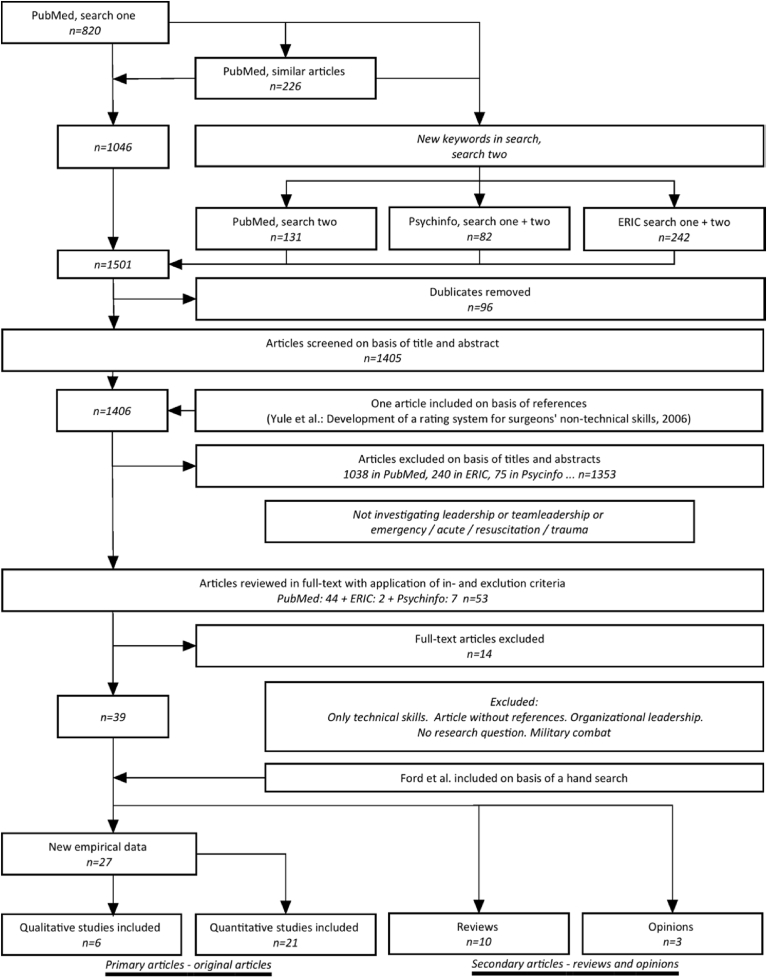
A systematic review was conducted (May-December 2016) in accordance with the PRISMA 2009 Checklist. A literature search was conducted against a set of inclusion criteria. Databases searched included PubMed, Psycinfo (via Ovid), and ERIC.
27 articles covering the period 1986-2016 were analysed. Four sources of data were identified: Intervention studies practising leadership, intervention studies on simulation and leadership assessment, observation studies assessing leadership, interview/survey studies about the need for leadership training. No workable training in practising leadership in emergencies for doctors was found. The majority of the research projects focused on various different types of taxonomies.
No consistent and workable leadership training for the emergency medical teamleader was identified. One study for paramedics succeeded in training empowering leadership skills. For many years multiple taxonomies and leadership assessment tools have been developed but failed to come to terms with workable leadership training. The literature describes lack of leadership as highly detrimental to performance during a critical, clinical situation.
本系统评价检索了医学、心理学和教育领域的文献,以了解针对团队领导者在紧急情况下的领导力实践培训情况。本文的目的是:(1)描述文献中如何阐述针对急诊医疗团队领导者领导力实践的操作培训;(2)增进对医疗环境中领导力培训的理解。
在全球范围内,医学导师发现很难让学生在紧急情况下担当起团队领导者的角色。似乎许多住院医师觉得自己没有做好在紧急情况下担任领导者的准备。
根据2009年PRISMA清单于2016年5月至12月进行了一项系统评价。根据一系列纳入标准进行文献检索。检索的数据库包括PubMed、Psycinfo(通过Ovid)和教育资源信息中心(ERIC)。
分析了涵盖1986年至2016年期间的27篇文章。确定了四个数据来源:领导力实践干预研究、模拟与领导力评估干预研究、领导力评估观察研究、关于领导力培训需求的访谈/调查研究。未发现针对医生在紧急情况下领导力实践的可行培训。大多数研究项目集中在各种不同类型的分类法上。
未确定针对急诊医疗团队领导者的一致且可行的领导力培训。一项针对护理人员的研究成功地培训了赋能型领导技能。多年来,已经开发了多种分类法和领导力评估工具,但未能达成可行的领导力培训方案。文献表明,在危急的临床情况下,缺乏领导力对表现极为不利。