Department of Population Health and Reproduction, School of Veterinary Medicine, University of California-Davis, Davis, California, United States of America.
Department of Veterinary Clinical Sciences, College of Veterinary Medicine, Washington State University, Pullman, Washington, United States of America.
PLoS One. 2019 Feb 14;14(2):e0212372. doi: 10.1371/journal.pone.0212372. eCollection 2019.
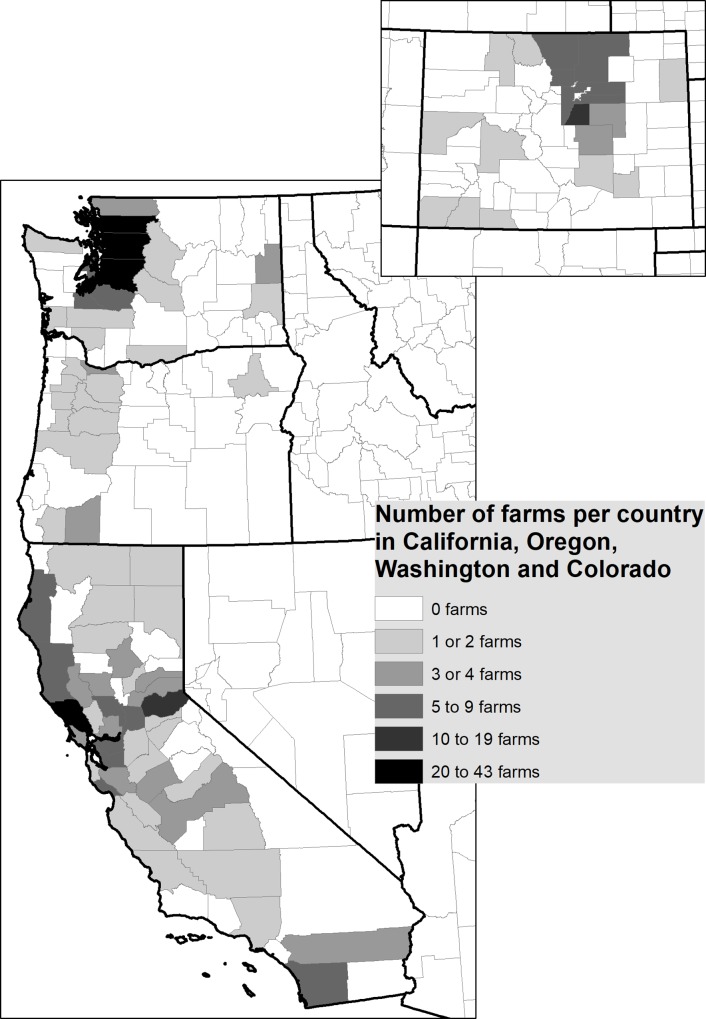
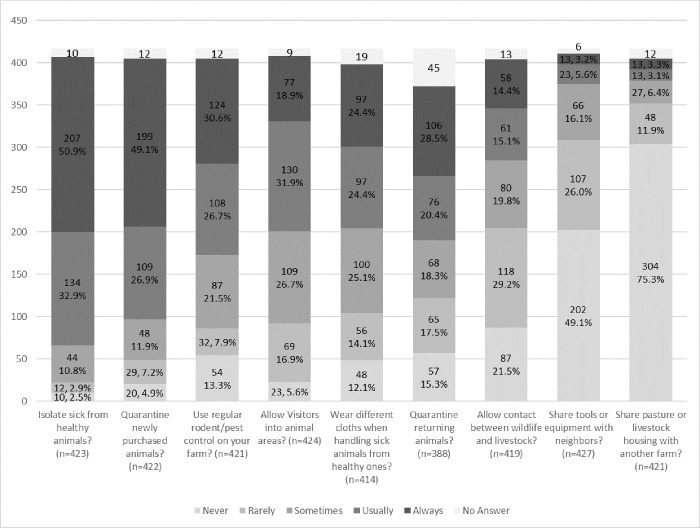
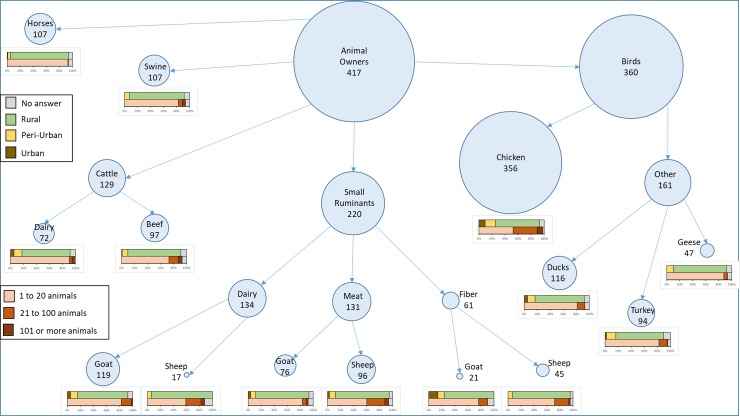
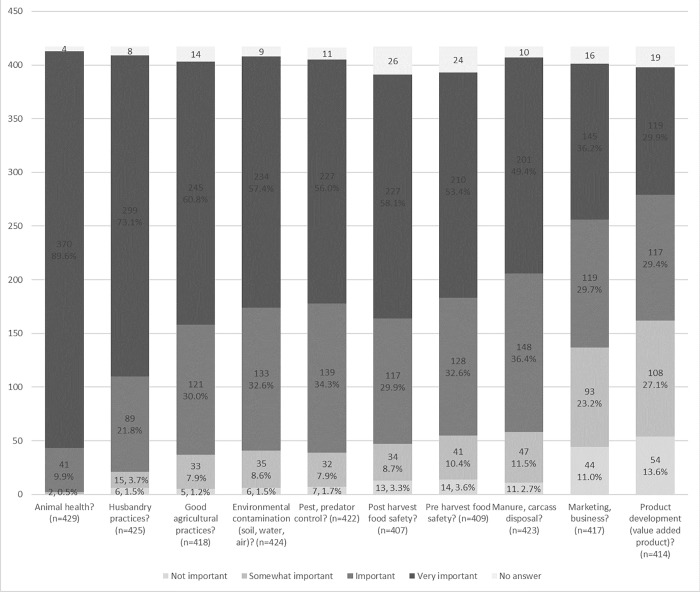
The number of small-scale and backyard livestock and poultry owners in urban and peri-urban areas has increased greatly over the last 10 years in the U.S. However, these animal owners may live in areas without access to livestock and/or poultry veterinary care. The purpose of this study was to identify potential veterinary service needs of these animal owners in the western US, assess their use of management and husbandry practices with regards to disease prevention, and assess their attitudes about animal health and food safety. A semi-structured survey was made available to small-scale and backyard livestock and poultry owners in Washington State, California, Colorado and Oregon. The survey instrument included questions about types of animals reared, uses of the animals, veterinary services and information-seeking behaviors of owners, attitudes on animal health and food safety, and management practices. Four hundred thirty-five individuals completed at least some portion of the survey. Most described themselves as living in rural areas (76%). Most (86%) owned chickens, 53% owned small ruminants, and 31% owned cattle. Many individuals owned more than one species and most had fewer than 20 animals of a given species. About 74% of respondents utilized their animals' products for their own consumption but 48% sold animal products (primarily through internet sales (35%) or farmers' markets (25%)). Overwhelmingly, respondents gained information about animal health (82%) and animal treatment procedures (71%) from the internet. Respondents reported their veterinarian's practice type as companion animal (26%) or a mixed animal or food animal predominant (66%). Overall, respondents were very satisfied with the level of care (82%), but 43% had not sought animal health care in last 12 months. However, the veterinarian's primary practice type and owner's satisfaction with veterinary care were associated with their location (state), species owned, and urban or peri-urban setting. Livestock species type (cattle, small ruminants and swine), and use (personal or commercial) were associated with implementation of different biosecurity practices. The results of this survey highlight some of the needs of these animal owners for veterinary care and information which are location- and species-specific. Veterinary care for these small-scale and backyard animals is vital to the health and welfare of the animals as well as for identification of zoonoses and assurance of the food safety of animal products.
在过去的 10 年中,美国城市和城郊地区小规模和后院家禽和家畜饲养者的数量大大增加。然而,这些动物饲养者可能居住在无法获得牲畜和/或家禽兽医护理的地区。本研究的目的是确定美国西部这些动物饲养者的潜在兽医服务需求,评估他们在疾病预防方面对管理和饲养实践的使用情况,并评估他们对动物健康和食品安全的态度。在华盛顿州、加利福尼亚州、科罗拉多州和俄勒冈州向小规模和后院家禽和家畜饲养者提供了半结构化调查。调查问卷包括有关饲养动物的类型、动物的用途、兽医服务以及所有者的信息寻求行为、对动物健康和食品安全的态度以及管理实践等问题。有 435 人至少完成了调查的一部分。大多数人将自己描述为居住在农村地区(76%)。大多数人(86%)拥有鸡,53%拥有小反刍动物,31%拥有牛。许多人拥有不止一种物种,大多数人饲养的同一种动物少于 20 只。约 74%的受访者利用其动物产品供自己消费,但 48%出售动物产品(主要通过互联网销售(35%)或农贸市场(25%))。绝大多数受访者从互联网上获得有关动物健康(82%)和动物治疗程序(71%)的信息。受访者报告说,他们的兽医的执业类型为伴侣动物(26%)或混合动物或主要为食用动物(66%)。总体而言,受访者对护理水平非常满意(82%),但有 43%的人在过去 12 个月内未寻求动物保健。但是,兽医的主要执业类型和所有者对兽医护理的满意度与他们的所在地(州)、拥有的物种以及城市或城郊环境有关。牲畜物种类型(牛,小反刍动物和猪)以及用途(个人或商业)与不同的生物安全实践的实施有关。这项调查的结果强调了这些动物饲养者对兽医护理和信息的一些需求,这些需求因地理位置和物种而异。这些小规模和后院动物的兽医护理对动物的健康和福利以及人畜共患病的识别以及动物产品的食品安全至关重要。