
宏量营养素组成对肥胖青少年食欲激素反应的影响。
Effect of Macronutrient Composition on Appetite Hormone Responses in Adolescents with Obesity.
机构信息
Department of Nutrition, Dietetics and Food, Monash University, Notting Hill 3168, Australia.
Monash Children's Hospital, Monash Medical Centre, Clayton 3168, Australia.
出版信息
Nutrients. 2019 Feb 5;11(2):340. doi: 10.3390/nu11020340.
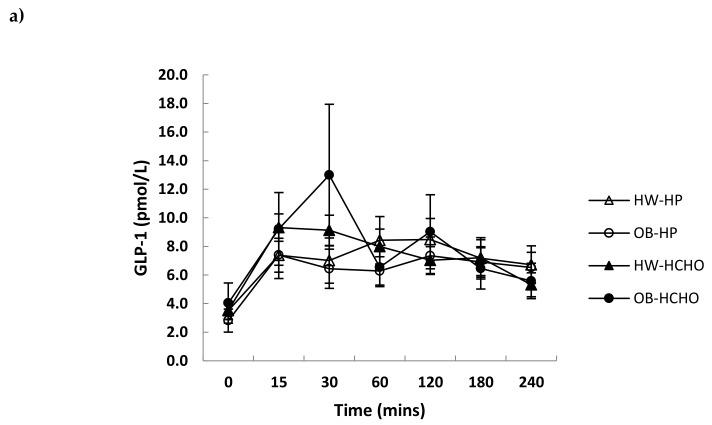
Gut appetite hormone responses may be influenced by meal macronutrients and obesity. The primary aim of this study was to examine in adolescents with obesity and of healthy weight the effect of a high-protein and a high-carbohydrate meal on postprandial gut appetite hormones. A postprandial cross-over study with adolescents 11⁻19 years old was undertaken. Participants consumed, in random order, a high 79% carbohydrate (HCHO) and a high 55% protein (HP) meal. Ghrelin, glucagon-like peptide 1 (GLP-1), peptide YY (PYY), and self-reported appetite were assessed for four hours postprandial. Total energy intake from an ad libitum lunch and remaining 24 h was assessed. Eight adolescents with obesity (OB) and 12 with healthy weight (HW) participated. Compared with HW, OB adolescents displayed a smaller ghrelin iAUC (-25,896.5 ± 7943 pg/mL/4 h vs. -60,863.5 ± 13104 pg/mL/4 h) ( = 0.008) with no effect of meal ( > 0.05). The suppression of ghrelin relative to baseline was similar between OB and HW. Ghrelin suppression was greater following the HP vs. HCHO meal (effect of meal, = 0.018). Glucose and insulin response were greater following HCHO vs. HP, with responses more marked in OB (time × weight × meal interaction, = 0.003 and = 0.018, respectively). There were no effects of weight or macronutrient on GLP-1 or PYY, appetite or subsequent energy intake. The present study demonstrates that dietary protein can modulate postprandial ghrelin responses; however, this did not translate to subsequent changes in subjective appetite or energy intake.
肠道食欲激素反应可能受膳食宏量营养素和肥胖的影响。本研究的主要目的是在肥胖和健康体重的青少年中,研究高蛋白和高碳水化合物膳食对餐后肠道食欲激素的影响。进行了一项青少年(11-19 岁)的餐后交叉研究。参与者随机摄入高碳水化合物(HCHO)和高蛋白质(HP)膳食。在餐后 4 小时评估胃饥饿素、胰高血糖素样肽 1(GLP-1)、肽 YY(PYY)和自我报告的食欲。评估自由进食午餐和 24 小时剩余时间的总能量摄入。8 名肥胖青少年(OB)和 12 名健康体重青少年(HW)参与了研究。与 HW 相比,OB 青少年的餐后 ghrelin iAUC 较小(-25,896.5 ± 7943 pg/mL/4 h 与 -60,863.5 ± 13104 pg/mL/4 h)( = 0.008),且膳食无影响( > 0.05)。ghrelin 相对于基线的抑制在 OB 和 HW 之间相似。与 HCHO 相比,HP 餐后 ghrelin 抑制更大(膳食效应, = 0.018)。HCHO 餐后血糖和胰岛素反应大于 HP,OB 中反应更明显(时间×体重×膳食交互作用, = 0.003 和 = 0.018)。体重或宏量营养素对 GLP-1 或 PYY、食欲或随后的能量摄入没有影响。本研究表明,膳食蛋白质可以调节餐后 ghrelin 反应;然而,这并没有转化为随后的主观食欲或能量摄入的变化。



 Zotero 插件