Department of Neurology, University of Sao Paulo, Brazil.
Cognitive Neuroscience Division, Department of Neurology, Columbia University, USA.
Neural Plast. 2018 Dec 2;2018:7301530. doi: 10.1155/2018/7301530. eCollection 2018.
Previous reviews have generally reported cognitive//behavioral improvements after cognitively oriented treatments (COTs) in persons with MCI. However, comparatively little is known about the neural mechanisms associated with such cognitive improvement.
The primary aim of the current review was to examine neurophysiological changes measured by functional magnetic resonance imaging (fMRI) and possible cognitive changes following COTs in those with MCI. An extensive literature search was conducted up to August 2018. Inclusion criteria were (1) studies that evaluated the effects of the COTs in patients with amnestic single- or multiple-domain MCI using fMRI, (2) the MCI patient sample having met Petersen's or Jack/Bond's criteria, (3) randomized and/or controlled trials, (4) fMRI and cognitive assessments completed pre- and post-intervention, and (5) articles available in English.
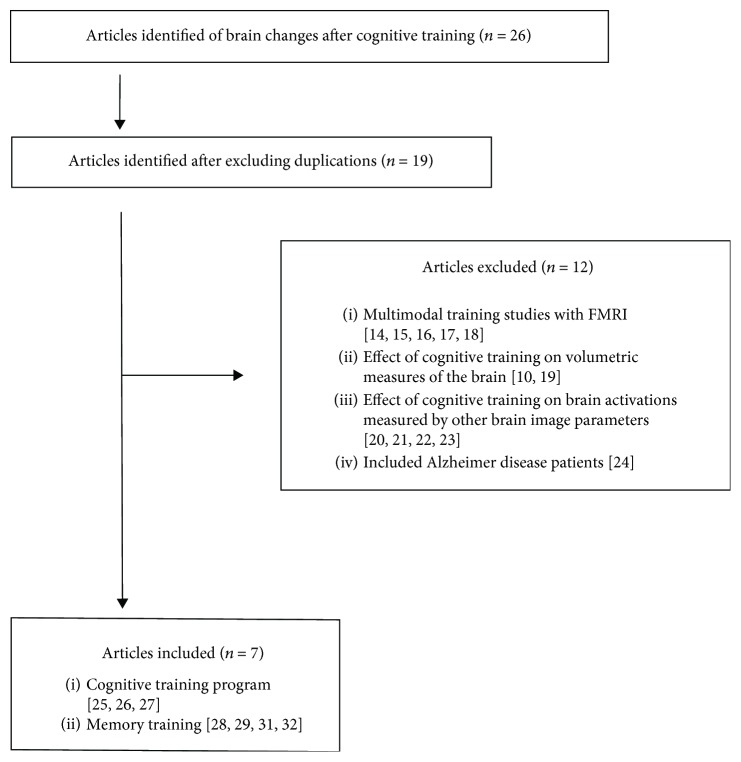
Amongst the 26 articles found, 7 studies were included according to the above inclusion criteria. A total of 3 studies applied rehearsal-based strategies as the primary intervention, all of which used computerized cognitive training. Four studies used fMRI to investigate the neurophysiologic and cognitive changes associated with memory strategy training. The majority of the studies included in this review showed evidence of improved objective cognitive performance associated with COTs, even in tasks similar to everyday life activities. In addition, there were significant changes in brain activation associated with interventions, in both typical and atypical brain areas and networks related to memory.
Although additional studies are needed given the small sample size, these initial findings suggest that cognitive improvement after COTs is generally associated with both compensatory (i.e., engaging alternative brain regions or networks not "typically" engaged) and restorative (i.e., reengaging the "typical" brain regions or networks) mechanisms.
先前的综述普遍报告称,认知导向治疗(COT)可改善 MCI 患者的认知/行为。然而,对于与这种认知改善相关的神经机制,我们知之甚少。
本次综述的主要目的是研究 fMRI 测量的神经生理变化以及 COT 后 MCI 患者的认知变化。我们进行了广泛的文献检索,截止日期为 2018 年 8 月。纳入标准为:(1)使用 fMRI 评估 COT 对单一或多领域遗忘型 MCI 患者影响的研究;(2)MCI 患者样本符合 Petersen 或 Jack/Bond 标准;(3)随机和/或对照试验;(4)完成干预前后的 fMRI 和认知评估;(5)文章为英文。
共找到 26 篇文章,根据上述纳入标准,有 7 项研究符合条件。其中 3 项研究采用复述策略作为主要干预措施,均采用计算机化认知训练。4 项研究使用 fMRI 研究与记忆策略训练相关的神经生理和认知变化。本综述纳入的大多数研究表明,COT 后认知表现有所改善,即使在类似于日常生活活动的任务中也是如此。此外,干预后与大脑活动相关的变化在典型和非典型与记忆相关的大脑区域和网络中均有显著变化。
尽管由于样本量较小,还需要进一步的研究,但这些初步发现表明,COT 后认知改善通常与代偿(即,参与非典型的替代大脑区域或网络)和修复(即,重新参与典型的大脑区域或网络)机制有关。