Cha Hye Jin, Song Yun Jeong, Lee Da Eun, Kim Young-Hoon, Shin Jisoon, Jang Choon-Gon, Suh Soo Kyung, Kim Sung Jin, Yun Jaesuk
Pharmacological Research Division, Toxicological Evaluation and Research Department, National Institute of Food and Drug Safety Evaluation, Ministry of Food and Drug Safety, Chungju, Korea.
Department of Pharmacology, School of Pharmacy, Sungkyunkwan University, Suwon, Korea.
Toxicol Res. 2019 Jan;35(1):37-44. doi: 10.5487/TR.2019.35.1.037. Epub 2018 Jan 15.
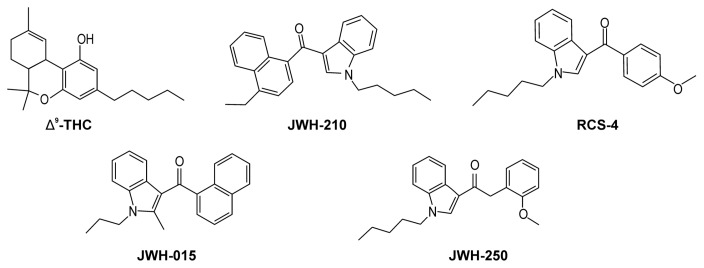
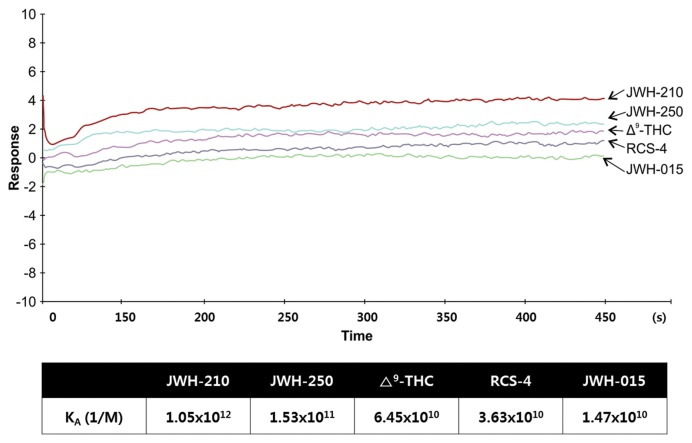
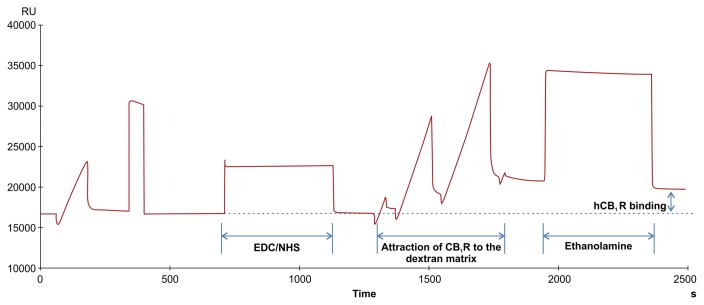
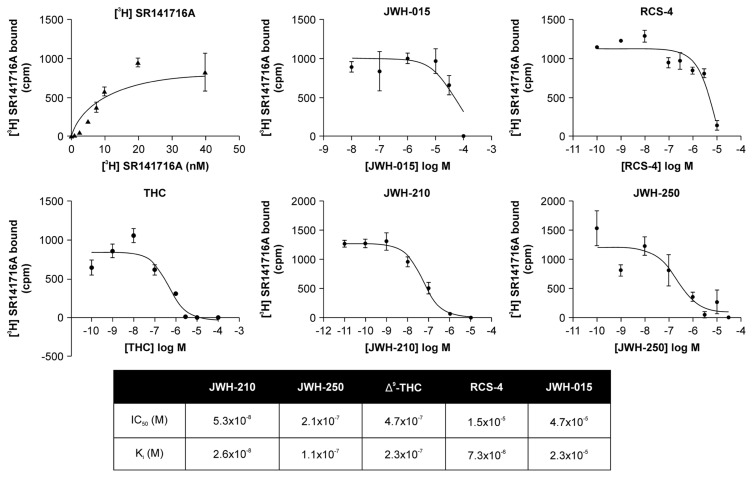
A major predictor of the efficacy of natural or synthetic cannabinoids is their binding affinity to the cannabinoid type I receptor (CB) in the central nervous system, as the main psychological effects of cannabinoids are achieved via binding to this receptor. Conventionally, receptor binding assays have been performed using isotopes, which are inconvenient owing to the effects of radioactivity. In the present study, the binding affinities of five cannabinoids for purified CB were measured using a surface plasmon resonance (SPR) technique as a putative non-isotopic receptor binding assay. Results were compared with those of a radio-isotope-labeled receptor binding assay. The representative natural cannabinoid Δ-tetrahydrocannabinol and four synthetic cannabinoids, JWH-015, JWH-210, RCS-4, and JWH-250, were assessed using both the SPR biosensor assay and the conventional isotopic receptor binding assay. The binding affinities of the test substances to CB were determined to be (from highest to lowest) 9.52 × 10 M (JWH-210), 6.54 × 10 M (JWH-250), 1.56 × 10 M (Δ-tetrahydrocannabinol), 2.75 × 10 M (RCS-4), and 6.80 ×10 M (JWH-015) using the non-isotopic method. Using the conventional isotopic receptor binding assay, the same order of affinities was observed. In conclusion, our results support the use of kinetic analysis via SPR in place of the isotopic receptor binding assay. To replace the receptor binding affinity assay with SPR techniques in routine assays, further studies for method validation will be needed in the future.
天然或合成大麻素功效的一个主要预测指标是它们与中枢神经系统中大麻素I型受体(CB)的结合亲和力,因为大麻素的主要心理效应是通过与该受体结合实现的。传统上,受体结合测定使用同位素进行,由于放射性的影响,这种方法不太方便。在本研究中,使用表面等离子体共振(SPR)技术作为一种假定的非同位素受体结合测定方法,测量了五种大麻素对纯化的CB的结合亲和力。将结果与放射性同位素标记的受体结合测定结果进行了比较。使用SPR生物传感器测定法和传统的同位素受体结合测定法评估了代表性的天然大麻素Δ-四氢大麻酚和四种合成大麻素JWH-015、JWH-210、RCS-4和JWH-250。使用非同位素方法测定受试物质与CB的结合亲和力(从高到低)为9.52×10 M(JWH-210)、6.54×10 M(JWH-250)、1.56×10 M(Δ-四氢大麻酚)、2.75×10 M(RCS-4)和6.80×10 M(JWH-015)。使用传统的同位素受体结合测定法,观察到了相同的亲和力顺序。总之,我们的结果支持使用SPR进行动力学分析来代替同位素受体结合测定法。为了在常规测定中用SPR技术取代受体结合亲和力测定法,未来还需要进行进一步的方法验证研究。