• 文献检索
  • 文档翻译
  • 深度研究
  • 学术资讯
  • Suppr Zotero 插件Zotero 插件
  • 邀请有礼
  • 套餐&价格
  • 历史记录
应用&插件
Suppr Zotero 插件Zotero 插件浏览器插件Mac 客户端Windows 客户端微信小程序
定价
高级版会员购买积分包购买API积分包
服务
文献检索文档翻译深度研究API 文档MCP 服务
关于我们
关于 Suppr公司介绍联系我们用户协议隐私条款
关注我们

Suppr 超能文献

核心技术专利:CN118964589B侵权必究
粤ICP备2023148730 号-1Suppr @ 2026

文献检索

告别复杂PubMed语法,用中文像聊天一样搜索,搜遍4000万医学文献。AI智能推荐,让科研检索更轻松。

立即免费搜索

文件翻译

保留排版,准确专业,支持PDF/Word/PPT等文件格式,支持 12+语言互译。

免费翻译文档

深度研究

AI帮你快速写综述,25分钟生成高质量综述,智能提取关键信息,辅助科研写作。

立即免费体验

一项基于回归分析的I期临床试验,用于未经过临床医生诱导的迟发性毒性反应。

A regression based phase I clinical trial for late-onset toxicities without clinician elicitation.

作者信息

Chapple Andrew G, Wojcik Janusz J, McDaniel Lee S

机构信息

Louisiana State University Health Sciences Center, New Orleans, 2020 Gravier Street, New Orleans, LA, 70112, USA.

出版信息

Contemp Clin Trials Commun. 2019 Jan 30;14:100327. doi: 10.1016/j.conctc.2019.100327. eCollection 2019 Jun.

DOI:10.1016/j.conctc.2019.100327
PMID:30766934
原文链接:https://pmc.ncbi.nlm.nih.gov/articles/PMC6360989/
Abstract

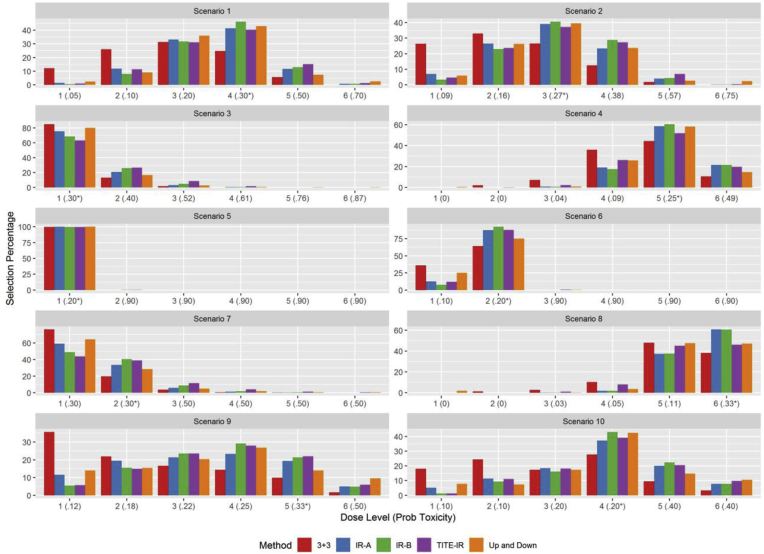
An extension of the isotonic regression based phase I clinical trial design is presented that incorporates partial follow-up times into estimation of the raw toxicity probabilities. This phase I clinical trial design, called the TITE-IR design, drastically decreases average trial duration by allowing patients to be treated immediately after being enrolled in a phase I clinical trial. The TITE-IR design does not require specification of a prior skeleton of toxicity probabilities like the continual reassessment method, has an additional trial parameter for controlling aggressiveness of dose escalation, and has an easily understood formula for estimating toxicity probabilities. An R statistical software package is described in detail in the appendix for simulating and implementing the design. A simulation study shows that the TITE-IR design outperforms the 3 + 3 design in terms of selecting the true maximum tolerated dose and results in shorter trial times, without a large loss in efficiency, compared to the isotonic regression design and Storer's up-and-down design D. These properties make the TITE-IR design a more appealing option to clinicians than the two most commonly used 3 + 3 designs and the isotonic regression design with larger follow-up windows for toxicity.

摘要

本文提出了一种基于等渗回归的I期临床试验设计的扩展方法,该方法将部分随访时间纳入原始毒性概率的估计中。这种I期临床试验设计称为TITE-IR设计,通过允许患者在进入I期临床试验后立即接受治疗,大幅缩短了平均试验持续时间。TITE-IR设计不像连续重新评估方法那样需要预先设定毒性概率的框架,有一个额外的试验参数用于控制剂量递增的激进程度,并且有一个易于理解的毒性概率估计公式。附录中详细描述了一个用于模拟和实施该设计的R统计软件包。一项模拟研究表明,在选择真正的最大耐受剂量方面,TITE-IR设计优于3+3设计,并且与等渗回归设计和斯托勒上下设计D相比,在不损失大量效率的情况下,能缩短试验时间。这些特性使得TITE-IR设计比两种最常用的3+3设计以及具有更大毒性随访窗口的等渗回归设计对临床医生来说更具吸引力。
https://cdn.ncbi.nlm.nih.gov/pmc/blobs/1f35/6360989/c2438b8ac20a/gr1.jpg

相似文献

1
A regression based phase I clinical trial for late-onset toxicities without clinician elicitation.一项基于回归分析的I期临床试验,用于未经过临床医生诱导的迟发性毒性反应。
Contemp Clin Trials Commun. 2019 Jan 30;14:100327. doi: 10.1016/j.conctc.2019.100327. eCollection 2019 Jun.
2
Practicalities in running early-phase trials using the time-to-event continual reassessment method (TiTE-CRM) for interventions with long toxicity periods using two radiotherapy oncology trials as examples.使用时间事件连续评估法(TiTE-CRM)进行早期试验的实际操作,以两个肿瘤放疗试验为例,这些试验的干预措施具有较长的毒性期。
BMC Med Res Methodol. 2020 Jun 22;20(1):162. doi: 10.1186/s12874-020-01012-z.
3
GUIP1: a R package for dose escalation strategies in phase I cancer clinical trials.GUIP1:一个用于 I 期癌症临床试验剂量递增策略的 R 包。
BMC Med Inform Decis Mak. 2020 Jun 24;20(1):134. doi: 10.1186/s12911-020-01149-3.
4
Designing dose-escalation trials with late-onset toxicities using the time-to-event continual reassessment method.使用事件发生时间连续重新评估法设计具有迟发性毒性的剂量递增试验。
J Clin Oncol. 2006 Sep 20;24(27):4426-33. doi: 10.1200/JCO.2005.04.3844.
5
Incorporating patient-reported outcomes in dose-finding clinical trials with continuous patient enrollment.在持续纳入患者的剂量探索性临床试验中纳入患者报告的结局。
J Biopharm Stat. 2023 Jul 26:1-12. doi: 10.1080/10543406.2023.2236216.
6
Practical modifications to the time-to-event continual reassessment method for phase I cancer trials with fast patient accrual and late-onset toxicities.适用于快速入组和迟发性毒性的 I 期癌症试验的时间事件连续再评估方法的实用改进。
Stat Med. 2011 Jul 30;30(17):2130-43. doi: 10.1002/sim.4255. Epub 2011 May 17.
7
Using the time-to-event continual reassessment method in the presence of partial orders.使用存在部分顺序情况下的事件时间持续重新评估方法。
Stat Med. 2013 Jan 15;32(1):131-41. doi: 10.1002/sim.5491. Epub 2012 Jul 17.
8
Handling Incomplete or Late-Onset Toxicities in Early-Phase Dose-Finding Clinical Trials: Current Practice and Future Prospects.早期临床试验中处理不完整或迟发性毒性:当前实践和未来展望。
JCO Precis Oncol. 2024 Jan;8:e2300441. doi: 10.1200/PO.23.00441.
9
Two-stage subgroup-specific time-to-event (2S-Sub-TITE): An adaptive two-stage time-to-toxicity design for subgroup-specific dose finding in phase I oncology trials.两阶段亚组特定时间事件(2S-Sub-TITE):一种适应性两阶段时间毒性设计,用于肿瘤 I 期临床试验中针对亚组特定剂量的发现。
Pharm Stat. 2022 Nov;21(6):1138-1148. doi: 10.1002/pst.2231. Epub 2022 May 12.
10
Subgroup-specific dose finding in phase I clinical trials based on time to toxicity allowing adaptive subgroup combination.基于毒性发生时间的I期临床试验中特定亚组的剂量探索,允许适应性亚组组合。
Pharm Stat. 2018 Nov;17(6):734-749. doi: 10.1002/pst.1891. Epub 2018 Aug 15.

引用本文的文献

1
A Road Map for Designing Phase I Clinical Trials of Radiotherapy-Novel Agent Combinations.放疗-新型药物联合治疗的 I 期临床试验设计路线图
Clin Cancer Res. 2022 Sep 2;28(17):3639-3651. doi: 10.1158/1078-0432.CCR-21-4087.

本文引用的文献

1
Phase 1 trial design: is 3 + 3 the best?1期试验设计:3+3方案是最佳方案吗?
Cancer Control. 2014 Jul;21(3):200-8. doi: 10.1177/107327481402100304.
2
A comprehensive comparison of the continual reassessment method to the standard 3 + 3 dose escalation scheme in Phase I dose-finding studies.在I期剂量探索研究中,持续重新评估方法与标准3+3剂量递增方案的全面比较。
Clin Trials. 2008;5(5):465-77. doi: 10.1177/1740774508096474.
3
Isotonic designs for phase I trials.I期试验的等渗设计。
Control Clin Trials. 2001 Apr;22(2):126-38. doi: 10.1016/s0197-2456(00)00132-x.
4
Sequential designs for phase I clinical trials with late-onset toxicities.具有迟发性毒性的I期临床试验的序贯设计。
Biometrics. 2000 Dec;56(4):1177-82. doi: 10.1111/j.0006-341x.2000.01177.x.
5
Continual reassessment method: a likelihood approach.连续重新评估法:一种似然性方法。
Biometrics. 1996 Jun;52(2):673-84.
6
Design and analysis of phase I clinical trials.I期临床试验的设计与分析。
Biometrics. 1989 Sep;45(3):925-37.
7
Continual reassessment method: a practical design for phase 1 clinical trials in cancer.连续重新评估法:癌症一期临床试验的实用设计
Biometrics. 1990 Mar;46(1):33-48.