Animal Sciences Unit, Flanders Research Institute for Agriculture, Fisheries and Food (ILVO), Scheldeweg 68, B-9090 Melle, Belgium.
Bristol Veterinary School, Langford House, Langford BS40 5DU, United Kingdom.
Poult Sci. 2019 Feb 1;98(2):514-521. doi: 10.3382/ps/pey326.
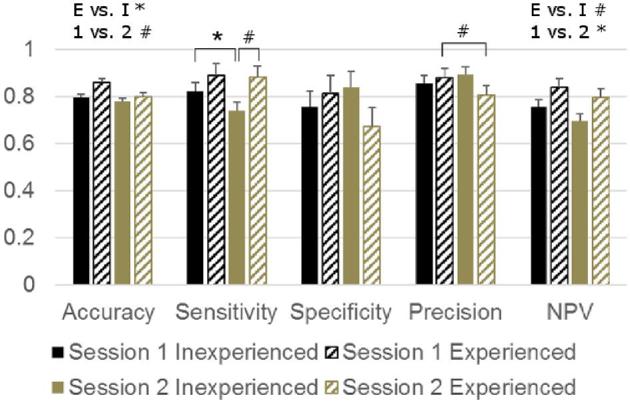
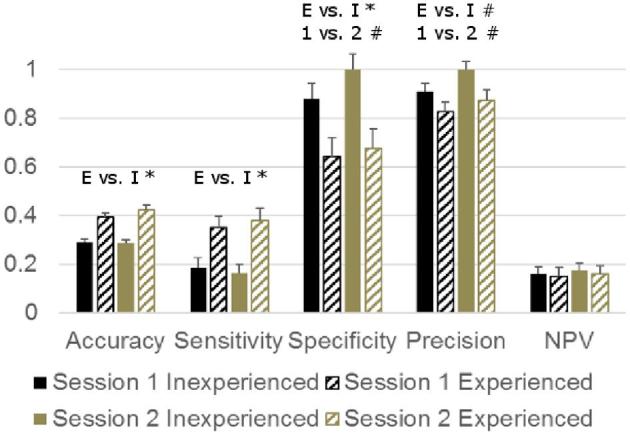
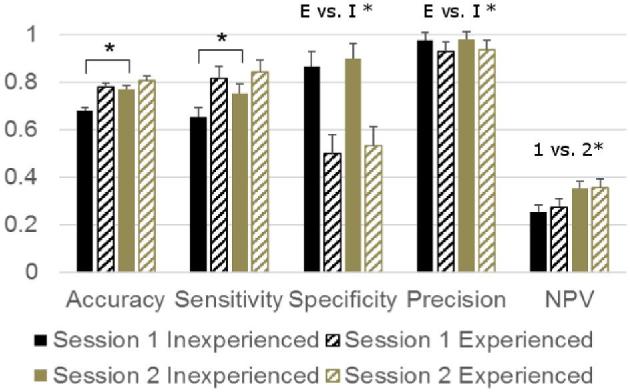
Accurate assessment is essential when evaluating keel bone damage. Palpation is commonly used to assess keel bone damage in living hens. However, there is little information on the accuracy of assessment of deviations and fractures on different parts of the keel, and on the consistency within, and agreement between, assessors. Crucially, although the importance of experience is commonly emphasized, knowledge on its effect is scarce. Ten assessors with or without prior experience palpated the same 50 75-wk-old hens for deviations, medial fractures, and caudal fractures (scored as present/absent). Accuracy, sensitivity, specificity, precision, and negative predictive value were determined by comparing palpation scores to post-dissection assessment, and then compared between experienced and inexperienced assessors. To determine the effect of the experience gained during the experiment, hens were subsequently re-assessed. Consistency within, and agreement between, assessors were also determined. Assessors with prior experience were more accurate (proportion of accurately assessed deviations: experienced 0.83 vs. inexperienced 0.79±0.01, P = 0.04; medial fractures: 0.82 vs. 0.68±0.03 in session 1 only, P = 0.04; caudal fractures: 0.41 vs. 0.29±0.03, P = 0.03), and inexperienced assessors classified medial fractures more accurately in session 2 (session 1: 0.68 vs. session 2: 0.77±0.04, P = 0.04). However, effect sizes were small for deviations and even experienced assessors lacked accuracy when assessing caudal fractures. Unexpectedly, deviations tended to be assessed more accurately in session 1 than in session 2, regardless of assessor status (1: 0.83 vs. 2: 0.79±0.01, P = 0.06), suggesting that prolonged assessment contributes to errors. Prior experience decreased specificity and precision of fracture assessment (more unfractured keels were classified as fractured) even though overall accuracy was greater. Intra-rater consistency was fair to good (0.55 to 0.67) for deviations and medial fractures, but poor to fair (0.36 to 0.44) for caudal fractures, and unaffected by prior experience (P = 0.49 to 0.89). In conclusion, experience improves accuracy to a limited extent but does not guarantee high accuracy for all types of damage. Future research should determine if other training methods (e.g., comparison to post-dissection scores or to radiographs) improve accuracy.
在评估龙骨损伤时,准确的评估至关重要。触诊常用于评估活禽的龙骨损伤。然而,关于不同部位的龙骨偏差和骨折的评估准确性、评估者之间的一致性和一致性的信息很少。至关重要的是,尽管经验的重要性通常被强调,但对其影响的了解却很少。10 名有或没有先前经验的评估者对 50 只 75 周龄的母鸡进行了偏差、内侧骨折和尾部骨折的触诊(评分存在/缺失)。通过将触诊评分与解剖后评估进行比较来确定准确性、敏感性、特异性、精密度和阴性预测值,然后在有经验和无经验的评估者之间进行比较。为了确定实验过程中获得的经验的影响,随后对母鸡进行了重新评估。还确定了评估者之间的内部一致性和一致性。有先前经验的评估者更准确(准确评估偏差的比例:有经验的为 0.83,无经验的为 0.79±0.01,P=0.04;内侧骨折:仅在第 1 次为 0.82,无经验的为 0.68±0.03,P=0.04;尾部骨折:0.41,无经验的为 0.29±0.03,P=0.03),而无经验的评估者在第 2 次更准确地分类内侧骨折(第 1 次:0.68,第 2 次:0.77±0.04,P=0.04)。然而,对于偏差,即使是有经验的评估者的准确性也很小,对于尾部骨折则更是如此。出乎意料的是,无论评估者的状态如何(第 1 次为 0.83,第 2 次为 0.79±0.01,P=0.06),第 1 次的偏差评估都比第 2 次更准确,这表明长时间的评估会导致错误。先前的经验降低了骨折评估的特异性和精确性(更多未骨折的龙骨被归类为骨折),尽管总体准确性更高。对于偏差和内侧骨折,内部评估者的一致性为中等至良好(0.55 至 0.67),而对于尾部骨折,一致性为差至中等(0.36 至 0.44),且不受先前经验的影响(P=0.49 至 0.89)。总之,经验在一定程度上提高了准确性,但并不能保证所有类型的损伤都具有高度的准确性。未来的研究应该确定是否有其他培训方法(例如,与解剖后评分或 X 射线进行比较)可以提高准确性。