King's College London, UK.
King's College London, UK; Duke University.
J Am Acad Child Adolesc Psychiatry. 2019 May;58(5):506-513. doi: 10.1016/j.jaac.2018.07.903. Epub 2018 Dec 12.
Victimized adolescents have an increased risk of self-injurious thoughts and behaviors. However, poor understanding of causal and non-causal mechanisms underlying this observed risk limits the development of interventions to prevent premature death in adolescents. This study tested whether pre-existing family-wide and individual vulnerabilities account for victimized adolescents' increased risk of self-injurious thoughts and behaviors.
Participants were 2,232 British children followed from birth to 18 years of age as part of the Environmental Risk Longitudinal Twin Study. Adolescent victimization (maltreatment, neglect, sexual victimization, family violence, peer/sibling victimization, cyber victimization, and crime victimization) was assessed through interviews with participants and co-informant questionnaires at the 18-year assessment. Suicidal ideation, self-harm, and suicide attempt in adolescence were assessed through interviews with participants at 18 years.
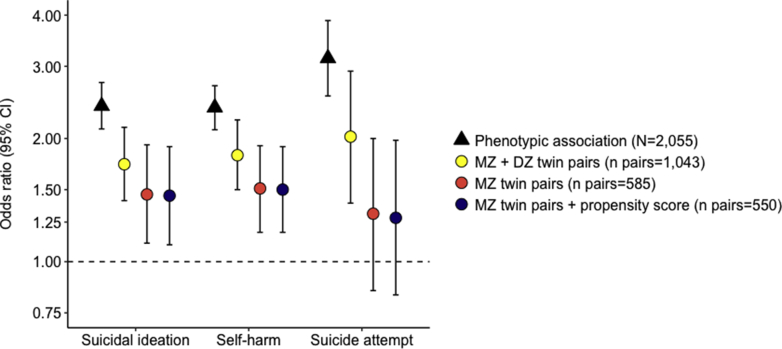
Victimized adolescents had an increased risk of suicidal ideation (odds ratio [OR] 2.40, 95% CI 2.11-2.74), self-harm (OR 2.38, 95% CI 2.10-2.69), and suicide attempt (OR 3.14, 95% CI 2.54-3.88). Co-twin control and propensity score matching analyses showed that these associations were largely accounted for by pre-existing familial and individual vulnerabilities, respectively. Over and above their prior vulnerabilities, victimized adolescents still showed a modest increase in risk for suicidal ideation (OR 1.45, 95%CI 1.10-1.91) and self-harm (OR 1.50, 95% CI 1.18-1.91) but not for suicide attempt (OR 1.28, 95% CI 0.83-1.98).
Risk for self-injurious thoughts and behaviors in victimized adolescents is explained only in part by the experience of victimization. Pre-existing vulnerabilities account for a large proportion of the risk. Therefore, effective interventions to prevent premature death in victimized adolescents should not only target the experience of victimization but also address pre-existing vulnerabilities.
受虐待的青少年有更高的自伤想法和行为的风险。然而,对导致这种观察到的风险的因果和非因果机制的理解不足,限制了预防青少年过早死亡的干预措施的发展。本研究检验了预先存在的家庭范围和个体脆弱性是否可以解释受虐待的青少年自伤想法和行为风险的增加。
参与者是 2232 名英国儿童,他们作为环境风险纵向双胞胎研究的一部分,从出生到 18 岁被跟踪。青少年受虐(虐待、忽视、性虐待、家庭暴力、同伴/兄弟姐妹受虐、网络受虐和犯罪受害)通过参与者的访谈和共同报告问卷在 18 岁评估中进行评估。自杀意念、自伤和青少年时期的自杀企图通过对参与者的访谈在 18 岁时进行评估。
受虐待的青少年自杀意念的风险增加(优势比 [OR] 2.40,95%CI 2.11-2.74),自伤(OR 2.38,95%CI 2.10-2.69)和自杀企图(OR 3.14,95%CI 2.54-3.88)。双胞胎对照和倾向评分匹配分析表明,这些关联分别主要由预先存在的家庭和个体脆弱性引起。除了他们以前的脆弱性之外,受虐待的青少年自杀意念(OR 1.45,95%CI 1.10-1.91)和自伤(OR 1.50,95%CI 1.18-1.91)的风险仍然略有增加,但自杀企图的风险没有增加(OR 1.28,95%CI 0.83-1.98)。
受虐待的青少年的自伤想法和行为风险仅部分由受虐待的经历来解释。预先存在的脆弱性占风险的很大一部分。因此,预防受虐待的青少年过早死亡的有效干预措施不仅应针对受虐待的经历,还应解决预先存在的脆弱性。