New York State Psychiatric Institute and the Department of Psychiatry, Vagelos College of Physicians & Surgeons, Columbia University, New York, NY.
New York State Psychiatric Institute and the Department of Psychiatry, Vagelos College of Physicians & Surgeons, Columbia University, New York, NY.
J Am Acad Child Adolesc Psychiatry. 2019 Jul;58(7):702-711. doi: 10.1016/j.jaac.2018.09.436. Epub 2018 Oct 31.
Disturbances in self-regulatory control are involved in the initiation and maintenance of addiction, including cannabis use disorder. In adults, long-term cannabis use is associated with disturbances in frontostriatal circuits during tasks that require the engagement of self-regulatory control, including the resolution of cognitive conflict. Understudied are the behavioral and neural correlates of these processes earlier in the course of cannabis use disentangled from effects of long-term use. The present study investigated the functioning of frontostriatal circuits during the resolution of cognitive conflict in cannabis-using youth.
Functional magnetic resonance imaging data were acquired from 28 cannabis-using youth and 32 age-matched healthy participants during the performance of a Simon task. General linear modeling was used to compare patterns of brain activation during correct responses to conflict stimuli across groups. Psychophysiologic interaction analyses were used to examine conflict-related frontostriatal connectivity across groups. Associations of frontostriatal activation and connectivity with cannabis use measures were explored.
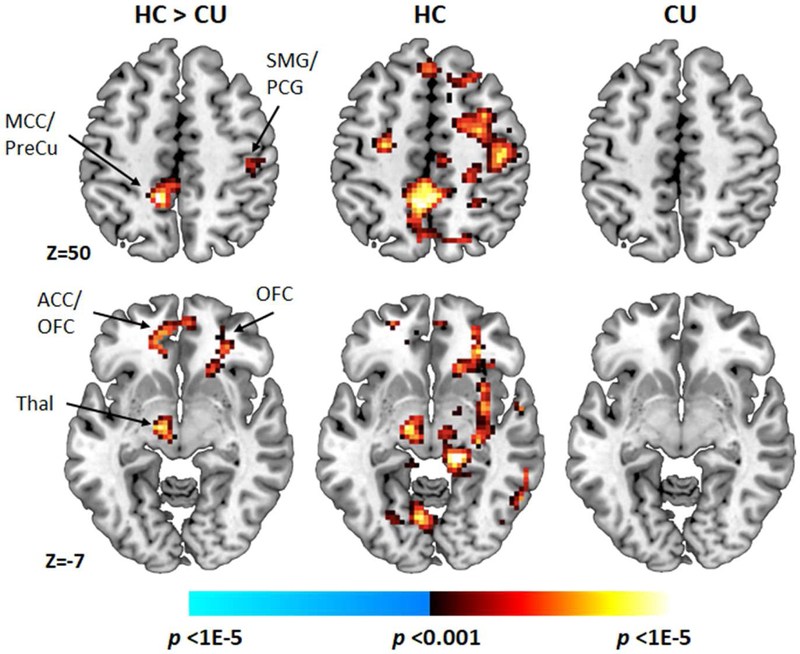
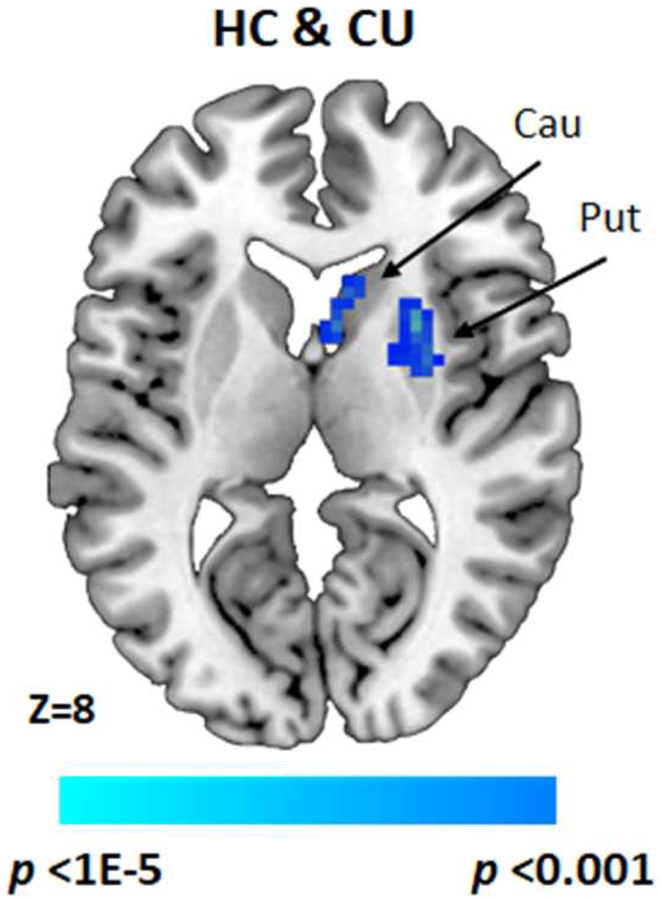
Decreased conflict-related activity was detected in cannabis-using versus healthy control youth in frontostriatal regions, including the ventromedial prefrontal cortex, striatum, pallidum, and thalamus. Frontostriatal connectivity did not differ across groups, but negative connectivity between the ventromedial prefrontal cortex and striatum was detected in the 2 groups.
These findings are consistent with previous reports of cannabis-associated disturbances in frontostriatal circuits in adults and point to the specific influence of cannabis on neurodevelopmental changes in youth. Future studies should examine whether frontostriatal functioning is a reliable marker of cannabis use disorder severity and a potential target for circuit-based interventions.
自我调节控制的障碍与成瘾的发生和维持有关,包括大麻使用障碍。在成年人中,长期使用大麻与执行需要自我调节控制的任务时前额叶-纹状体回路的紊乱有关,包括认知冲突的解决。在大麻使用障碍的早期,与这些过程相关的行为和神经相关性尚未得到充分研究,这些过程与长期使用的影响分开。本研究调查了大麻使用青少年在解决认知冲突期间前额叶-纹状体回路的功能。
在执行 Simon 任务期间,从 28 名大麻使用青少年和 32 名年龄匹配的健康参与者中获取功能磁共振成像数据。使用一般线性模型比较两组在正确响应冲突刺激时的大脑激活模式。使用心理生理相互作用分析来检查两组之间与冲突相关的前额叶-纹状体连接。探索了前额叶皮层激活和连接与大麻使用测量值的相关性。
与健康对照组青少年相比,大麻使用青少年在前额叶-纹状体区域(包括腹侧前额叶皮层、纹状体、苍白球和丘脑)中检测到与冲突相关的活动减少。两组之间的前额叶-纹状体连接没有差异,但在两组中都检测到腹侧前额叶皮层和纹状体之间的负连接。
这些发现与先前关于成人中大麻相关前额叶-纹状体回路紊乱的报告一致,并指出大麻对青少年神经发育变化的特定影响。未来的研究应该检查前额叶皮层功能是否是大麻使用障碍严重程度的可靠标志物,以及是否是基于回路的干预的潜在靶点。