Battistella Giovanni, Fornari Eleonora, Annoni Jean-Marie, Chtioui Haithem, Dao Kim, Fabritius Marie, Favrat Bernard, Mall Jean-Frédéric, Maeder Philippe, Giroud Christian
Department of Radiology, Centre Hospitalier Universitaire Vaudois (CHUV), University of Lausanne, Lausanne, Switzerland.
1] Department of Radiology, Centre Hospitalier Universitaire Vaudois (CHUV), University of Lausanne, Lausanne, Switzerland [2] CIBM (Centre d'Imagerie Biomédicale), Centre Hospitalier Universitaire Vaudois (CHUV) unit, Lausanne, Switzerland.
Neuropsychopharmacology. 2014 Aug;39(9):2041-8. doi: 10.1038/npp.2014.67. Epub 2014 Mar 17.
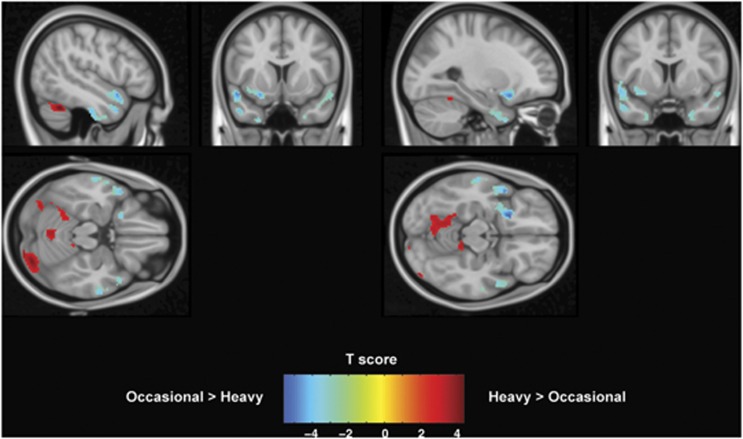
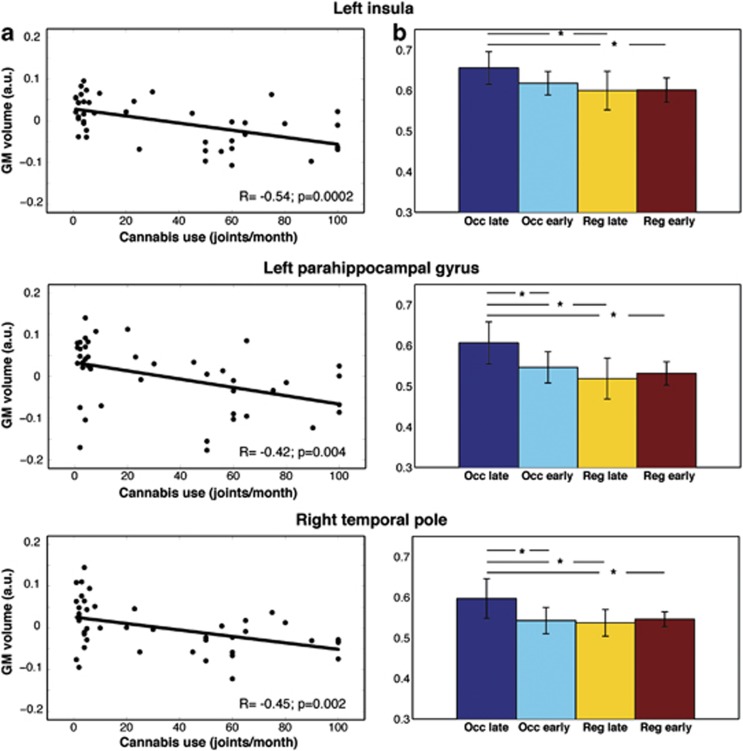
The dose-dependent toxicity of the main psychoactive component of cannabis in brain regions rich in cannabinoid CB1 receptors is well known in animal studies. However, research in humans does not show common findings across studies regarding the brain regions that are affected after long-term exposure to cannabis. In the present study, we investigate (using Voxel-based Morphometry) gray matter changes in a group of regular cannabis smokers in comparison with a group of occasional smokers matched by the years of cannabis use. We provide evidence that regular cannabis use is associated with gray matter volume reduction in the medial temporal cortex, temporal pole, parahippocampal gyrus, insula, and orbitofrontal cortex; these regions are rich in cannabinoid CB1 receptors and functionally associated with motivational, emotional, and affective processing. Furthermore, these changes correlate with the frequency of cannabis use in the 3 months before inclusion in the study. The age of onset of drug use also influences the magnitude of these changes. Significant gray matter volume reduction could result either from heavy consumption unrelated to the age of onset or instead from recreational cannabis use initiated at an adolescent age. In contrast, the larger gray matter volume detected in the cerebellum of regular smokers without any correlation with the monthly consumption of cannabis may be related to developmental (ontogenic) processes that occur in adolescence.
大麻主要精神活性成分在富含大麻素CB1受体的脑区中呈现剂量依赖性毒性,这在动物研究中已广为人知。然而,在人类研究中,关于长期接触大麻后受影响的脑区,各项研究并未显示出一致的结果。在本研究中,我们(使用基于体素的形态测量法)调查了一组经常吸食大麻者与一组按大麻使用年限匹配的偶尔吸食者相比的灰质变化情况。我们提供的证据表明,经常吸食大麻与内侧颞叶皮质、颞极、海马旁回、脑岛和眶额皮质的灰质体积减少有关;这些区域富含大麻素CB1受体,并且在功能上与动机、情绪和情感加工相关。此外,这些变化与纳入研究前3个月内大麻的使用频率相关。吸毒起始年龄也会影响这些变化的程度。显著的灰质体积减少可能是由于与起始年龄无关的大量吸食造成的,或者是由于青少年时期开始的娱乐性大麻使用所致。相比之下,在经常吸食者的小脑中检测到的较大灰质体积与每月大麻消费量无任何关联,这可能与青春期发生的发育(个体发生)过程有关。