LEASP, UMR 1027, Inserm-Université Toulouse III Paul Sabatier, Toulouse, 31000, France.
MRC-PHE Centre for Environment and Health, School of Public Health, Department of Epidemiology and Biostatistics, Imperial College London, London, W2 1PG, UK.
Nat Commun. 2019 Feb 15;10(1):773. doi: 10.1038/s41467-019-08732-x.
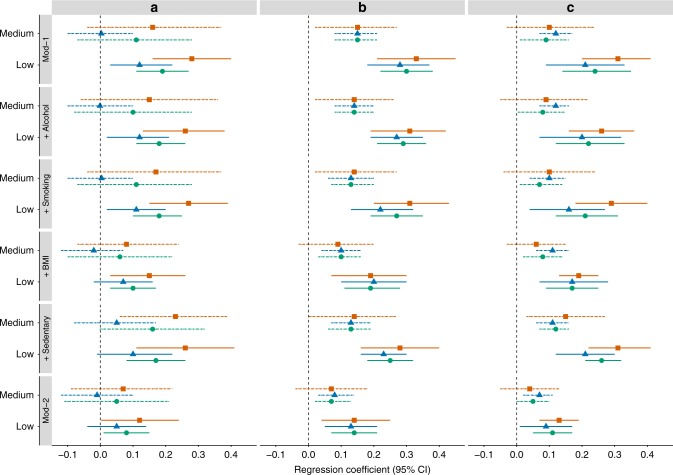
Chronic inflammation has been proposed as having a prominent role in the construction of social inequalities in health. Disentangling the effects of early life and adulthood social disadvantage on inflammation is key in elucidating biological mechanisms underlying socioeconomic disparities. Here we explore the relationship between socioeconomic position (SEP) across the life course and inflammation (as measured by CRP levels) in up to 23,008 participants from six European cohort studies from three countries conducted between 1958 and 2013. We find a consistent inverse association between SEP and CRP across cohorts, where participants with a less advantaged SEP have higher levels of inflammation. Educational attainment is most strongly related to inflammation, after adjusting for health behaviours, body mass index and later-in-life SEP. These findings suggest socioeconomic disadvantage in young adulthood is independently associated with later life inflammation calling for further studies of the pathways operating through educational processes.
慢性炎症被认为在健康方面的社会不平等构建中起着重要作用。厘清童年和成年期社会劣势对炎症的影响,对于阐明社会经济差异背后的生物学机制至关重要。在这里,我们探索了六个欧洲队列研究中,在 1958 年至 2013 年期间进行的三个国家的参与者在整个生命过程中的社会经济地位(SEP)与炎症(通过 CRP 水平衡量)之间的关系。我们发现,在整个队列中,SEP 与 CRP 之间存在一致的反比关系,社会经济地位较低的参与者炎症水平较高。在调整了健康行为、体重指数和后期社会经济地位后,受教育程度与炎症的关系最为密切。这些发现表明,青年时期的社会经济劣势与晚年的炎症有关,这需要进一步研究通过教育过程发挥作用的途径。