Centre for Longitudinal Studies, Social Research Institute, University College London, London, UK.
CLOSER, Social Research Institute, University College London, London, UK.
BMC Med. 2020 Nov 18;18(1):338. doi: 10.1186/s12916-020-01800-w.
High blood pressure (BP) is a key modifiable determinant of cardiovascular disease and a likely determinant of other adverse health outcomes. While socioeconomic inequalities in BP are well documented, it remains unclear (1) how these inequalities have changed across time, given improvements over time in the detection and treatment of high BP (hypertension); (2) whether BP inequalities are present below and above hypertension treatment thresholds; and (3) whether socioeconomic position (SEP) across life has cumulative effects on BP. We sought to address these gaps using evidence from two complementary sources: birth cohort and repeated cross-sectional datasets.
We used three British birth cohort studies-born in 1946, 1958, and 1970-with BP measured at 43-46 years (in 1989, 2003, and 2016), and 21 repeated cross-sectional datasets-the Health Survey for England (HSE), with BP measured among adults aged ≥ 25 years (1994-2016). Adult education attainment was used as an indicator of SEP in both datasets; childhood father's social class was used as an alternative indicator of (early life) SEP in cohorts. Adjusting for the expected average effects of antihypertensive medication use, we used linear regression to quantify SEP differences in mean systolic BP (SBP), and quantile regression to investigate whether inequalities differed across SBP distributions-below and above hypertension treatment thresholds.
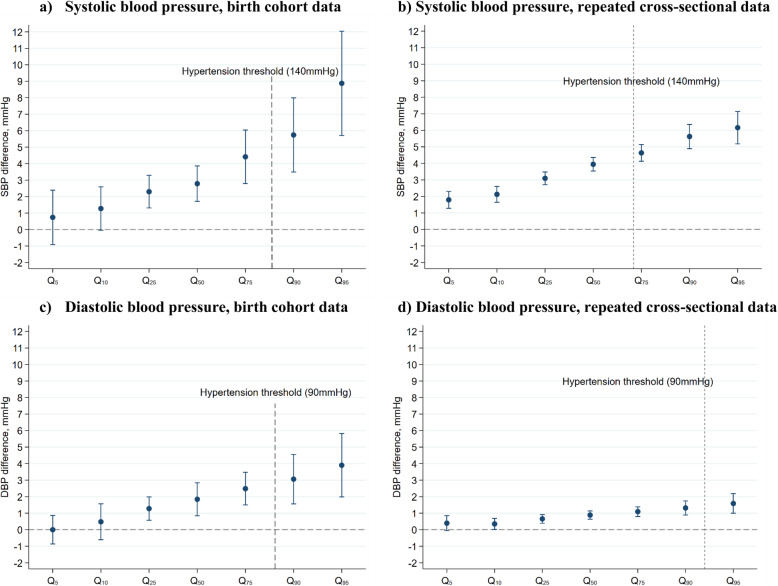
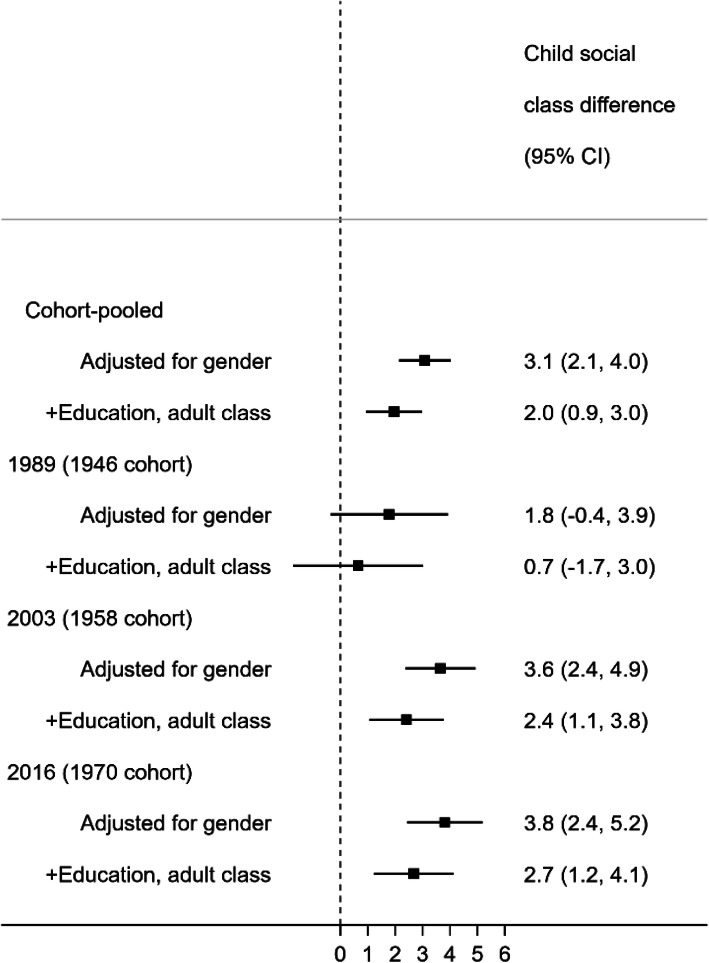
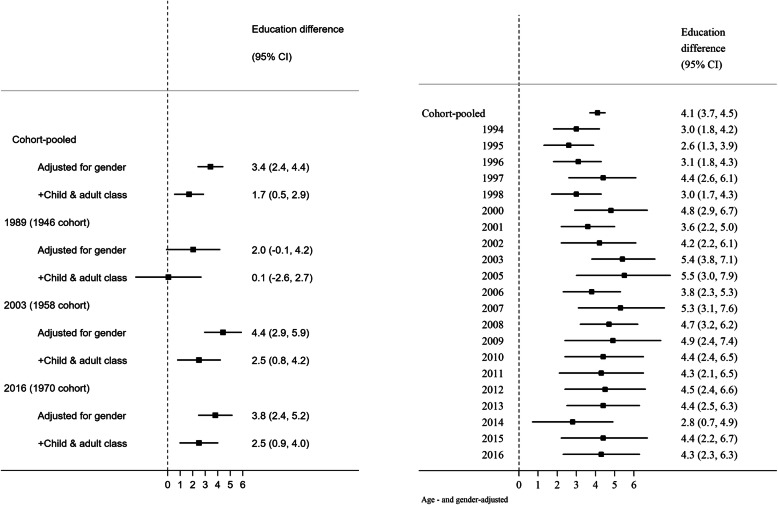
In both datasets, lower educational attainment was associated with higher SBP, with similar absolute magnitudes of inequality across the studied period. Differences in SBP by education (Slope Index of Inequality) based on HSE data were 3.0 mmHg (95% CI 1.8, 4.2) in 1994 and 4.3 mmHg (2.3, 6.3) in 2016. Findings were similar for diastolic BP (DBP) and survey-defined hypertension. Inequalities were found across the SBP distribution in both datasets-below and above the hypertension threshold-yet were larger at the upper tail; in HSE, median SBP differences were 2.8 mmHg (1.7, 3.9) yet 5.6 mmHg (4.9, 6.4) at the 90th quantile. Adjustment for antihypertensive medication use had little impact on the magnitude of inequalities; in contrast, associations were largely attenuated after adjustment for body mass index. Finally, cohort data suggested that disadvantage in early and adult life had cumulative independent associations with BP: cohort-pooled differences in SBP were 5.0 mmHg (3.8, 6.1) in a score combining early life social class and own education, yet were 3.4 mmHg (2.4, 4.4) for education alone.
Socioeconomic inequalities in BP have persisted from 1989 to 2016 in Britain/England, despite improved detection and treatment of high BP. To achieve future reductions in BP inequalities, policies addressing the wider structural determinants of high BP levels are likely required, particularly those curtailing the obesogenic environment-targeting detection and treatment alone is unlikely to be sufficient.
高血压(BP)是心血管疾病的一个主要可改变决定因素,也是其他不良健康结果的一个可能决定因素。虽然社会经济地位与 BP 之间的不平等现象已得到充分证明,但仍不清楚(1)随着高血压(高血压)的检测和治疗的改善,这些不平等现象随时间发生了怎样的变化;(2)BP 不平等现象是否存在于高血压治疗阈值以下和以上;以及(3)生命中社会经济地位(SEP)是否对 BP 有累积影响。我们试图利用来自两个互补来源的证据来解决这些差距:出生队列和重复的横截面数据集。
我们使用了三个英国出生队列研究-1946 年、1958 年和 1970 年出生,在 43-46 岁(1989 年、2003 年和 2016 年)时测量 BP,以及 21 个重复的横截面数据集-英格兰健康调查(HSE),在≥25 岁的成年人中测量 BP(1994-2016 年)。在两个数据集中,成人教育程度都被用作社会经济地位的指标;在队列中,儿童父亲的社会阶层被用作(早期生活)社会经济地位的替代指标。我们使用线性回归来量化平均收缩压(SBP)的社会经济地位差异,并使用分位数回归来研究 SBP 分布(高血压治疗阈值以下和以上)是否存在不平等现象。
在两个数据集中,较低的教育程度与较高的 SBP 相关,在研究期间,不平等的绝对幅度相似。基于 HSE 数据的教育程度与 SBP 的差异(斜率指数不平等)在 1994 年为 3.0mmHg(95%CI 1.8,4.2),在 2016 年为 4.3mmHg(2.3,6.3)。舒张压(DBP)和调查定义的高血压也有类似的结果。在两个数据集的 SBP 分布中都存在不平等现象-在高血压阈值以下和以上-但在尾部更大;在 HSE 中,中位数 SBP 差异为 2.8mmHg(1.7,3.9),但在第 90 分位数为 5.6mmHg(4.9,6.4)。使用降压药物治疗的调整对不平等的程度影响不大;相比之下,调整后,关联在很大程度上减弱了。最后,队列数据表明,早期和成年生活中的劣势与 BP 有独立的累积关联:结合早期社会阶层和自身教育程度的 SBP 综合评分,队列汇总的 SBP 差异为 5.0mmHg(3.8,6.1),而仅为教育程度的差异为 3.4mmHg(2.4,4.4)。
尽管高血压的检测和治疗有所改善,但英国/英格兰的 BP 社会经济不平等现象从 1989 年持续到 2016 年。为了实现未来 BP 不平等现象的减少,可能需要制定解决高血压水平广泛结构性决定因素的政策,特别是那些遏制肥胖环境的政策-仅针对检测和治疗不太可能足够。