Department for Research, Studies, Evaluation and Statistics (DREES), French Health and Social Affairs Ministry, Paris, France.
Biostatistics and Bioinformatics (DIM), University Hospital, Dijon & France Bourgogne Franche-Comté University, Dijon, France.
Epidemiol Psychiatr Sci. 2019 Feb 18;29:e20. doi: 10.1017/S2045796019000039.
A large number of people present each day at hospitals for non-fatal deliberate self-harm (DSH). Examination of the short-term risk of non-fatal recurrence and mortality at the national level is of major importance for both individual medical decision-making and global organisation of care.
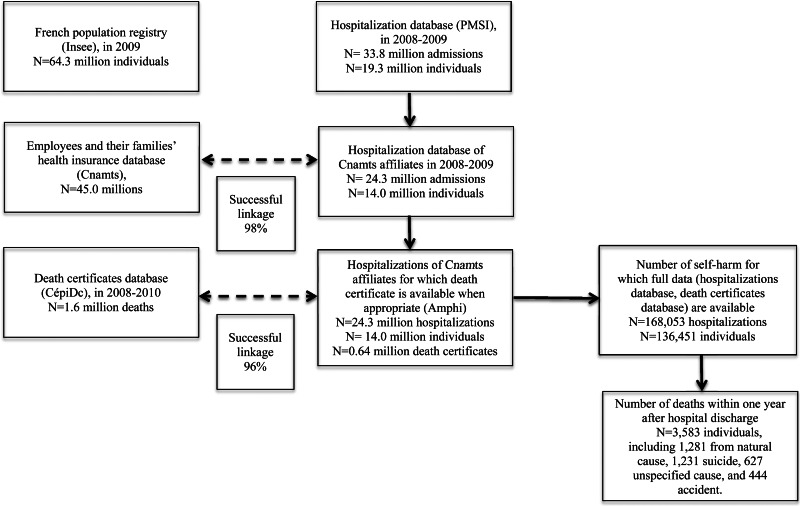
Following the almost exhaustive linkage (96%) of two national registries in France covering 45 million inhabitants (i.e. 70% of the whole population), information about hospitalisation for DSH in 2008-2009 and vital status at 1 year was obtained. Individuals who died during the index hospital stay were excluded from analyses.
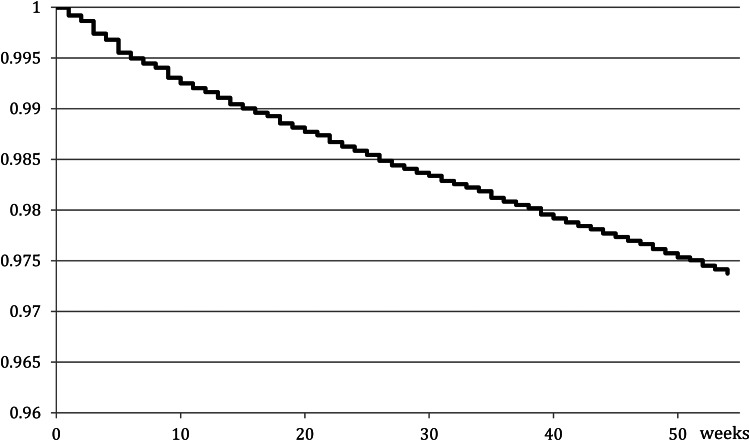
Over 2 years, 136,451 individuals were hospitalised in medicine or surgery for DSH. The sample comprised 62.8% women, median age 38 in both genders, with two peaks at 16 and 44 years in women, and one peak at 37 years in men. The method used for DSH was drug overdose in 82.1% of cases. Admission to an intensive care unit occurred in 12.9%. Following index hospitalisation, 71.3% returned home and 23.7% were transferred to a psychiatric inpatient care unit. DSH recurrence during the following year occurred in 12.4% of the sample, within the first 6 months in 75.2%, and only once in 74.6%. At 1 year, 2.6% of the sample had died. The overall standardised mortality ratio was 7.5 but reached more than 20 in young adults. The causes were natural causes (35.7%), suicide (34.4%), unspecified cause (17.5%) and accident (12.4%). Most (62.9%) deaths by suicide occurred within the first 6 months following index DSH. Violent means (i.e. not drug overdose) were used in 70% of suicide cases. Concordance between means used for index DSH and for suicide was low (30% overall), except for drug overdose. Main suicide risk factors were older age, being male, use of a violent means at index DSH, index admission to an intensive care unit, a transfer to another medical department or to a psychiatric inpatient unit, and recurrence of DSH. However, these factors had low positive predictive values individually (below 2%).
Non-fatal DSH represent frequent events with a significant risk of short-term recurrence and death from various causes. The first 6 months following hospital discharge appear to be a critical period. Specific short-term aftercare programs targeting all people with a DSH episode have to be developed, along other suicide prevention strategies.
每天都有大量的人因非致命性的故意自伤(DSH)而到医院就诊。在国家层面上检查非致命性复发和死亡率的短期风险对个体医疗决策和全球护理组织都非常重要。
在法国两个覆盖 4500 万居民(占总人口的 70%)的全国性登记处几乎进行了详尽的(96%)链接后,获得了 2008-2009 年因 DSH 住院和 1 年时的生存状态信息。在指数住院期间死亡的人被排除在分析之外。
在两年内,有 136451 人因 DSH 在医学或外科住院治疗。样本包括 62.8%的女性,两性中位年龄均为 38 岁,女性有两个高峰,分别在 16 岁和 44 岁,男性有一个高峰在 37 岁。在 82.1%的病例中,自杀的方法是药物过量。12.9%的人入住重症监护病房。在指数住院后,71.3%的人回家,23.7%的人转至精神病住院治疗。在接下来的一年中,该样本中有 12.4%出现 DSH 复发,75.2%在头 6 个月内复发,74.6%仅复发一次。在 1 年时,该样本中有 2.6%的人死亡。总体标准化死亡率为 7.5,但在年轻成年人中超过 20。原因是自然原因(35.7%)、自杀(34.4%)、未明确原因(17.5%)和意外(12.4%)。大多数(62.9%)自杀发生在 DSH 指数后的头 6 个月内。70%的自杀病例使用了暴力手段(即非药物过量)。用于 DSH 指数和自杀的手段之间的一致性较低(总体为 30%),除了药物过量。主要的自杀危险因素是年龄较大、男性、在 DSH 指数时使用暴力手段、指数入住重症监护病房、转至另一个医学部门或精神病住院部,以及 DSH 复发。然而,这些因素的个体阳性预测值较低(均低于 2%)。
非致命性 DSH 是常见事件,有很高的短期复发风险,并可能导致各种原因的死亡。出院后最初的 6 个月似乎是一个关键时期。必须开发针对所有经历过 DSH 发作的人的特定短期后续护理计划,以及其他预防自杀的策略。