Departments of Dermatology, Medical University of Vienna, Vienna, Austria.
Departments of Surgery, Medical University of Vienna, Vienna, Austria.
Br J Dermatol. 2019 Jul;181(1):186-189. doi: 10.1111/bjd.17783. Epub 2019 Mar 26.
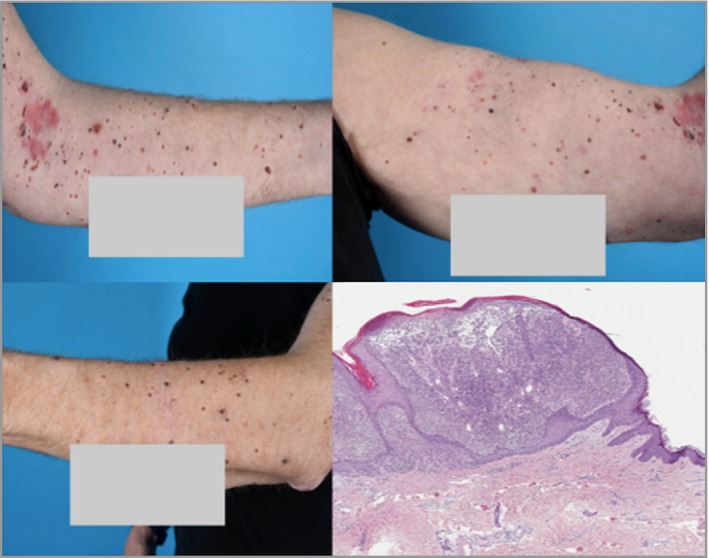
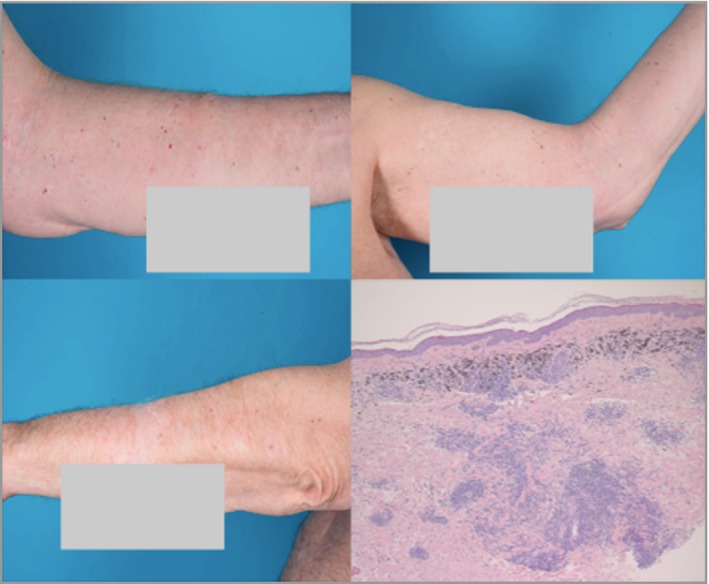
Talimogene laherparepvec (T-VEC) is a intralesional oncolytic virotherapy, licensed in the European Union for locoregional advanced melanoma of American Joint Committee on Cancer stages IIIB, IIIC and IVM1a. Organ transplant recipients are currently excluded from all clinical trials dealing with immunotherapies due to the risk of transplant rejection. A 58-year-old white man with a history of heart and kidney transplantation in 2014 was diagnosed with melanoma (Breslow thickness 1·6 mm, stage pT2a) on the left arm in September 2015. In March 2016 he developed in transit metastases, and local therapy with a combination of topical imiquimod (5%) and cryotherapy of individual lesions was initiated. However, in November 2016 therapy was stopped following local progression of the metastases. An interdisciplinary decision to treat the patient with T-VEC was taken. After 11 cycles of T-VEC, the patient showed a complete response. As of June 2018, 11 months after the last treatment cycle of T-VEC, the patient continues to be tumour free. The patient tolerated the therapy well with only mild adverse events and did not show any sign of graft rejection or loss of function of the transplanted organs. We conclude that T-VEC can be a potentially effective and safe treatment in patients with a history of organ transplantation. Nevertheless, due to this special situation, the risks and benefits should always be discussed with an interdisciplinary tumour board.
替莫唑胺(T-VEC)是一种瘤内溶瘤病毒治疗药物,在欧盟获准用于治疗美国癌症联合委员会分期为 IIIB、IIIC 和 IVM1a 的局部晚期黑色素瘤。由于存在移植排斥的风险,器官移植受者目前被排除在所有涉及免疫疗法的临床试验之外。一名 58 岁白人男性,2014 年接受过心脏和肾脏移植,2015 年 9 月在左臂被诊断患有黑色素瘤(Breslow 厚度 1.6mm,分期为 pT2a)。2016 年 3 月,他出现了转移病灶,开始接受局部治疗,包括外用咪喹莫特(5%)和单个病变的冷冻疗法。然而,2016 年 11 月,由于转移灶的局部进展,停止了治疗。经多学科讨论决定对患者采用 T-VEC 治疗。在接受 11 个周期的 T-VEC 治疗后,患者达到完全缓解。截至 2018 年 6 月,即最后一次 T-VEC 治疗周期后 11 个月,患者持续无肿瘤。患者对治疗耐受良好,仅有轻微不良反应,且未出现移植物排斥或移植器官功能丧失的迹象。我们的结论是,对于有器官移植史的患者,T-VEC 可能是一种潜在有效且安全的治疗方法。然而,由于这种特殊情况,应始终与多学科肿瘤委员会讨论治疗的风险和获益。