Department of Molecular Imaging and Nuclear Medicine, Tianjin Medical University Cancer Institute and Hospital, Tianjin, China.
National Clinical Research Center for Cancer, Tianjin, China.
Thorac Cancer. 2019 Apr;10(4):659-664. doi: 10.1111/1759-7714.12981. Epub 2019 Feb 18.
The purpose of this study was to investigate an association between EGFR mutation status and F-fluorodeoxyglucose positron emission tomography-computed tomography ( F-FDG PET-CT) image features in lung adenocarcinoma.
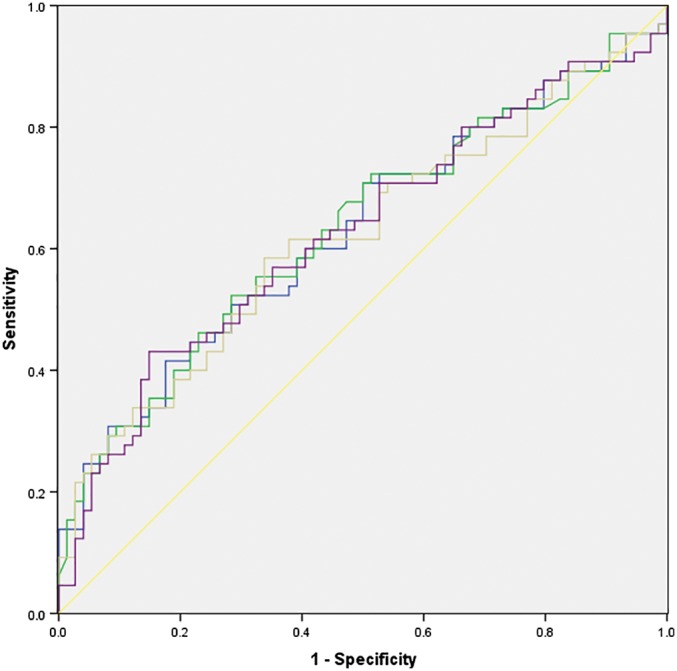
Retrospective analysis of the data of 139 patients with lung adenocarcinoma confirmed by surgical pathology who underwent preoperative F-FDG PET-CT was conducted. Correlations between EGFR mutation status, clinical characteristics, and PET-CT parameters, including the maximum standardized uptake value (SUVmax), the mean of the SUV (SUVmean), the peak of the SUV (SUVpeak) of the primary tumor, and the ratio of SUVmax between the primary tumor and the mediastinal blood pool (SUVratio), were statistically analyzed. Multivariate logistic regression analysis was performed to identify predictors of EGFR mutation. Receiver operating characteristic curves of statistical quantitative parameters were compared.
EGFR mutations were detected in 74 (53.2%) of the 139 lung adenocarcinomas and were more frequent in non-smoking patients. Univariate analysis showed that the SUVmax, SUVmean, SUVpeak, and SUVratio were lower in EGFR-mutated than in wild-type tumors. The receiver operating characteristic curves showed no significant differences between their diagnostic efficiencies. Multivariate logistic regression analysis showed that being a never smoker was an independent predictor of EGFR mutation.
Quantitative parameters based on F-FDG PET-CT have modest power to predict the presence of EGFR mutation in lung adenocarcinoma; however, when compared to smoking history, they are not good or significant predictive factors.
本研究旨在探讨肺腺癌中表皮生长因子受体(EGFR)突变状态与 F-氟脱氧葡萄糖正电子发射断层扫描-计算机断层扫描(F-FDG PET-CT)图像特征之间的关系。
对 139 例经手术病理证实为肺腺癌的患者的 F-FDG PET-CT 术前数据进行回顾性分析。对 EGFR 突变状态、临床特征与 PET-CT 参数(包括原发肿瘤的最大标准化摄取值(SUVmax)、SUV 均值(SUVmean)、SUV 峰值(SUVpeak)和原发肿瘤与纵隔血池 SUVmax 比值(SUVratio))之间的相关性进行统计学分析。采用多变量逻辑回归分析识别 EGFR 突变的预测因素。比较统计定量参数的受试者工作特征曲线。
在 139 例肺腺癌中,检测到 74 例(53.2%)EGFR 突变,且在不吸烟者中更为常见。单因素分析显示,EGFR 突变型肿瘤的 SUVmax、SUVmean、SUVpeak 和 SUVratio 均低于野生型肿瘤。受试者工作特征曲线显示,这些定量参数的诊断效能无显著差异。多变量逻辑回归分析显示,从不吸烟是 EGFR 突变的独立预测因素。
F-FDG PET-CT 定量参数对肺腺癌 EGFR 突变的预测能力中等;但与吸烟史相比,其不是良好或显著的预测因素。