Aide Nicolas, Weyts Kathleen, Lasnon Charline
UNICAEN, INSERM 1086 ANTICIPE, Normandy University, 14000 Caen, France.
Nuclear Medicine Department, Comprehensive Cancer Centre F. Baclesse, UNICANCER, 14000 Caen, France.
Diagnostics (Basel). 2022 Oct 10;12(10):2448. doi: 10.3390/diagnostics12102448.
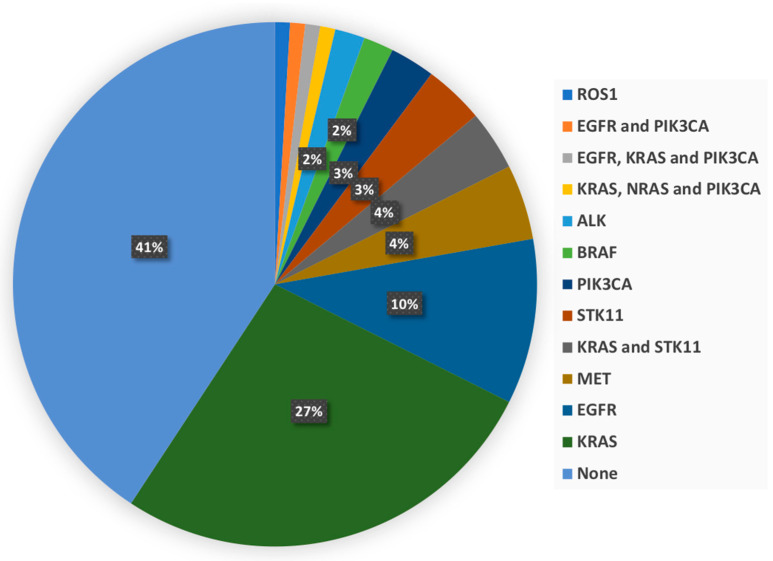
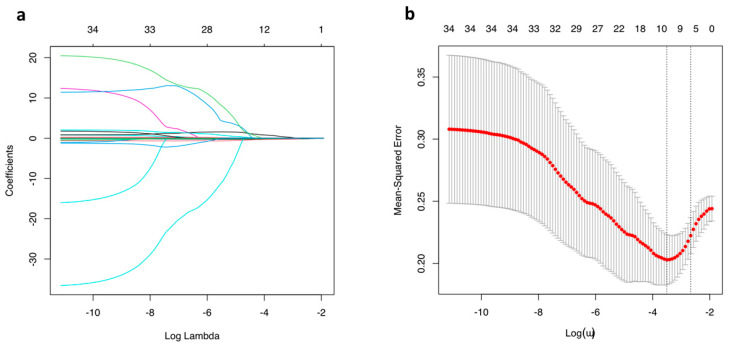
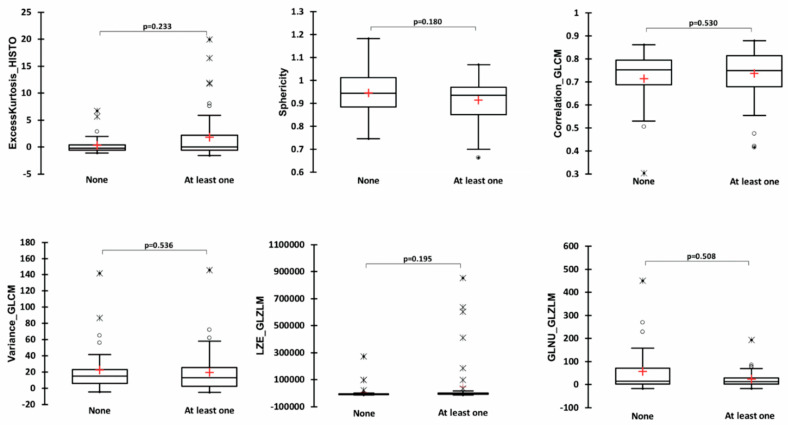
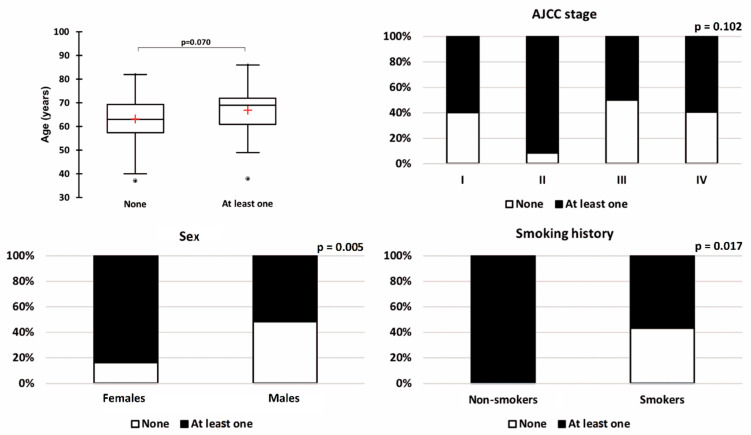
This study aimed to investigate if combining clinical characteristics with pre-therapeutic 18 F-fluorodeoxyglucose (18 F-FDG) positron emission tomography (PET) radiomics could predict the presence of molecular alteration(s) in key molecular targets in lung adenocarcinoma. This non-interventional monocentric study included patients with newly diagnosed lung adenocarcinoma referred for baseline PET who had tumour molecular analyses. The data were randomly split into training and test datasets. LASSO regression with 100-fold cross-validation was performed, including sex, age, smoking history, AJCC cancer stage and 31 PET variables. In total, 109 patients were analysed, and it was found that 63 (57.8%) patients had at least one molecular alteration. Using the training dataset (n = 87), the model included 10 variables, namely age, sex, smoking history, AJCC stage, excessKustosis_HISTO, sphericity_SHAPE, variance_GLCM, correlation_GLCM, LZE_GLZLM, and GLNU_GLZLM. The ROC analysis for molecular alteration prediction using this model found an AUC equal to 0.866 (p < 0.0001). A cut-off value set to 0.48 led to a sensitivity of 90.6% and a positive likelihood ratio (LR+) value equal to 2.4. After application of this cut-off value in the unseen test dataset of patients (n = 22), the test presented a sensitivity equal to 90.0% and an LR+ value of 1.35. A clinico-metabolic 18 F-FDG PET phenotype allows the detection of key molecular target alterations with high sensitivity and negative predictive value. Hence, it opens the way to the selection of patients for molecular analysis.
本研究旨在探讨将临床特征与治疗前18F-氟脱氧葡萄糖(18F-FDG)正电子发射断层扫描(PET)影像组学相结合,是否能够预测肺腺癌关键分子靶点的分子改变情况。这项非干预性单中心研究纳入了因基线PET检查而转诊且进行了肿瘤分子分析的新诊断肺腺癌患者。数据被随机分为训练集和测试集。采用具有100倍交叉验证的LASSO回归分析,纳入的因素包括性别、年龄、吸烟史、美国癌症联合委员会(AJCC)癌症分期以及31个PET变量。总共分析了109例患者,发现63例(57.8%)患者至少存在一种分子改变。利用训练集(n = 87),该模型纳入了10个变量,即年龄、性别、吸烟史、AJCC分期、过量峰度_HISTO、球形度_SHAPE、方差_GLCM、相关性_GLCM、长游程长度矩阵_ZLGLM和灰度共生矩阵均匀度_GLCM。使用该模型进行分子改变预测的ROC分析发现曲线下面积(AUC)等于0.866(p < 0.0001)。设定截断值为0.48时,灵敏度为90.6%,阳性似然比(LR+)值等于2.4。在未见过的患者测试集(n = 22)中应用该截断值后,测试的灵敏度为90.0%,LR+值为1.35。临床代谢型18F-FDG PET表型能够以高灵敏度和阴性预测值检测关键分子靶点的改变。因此,它为选择进行分子分析的患者开辟了道路。