Buvik Astrid, Bergmo Trine S, Bugge Einar, Smaabrekke Arvid, Wilsgaard Tom, Olsen Jan Abel
Department of Orthopaedic Surgery, University Hospital of North Norway, Tromsø, Norway.
Norwegian Centre for E-health Research, University Hospital of North Norway, Tromsø, Norway.
J Med Internet Res. 2019 Feb 19;21(2):e11330. doi: 10.2196/11330.
Telemedicine consultations using real-time videoconferencing has the potential to improve access and quality of care, avoid patient travels, and reduce health care costs.
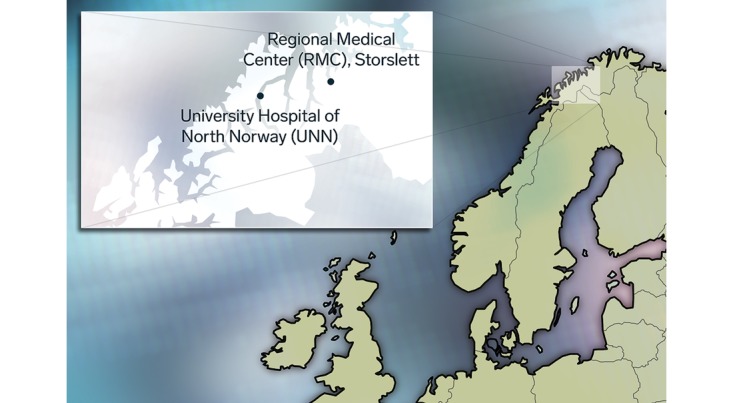
The aim of this study was to examine the cost-effectiveness of an orthopedic videoconferencing service between the University Hospital of North Norway and a regional medical center in a remote community located 148 km away.
An economic evaluation based on a randomized controlled trial of 389 patients (559 consultations) referred to the hospital for an orthopedic outpatient consultation was conducted. The intervention group (199 patients) was randomized to receive video-assisted remote orthopedic consultations (302 consultations), while the control group (190 patients) received standard care in outpatient consultation at the hospital (257 consultations). A societal perspective was adopted for calculating costs. Health outcomes were measured as quality-adjusted life years (QALYs) gained. Resource use and health outcomes were collected alongside the trial at baseline and at 12 months follow-up using questionnaires, patient charts, and consultation records. These were valued using externally collected data on unit costs and QALY weights. An extended sensitivity analysis was conducted to address the robustness of the results.
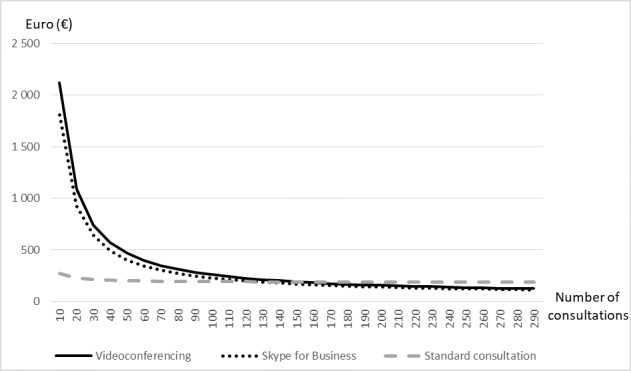
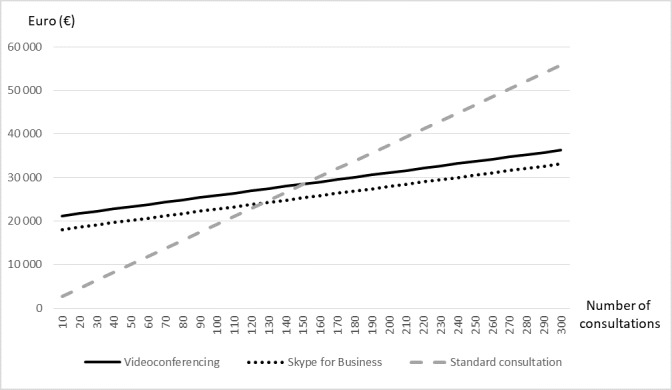
This study showed that using videoconferencing for orthopedic consultations in the remote clinic costs less than standard outpatient consultations at the specialist hospital, as long as the total number of patient consultations exceeds 151 per year. For a total workload of 300 consultations per year, the annual cost savings amounted to €18,616. If costs were calculated from a health sector perspective, rather than a societal perspective, the number of consultations needed to break even was 183.
This study showed that providing video-assisted orthopedic consultations to a remote clinic in Northern Norway, rather than having patients travel to the specialist hospital for consultations, is cost-effective from both a societal and health sector perspective. This conclusion holds as long as the activity exceeds 151 and 183 patient consultations per year, respectively.
ClinicalTrials.gov NCT00616837; https://clinicaltrials.gov/ct2/show/NCT00616837 (Archived by WebCite at http://www.webcitation.org/762dZPoKX).
使用实时视频会议进行远程医疗咨询有潜力改善医疗服务的可及性和质量,避免患者奔波,并降低医疗成本。
本研究旨在考察挪威北部大学医院与相距148公里的偏远社区的一家区域医疗中心之间开展的骨科视频会议服务的成本效益。
基于一项针对389例(559次会诊)因骨科门诊会诊而转诊至该医院的患者的随机对照试验进行了一项经济学评估。干预组(199例患者)被随机分配接受视频辅助远程骨科会诊(302次会诊),而对照组(190例患者)在医院接受门诊会诊的标准治疗(257次会诊)。采用社会视角计算成本。健康结局以获得的质量调整生命年(QALYs)来衡量。在试验期间,通过问卷调查、患者病历和会诊记录,在基线和12个月随访时收集资源使用情况和健康结局。使用外部收集的单位成本数据和QALY权重对这些数据进行估值。进行了扩展敏感性分析以检验结果的稳健性。
本研究表明,只要每年患者会诊总数超过151次,在偏远诊所使用视频会议进行骨科会诊的成本低于专科医院的标准门诊会诊成本。对于每年300次会诊的总工作量,每年节省的成本达18,616欧元。如果从卫生部门而非社会视角计算成本,收支平衡所需的会诊次数为183次。
本研究表明,从社会和卫生部门视角来看,为挪威北部的偏远诊所提供视频辅助骨科会诊,而非让患者前往专科医院会诊,具有成本效益。只要每年的活动量分别超过151次和183次患者会诊,这一结论就成立。
ClinicalTrials.gov NCT00616837;https://clinicaltrials.gov/ct2/show/NCT00616837(由WebCite存档于http://www.webcitation.org/762dZPoKX)。