Program in Cancer Biology, Vanderbilt University, Nashville, USA.
Vanderbilt University Medical Center, Nashville, USA.
Clin Exp Metastasis. 2019 Apr;36(2):87-95. doi: 10.1007/s10585-019-09957-2. Epub 2019 Feb 18.
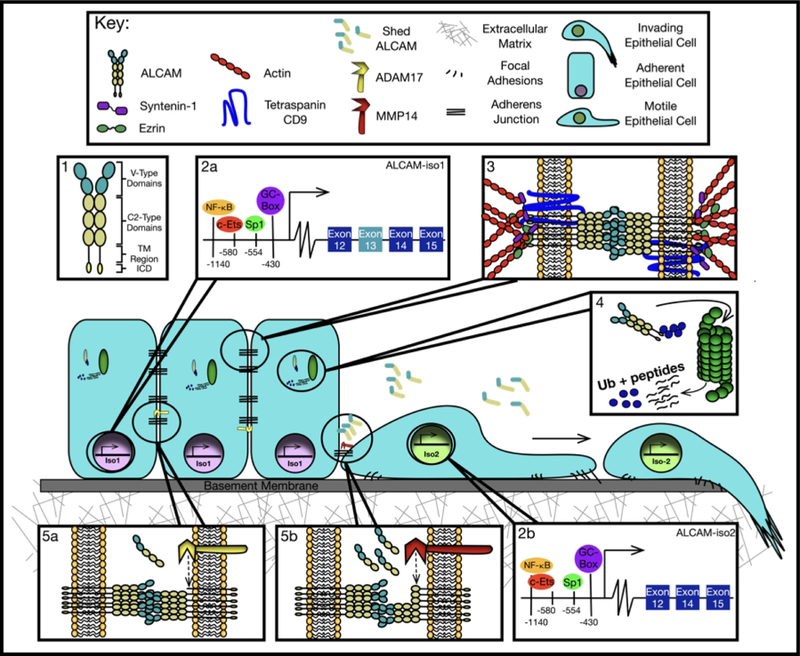
In epithelial-derived cancers, altered regulation of cell-cell adhesion facilitates the disruption of tissue cohesion that is central to the progression to malignant disease. Although numerous intercellular adhesion molecules participate in epithelial adhesion, the immunoglobulin superfamily (IgSF) member activated leukocyte cell adhesion molecule (ALCAM), has emerged from multiple independent studies as a central contributor to tumor progression. ALCAM is an archetypal member of the IgSF with conventional organization of five Ig-like domains involved in homo- and heterotypic adhesions. Like many IgSF members, ALCAM is broadly expressed and involved in cellular adhesion across many cellular processes. While the redundancy of intercellular adhesion molecules (CAMs) could diminish the impact of any single CAM, consistent correlation between ALCAM expression and patient outcome for multiple cancers underscores its role in tumor progression. Unlike most oncogenes and tumor suppressors, ALCAM is neither mutated nor amplified or deleted. Experimental disruption of ALCAM-mediated adhesions implies that this IgSF member contributes to tumor progression through dynamic turnover of the protein at the cell surface. Since ALCAM is not frequently altered at the gene level, it appears to promote malignant behavior through regulation of its availability rather than its specific activity. These observations help explain its heterogeneous expression within malignant disease and the drastic changes in protein levels across tumor progression. To reveal how ALCAM contributes to tumor progression, we review regulation of its gene expression, alternative splicing, targeted proteolysis, binding partners, and surface shedding within the context of cancer. Studying ALCAM regulation has led to a novel understanding of the fine-tuning of cell adhesive state through the utilization of otherwise normal regulatory processes, which thereby enable tumor cell invasion and metastasis.
在上皮源性癌症中,细胞间黏附的改变调节促进了组织黏附的破坏,这是恶性疾病进展的核心。尽管许多细胞间黏附分子参与上皮细胞黏附,但免疫球蛋白超家族(IgSF)成员活化白细胞细胞黏附分子(ALCAM)已从多项独立研究中脱颖而出,成为肿瘤进展的核心贡献者。ALCAM 是 IgSF 的典型成员,具有参与同型和异型黏附的五个 Ig 样结构域的常规组织。与许多 IgSF 成员一样,ALCAM 广泛表达,并参与许多细胞过程中的细胞黏附。虽然细胞间黏附分子(CAMs)的冗余性可能会降低任何单个 CAM 的影响,但 ALCAM 表达与多种癌症患者预后的一致相关性强调了其在肿瘤进展中的作用。与大多数癌基因和肿瘤抑制基因不同,ALCAM 既没有突变、扩增或缺失。ALCAM 介导的黏附的实验性破坏意味着,这种 IgSF 成员通过在细胞表面的蛋白质动态周转促进肿瘤进展。由于 ALCAM 在基因水平上不常改变,因此它似乎通过调节其可用性而不是其特定活性来促进恶性行为。这些观察结果有助于解释其在恶性疾病中的异质性表达以及肿瘤进展过程中蛋白质水平的急剧变化。为了揭示 ALCAM 如何促进肿瘤进展,我们回顾了其基因表达、选择性剪接、靶向蛋白水解、结合伴侣和表面脱落的调节,以癌症为背景。研究 ALCAM 的调节导致了对细胞黏附状态的精细调节的新认识,这种调节是通过利用其他正常的调节过程来实现的,从而使肿瘤细胞能够侵袭和转移。