Broers Eva R, Lodder Paul, Spek Viola R M, Widdershoven Jos W M G, Pedersen Susanne S, Habibović Mirela
Department of Cardiology, St. Elisabeth-TweeSteden Hospital, Tilburg, The Netherlands.
Department of Medical and Clinical Psychology, Tilburg University, Tilburg, The Netherlands.
Pacing Clin Electrophysiol. 2019 Apr;42(4):439-446. doi: 10.1111/pace.13636. Epub 2019 Mar 5.
Knowledge of the level of healthcare utilization (HCU) and the predictors of high HCU use in patients with an implantable cardioverter defibrillator (ICD) is lacking. We examined the level of HCU and predictors associated with increased HCU in first-time ICD patients, using a prospective study design.
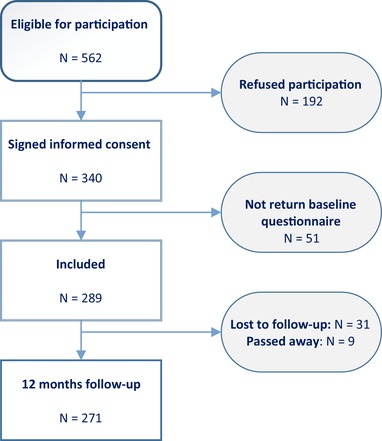
ICD patients (N = 201) completed a set of questionnaires at baseline and 3, 6, and 12 months after inclusion. A hierarchical multiple linear regression with three models was performed to examine predictors of HCU.
HCU was highest between baseline and 3 months postimplantation and gradually decreased during 12 months follow-up. During the first year postimplantation, only depression (β = 0.342, P = 0.002) was a significant predictor. Between baseline and 3 months follow-up, younger age (β = -0.220, P < 0.01), New York Heart Association class III/IV (β = 0.705, P = 0.01), and secondary indication (β = 0.148, P = 0.05) were independent predictors for increased HCU. Between 3 and 6 months follow-up, younger age (β = -0.151, P = 0.05) and depression (β = 0.370, P < 0.001) predicted increased HCU. Between 6 and 12 months only depression (β = 0.355, P = 0.001) remained a significant predictor.
Depression was an important predictor of increased HCU in ICD patients in the first year postimplantation, particularly after 3 months postimplantation. Identifying patients who need additional care and provide this on time might better meet patients' needs and lower future HCU.
目前尚缺乏关于植入式心脏复律除颤器(ICD)患者医疗保健利用率(HCU)水平以及高HCU使用预测因素的相关知识。我们采用前瞻性研究设计,研究了首次植入ICD患者的HCU水平及其增加的预测因素。
ICD患者(N = 201)在基线时以及纳入研究后的3、6和12个月完成了一组问卷调查。进行了包含三个模型的分层多元线性回归,以研究HCU的预测因素。
HCU在植入后基线至3个月期间最高,并在12个月的随访期间逐渐下降。在植入后的第一年,只有抑郁(β = 0.342,P = 0.002)是一个显著的预测因素。在基线至3个月的随访期间,年龄较小(β = -0.220,P < 0.01)、纽约心脏协会III/IV级(β = 0.705,P = 0.01)和次要适应症(β = 0.148,P = 0.05)是HCU增加的独立预测因素。在3至6个月的随访期间,年龄较小(β = -0.151,P = 0.05)和抑郁(β = 0.370,P < 0.001)预测HCU增加。在6至12个月期间,只有抑郁(β = 0.355,P = 0.001)仍然是一个显著的预测因素。
抑郁是ICD患者植入后第一年HCU增加的重要预测因素,尤其是在植入后3个月之后。识别出需要额外护理的患者并及时提供护理,可能会更好地满足患者需求并降低未来的HCU。