College of Plant Protection, China Agricultural University, Beijing, China.
State Key Laboratory for Biology of Plant Diseases and Insect Pests, Institute of Plant Protection, Chinese Academy of Agricultural Sciences, Beijing, China.
Insect Sci. 2020 Jun;27(3):425-439. doi: 10.1111/1744-7917.12667. Epub 2019 Mar 14.
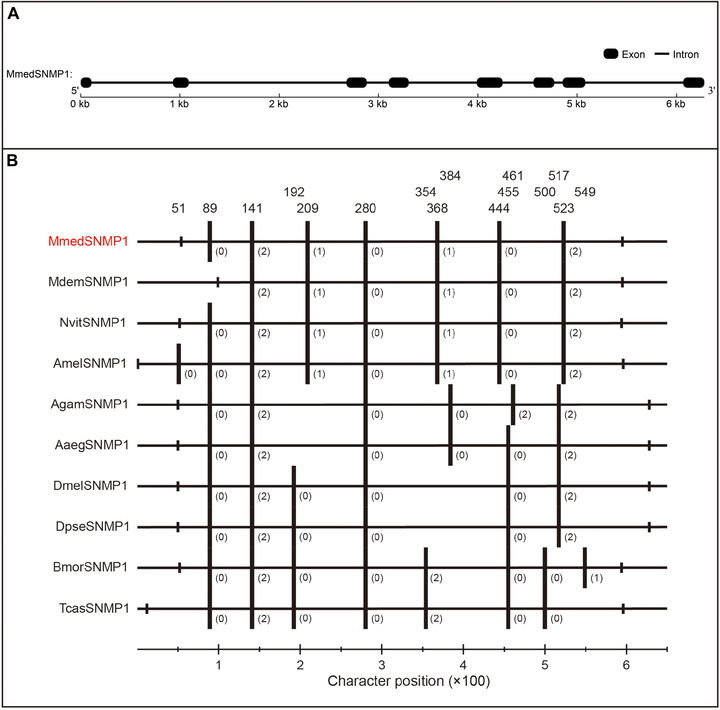
Sensory neuron membrane proteins (SNMPs), homologs of the human fatty acid transport protein CD36 family, are observed to play a significant role in chemoreception, especially in detecting sex pheromone in Drosophila and some lepidopteran species. In the current study, two full-length SNMP transcripts, MmedSNMP1 and MmedSNMP2, were identified in the parasitoid Microplitis mediator (Hymenoptera: Braconidae). Quantitative real-time polymerase chain reaction analysis showed that the expression of MmedSNMP1 was significantly higher in antennae than in other tissues of both sexes. In addition, the MmedSNMP1 transcript was increased dramatically in newly emerged adults and there were no significant differences between adults with or without mating and parasitic experiences. However, compared with MmedSNMP1, the expression of MmedSNMP2 was widely found in various tissues, significantly increased at half-pigmented pupae stage and remained at a relatively constant level during the following developmental stages. It was found that MmedSNMP1 contained eight exons and seven introns, which was highly conserved compared with other insect species. In situ hybridization assay demonstrated that MmedSNMP1 transcript was distributed widely in antennal flagella. Among selected chemosensory genes (odorant binding protein, odorant receptor, and ionotropic receptor genes), MmedSNMP1 only partially overlapped with MmedORco in olfactory sensory neurons of antennae. Subsequent immunolocalization results further indicated that MmedSNMP1 was mainly expressed in sensilla placodea of antennae and possibly involved in perceiving plant volatiles and sex pheromones. These findings lay a foundation for further investigating the roles of SNMPs in the chemosensation of parasitoids.
感觉神经元膜蛋白(SNMPs)是人类脂肪酸转运蛋白 CD36 家族的同源物,被观察到在化学感受中发挥重要作用,特别是在果蝇和一些鳞翅目物种中检测性信息素。在本研究中,在寄生蜂 Mediator(膜翅目:Braconidae)中鉴定出两个全长 SNMP 转录本 MmedSNMP1 和 MmedSNMP2。定量实时聚合酶链反应分析表明,MmedSNMP1 在两性触角中的表达均显著高于其他组织。此外,MmedSNMP1 转录本在新出现的成虫中急剧增加,并且有无交配和寄生经验的成虫之间没有显著差异。然而,与 MmedSNMP1 相比,MmedSNMP2 的表达广泛存在于各种组织中,在半色素化蛹期显著增加,并在随后的发育阶段保持相对恒定的水平。发现 MmedSNMP1 包含 8 个外显子和 7 个内含子,与其他昆虫物种高度保守。原位杂交分析表明,MmedSNMP1 转录本广泛分布在触角鞭节中。在所选择的化学感觉基因(气味结合蛋白、气味受体和离子型受体基因)中,MmedSNMP1 仅与触角嗅觉感觉神经元中的 MmedORco 部分重叠。随后的免疫定位结果进一步表明,MmedSNMP1 主要表达在触角的感觉毛基板中,可能参与感知植物挥发物和性信息素。这些发现为进一步研究 SNMPs 在寄生蜂的化学感觉中的作用奠定了基础。