Chen Ying, Zheng Xiaozhen, Wang Ying, Song Junjie
Department of Anesthesiology, The First Affiliated Hospital of Henan University, Kaifeng, Henan 475000, P.R. China.
Exp Ther Med. 2019 Mar;17(3):1771-1775. doi: 10.3892/etm.2018.7120. Epub 2018 Dec 20.
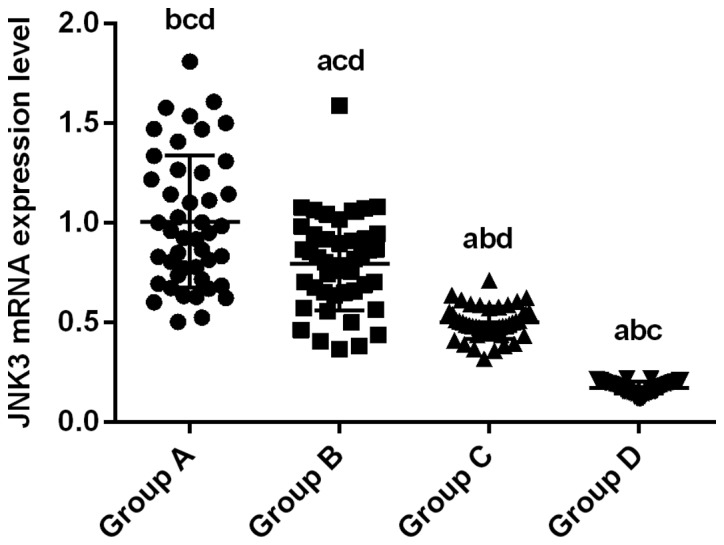
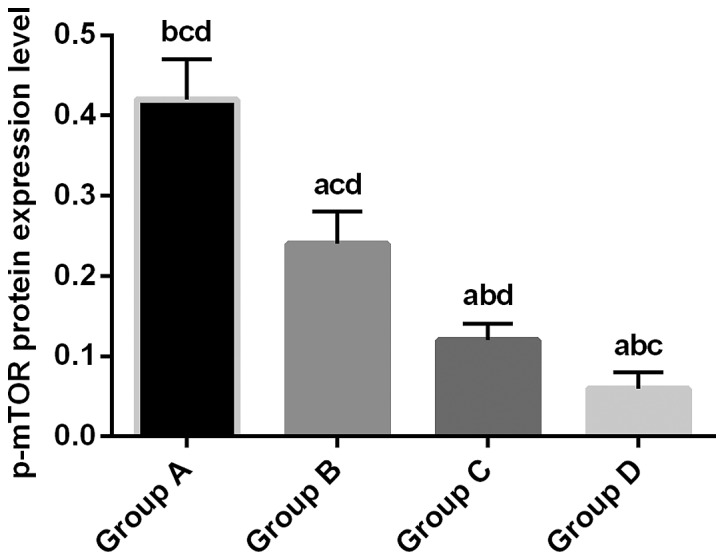
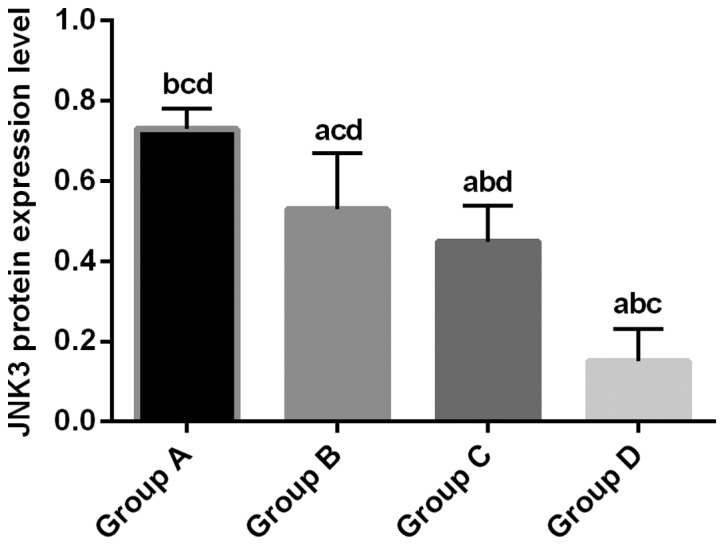
Effect of PI3K/Akt/mTOR signaling pathway on the expression of JNK3 in Parkinsonian rats was investigated. A total of 200 rats were used for Parkinson's disease (PD) modeling and 180 models were successfully established. Rats were randomly divided into four groups including A, B, C, and D, 45 in each group. Group A was control group and no inhibitor was given. Group B was given PI3K inhibitor LY294002. Group C was given rapamycin inhibitor rapamycin; and group D was given inhibitor LY294002 and inhibitor rapamycin. JNK3 mRNA expression was detected by RT-qPCR and expression of p-mTOR protein and JNK3 protein was detected by western blot analysis. Expression level of JNK3 mRNA and protein in groups C and D was significantly lower than that in group B (P<0.01). Expression level of JNK3 mRNA and protein in group D was significantly lower than that in group C (P<0.01). Relative expression level of p-mTOR protein in groups C and D was significantly lower than that in group B (P<0.01). Relative expression level of JNK3 protein in group D was significantly lower than that in group C (P<0.01). Pearson's correlation analysis showed that expression of JNK3 mRNA was positively correlated with the expression of JNK3 protein and Pearson's correlation coefficient was 0.98 (P<0.01). There was also a positive correlation between the expression of JNK3 mRNA and the expression of p-mTOR protein and Pearson's correlation coefficient was 0.95 (P<0.01). Expression of JNK3 protein was positively correlated with the expression of p-mTOR protein, and the Pearson's correlation coefficient was 0.93 (P<0.01). Inhibition of PI3K/Akt/mTOR signaling pathway is negatively correlated with the expression of JNK3. Inhibition of PI3K-Akt-mTOR signaling pathway leads to a decrease in the expression of JNK3, which protects dopaminergic neurons and improves PD.
研究PI3K/Akt/mTOR信号通路对帕金森病大鼠中JNK3表达的影响。总共200只大鼠用于帕金森病(PD)建模,成功建立了180个模型。大鼠随机分为A、B、C、D四组,每组45只。A组为对照组,未给予抑制剂。B组给予PI3K抑制剂LY294002。C组给予雷帕霉素抑制剂雷帕霉素;D组给予抑制剂LY294002和抑制剂雷帕霉素。通过RT-qPCR检测JNK3 mRNA表达,通过蛋白质免疫印迹分析检测p-mTOR蛋白和JNK3蛋白的表达。C组和D组中JNK3 mRNA和蛋白的表达水平显著低于B组(P<0.01)。D组中JNK3 mRNA和蛋白的表达水平显著低于C组(P<0.01)。C组和D组中p-mTOR蛋白的相对表达水平显著低于B组(P<0.01)。D组中JNK3蛋白的相对表达水平显著低于C组(P<0.01)。Pearson相关性分析表明,JNK3 mRNA的表达与JNK3蛋白的表达呈正相关,Pearson相关系数为0.98(P<0.01)。JNK3 mRNA的表达与p-mTOR蛋白的表达之间也存在正相关,Pearson相关系数为0.95(P<0.01)。JNK3蛋白的表达与p-mTOR蛋白的表达呈正相关,Pearson相关系数为0.93(P<0.01)。PI3K/Akt/mTOR信号通路的抑制与JNK3的表达呈负相关。抑制PI3K-Akt-mTOR信号通路导致JNK3表达降低,从而保护多巴胺能神经元并改善帕金森病。