Bhat Nazir Ahmad, Jeri Licha, Karmakar Dolly, Mipun Puranjoy, Bharali Pankaj, Sheikh Nilofer, Nongkynrih Chester John, Kumar Yogendra
Centre for Advanced Studies in Botany, North-Eastern Hill University, Shillong, 793022, Meghalaya, India.
Department of Botany, University of Science and Technology (USTM), Ri-Bhoi, 793101, Meghalaya, India.
Heliyon. 2023 Jul 13;9(7):e18214. doi: 10.1016/j.heliyon.2023.e18214. eCollection 2023 Jul.
For generations, the inhabitants of Meghalaya have relied on medicinal plants to maintain the health of their livestock and treat various illnesses that may afflict their animals. Due to the lack of survey for use and documentation, these plants have never been undertaken. Therefore, it is imperative to explore the diversity, utilization, and phytochemical profile of these plants and quantitatively analyse the data to identify important medicinal plants. By doing so, we can better understand the potential of these plants for developing novel drugs.
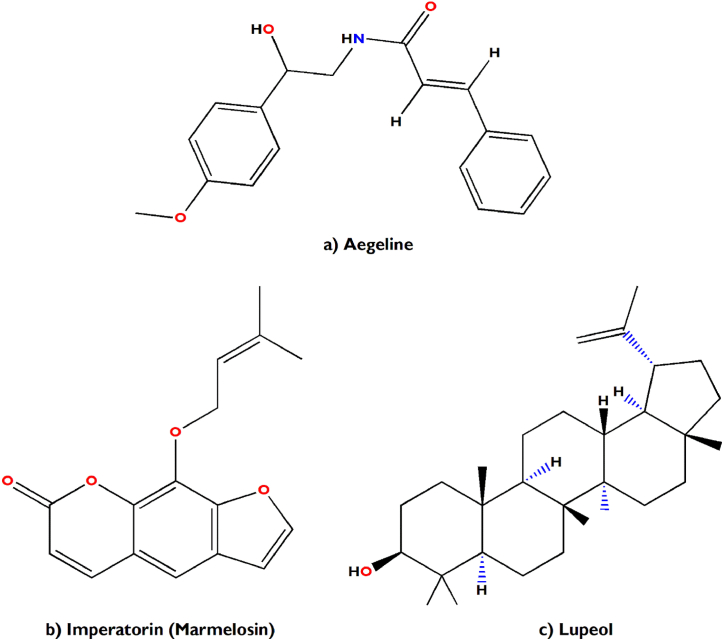
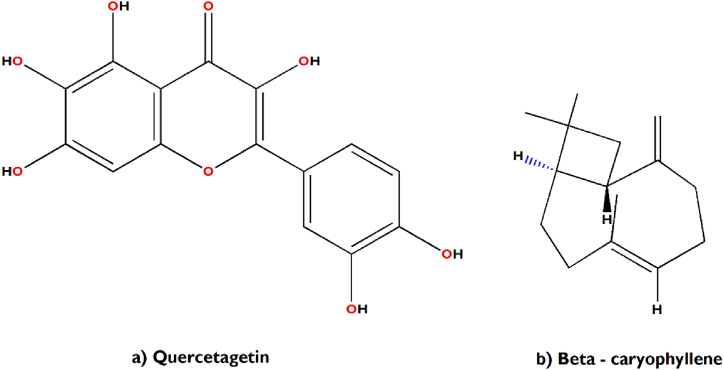
Frequent field trips were made for the collection of ethnoveterinary data of medicinal plants from local animal-keepers, traditional healers (THs) and inhabitants of different age groups. This information was gathered through semi-structured interviews, individual discussions, direct field-use observation, and questionnaires. A total of 52 informants (35 females and 17 males) were interviewed from seven rural villages and the information obtained from them were quantitatively analysed using the informant consensus factor (ICF), and fidelity level (FL). Additionally, for each documented plant, available published literature was extensively surveyed to identify the presence of bioactive chemical compounds responsible for their therapeutic effects.
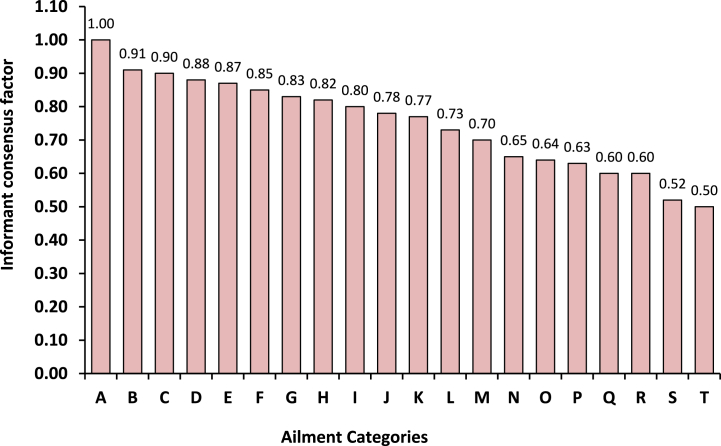
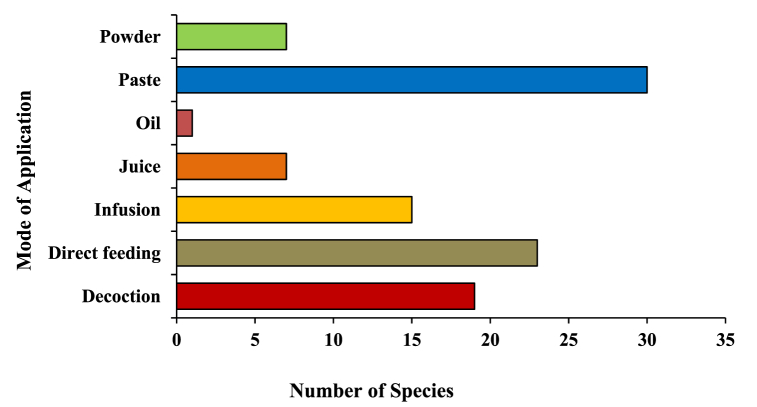
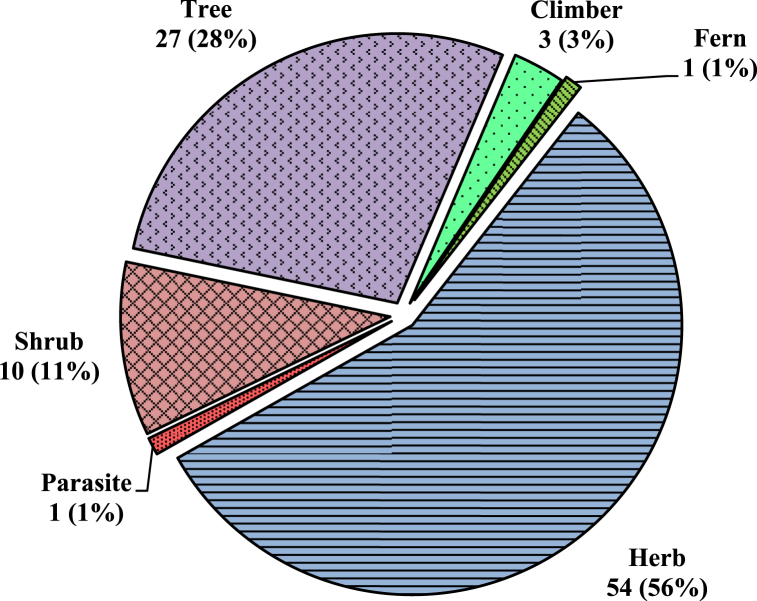
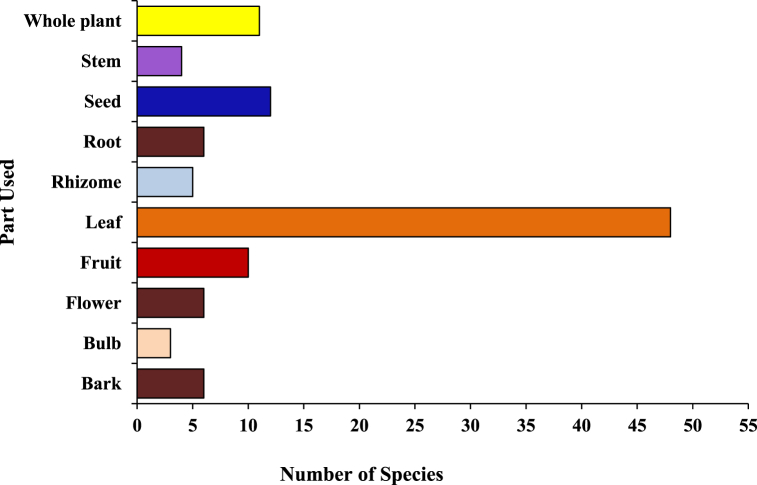
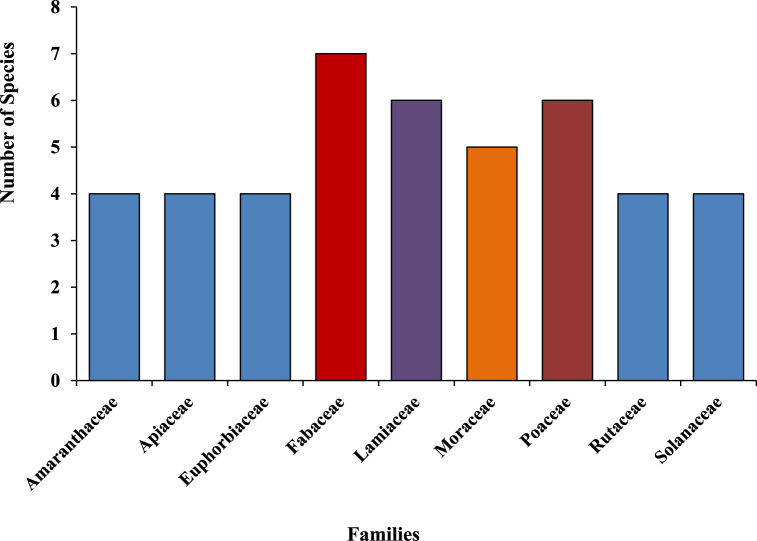
During the present study, a total 96 plants, distributed into 87 genera and 43 families were identified and recorded for their use in ethnoveterinary practices against more than 25 diseases. Out of the recorded plant species, the Fabaceae family was found to be the most dominant with seven species, followed by Poaceae and Lamiaceae with six species each, and Moraceae with five species. The leaves (50.00%) and seeds (12.50%) were the most frequently used plant parts, while the paste (30 species) was the common mode of application. Correa exhibited a fidelity level (FL) of 100% for indigestion, while L. had a fidelity level of 94.11% for wound treatment, making them the most promising candidates for further study. The highest FIC value of 1.00 was recorded for the treatment of neurological disorder (1.00), followed by foot and mouth disease (FIC 0.91), which depicted that some species were frequently utilized to treat multiple livestock ailments.
The study presents trustworthy information about medicinal plants and their associated indigenous ethnoveterinary knowledge. It has been scientifically proven that these plants contain bioactive compounds responsible for their therapeutic properties. However, this knowledge is in danger of being lost due to factors like socioeconomic changes, environmental and technological alterations, and lack of interest from younger generations. Therefore, it is essential to document this empirical folklore knowledge systematically and take measures to protect and conserve it.
几代以来,梅加拉亚邦的居民一直依靠药用植物来维持家畜健康,并治疗可能折磨其动物的各种疾病。由于缺乏对其用途的调查和记录,这些植物从未得到研究。因此,必须探索这些植物的多样性、利用情况和植物化学特征,并对数据进行定量分析,以确定重要的药用植物。通过这样做,我们可以更好地了解这些植物在开发新药方面的潜力。
频繁进行实地考察,从当地动物饲养者、传统治疗师(THs)和不同年龄组的居民那里收集药用植物的民族兽医学数据。这些信息通过半结构化访谈、个人讨论、直接实地使用观察和问卷调查收集。总共从七个乡村采访了52名信息提供者(35名女性和17名男性),并使用信息提供者共识因子(ICF)和可信度水平(FL)对从他们那里获得的信息进行定量分析。此外,对于每种记录的植物,广泛查阅现有的已发表文献,以确定负责其治疗效果的生物活性化合物的存在。
在本研究中,共鉴定并记录了96种植物,分布在87个属和43个科中,用于民族兽医学实践治疗超过25种疾病。在所记录的植物物种中,豆科最为突出,有7种,其次是禾本科和唇形科,各有6种,桑科有5种。叶子(50.00%)和种子(12.50%)是最常用的植物部位,而糊剂(30种)是常见的应用方式。Correa对消化不良的可信度水平(FL)为100%,而L.对伤口治疗的可信度水平为94.11%,使其成为进一步研究最有希望的候选植物。治疗神经系统疾病的信息共识因子(FIC)值最高,为1.00,其次是口蹄疫(FIC 0.91),这表明一些物种经常被用于治疗多种家畜疾病。
该研究提供了关于药用植物及其相关本土民族兽医学知识的可靠信息。科学证明,这些植物含有负责其治疗特性的生物活性化合物。然而,由于社会经济变化、环境和技术变革以及年轻一代缺乏兴趣等因素,这些知识有失传的危险。因此,有必要系统地记录这一经验性民俗知识,并采取措施保护和保存它。