Aazami Hossein, Seif Farhad, Ghalehbaghi Babak, Mohebbi Alireza, Ahmadi Aslan, Babaheidarian Pegah, Zinat Entezami Kobra, Khoshmirsafa Majid, Ghalehbaghi Sahand, Falak Reza
Department of Immunology, School of Medicine, Iran University of Medical Sciences, Tehran, Iran.
Immunology Research Center, Institute of Immunology and Infectious Diseases, Iran University of Medical Sciences, Tehran, Iran.
Med J Islam Repub Iran. 2018 Sep 30;32:94. doi: 10.14196/mjiri.32.94. eCollection 2018.
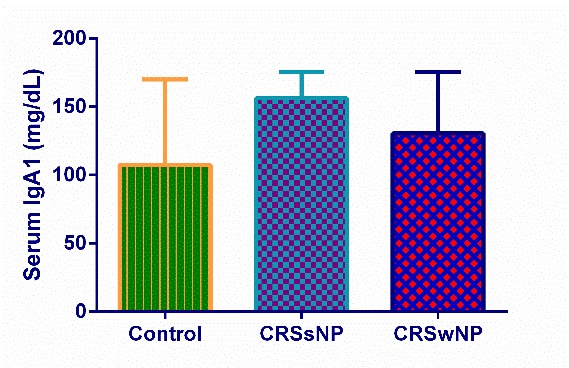
Different inflammatory mechanisms take part in the immunopathogenesis of chronic rhinosinusitis (CRS). Immunoglobulin (Ig) A is the first-line defense in the airway tracts and other mucosal sites, but little is reported regarding its serum level in CRS patients. The purpose of current study is to determine the serum levels of total IgA, and its subclasses (IgA1, and IgA2) in CRS with nasal polyps (CRSwNP), CRS without nasal polyps (CRSsNP), and control groups. In this case-control study the serum levels of total IgA and IgA subclasses were determined by Nephelometry and ELISA methods, respectively. The difference of the median concentrations was analyzed with the Kruskal-Wallis test. Collected data were analyzed using SPSS and presented by GraphPad Prism software. A total of 10 CRSwNP patient, 10 CRSsNP patients and 10 healthy controls participated in our study. The mean age of the groups were 38.2±12.6, 25.6±10.54, and 30.1±9.5, respectively. The concentrations of total IgA were 156(120-165), 165 (149-173), and 172 (152.8-184.3) mg/dl, respectively. The concentrations of IgA1 were 107 (77.9-169.9), 156.1(112.8-175.6), and 130.4 (118.8- 175.2) mg/dl, respectively. The concentrations of IgA2 were 26.11 (18.41-38.11), 26.96 (15.48-38.39), and 23.2 (18.42-31.78) mg/dl, respectively. There was no significant difference in total IgA (p=0.120), IgA1 (p=0.397) and IgA2 (p=0.925) serum levels among three groups. Our study showed there is no difference in total IgA and IgA subclasses in the serum of CRS patients in comparison to healthy controls.
不同的炎症机制参与了慢性鼻窦炎(CRS)的免疫发病机制。免疫球蛋白(Ig)A是气道和其他黏膜部位的一线防御,但关于CRS患者血清水平的报道较少。本研究的目的是测定伴鼻息肉的CRS(CRSwNP)、不伴鼻息肉的CRS(CRSsNP)和对照组中总IgA及其亚类(IgA1和IgA2)的血清水平。在这项病例对照研究中,总IgA和IgA亚类的血清水平分别通过散射比浊法和酶联免疫吸附测定法测定。中位数浓度的差异采用Kruskal-Wallis检验进行分析。收集的数据使用SPSS进行分析,并由GraphPad Prism软件呈现。共有10例CRSwNP患者、10例CRSsNP患者和10名健康对照参与了我们的研究。各组的平均年龄分别为38.2±12.6、25.6±10.54和30.1±9.5。总IgA的浓度分别为156(120 - 165)、165(149 - 173)和172(152.8 - 184.3)mg/dl。IgA1的浓度分别为107(77.9 - 169.9)、156.1(112.8 - 175.6)和130.4(118.8 - 175.2)mg/dl。IgA2的浓度分别为26.11(18.41 - 38.11)、26.96(15.48 - 38.39)和23.2(18.42 - 31.78)mg/dl。三组之间总IgA(p = 0.120)、IgA1(p = 0.397)和IgA2(p = 0.925)的血清水平无显著差异。我们的研究表明,与健康对照相比,CRS患者血清中的总IgA和IgA亚类无差异。