Overgaard Rune V, Delff Philip H, Petri Kristin C C, Anderson Thomas W, Flint Anne, Ingwersen Steen H
Quantitative Clinical Pharmacology, Novo Nordisk A/S, Søborg, Denmark.
Development PK/PD, Novo Nordisk A/S, Måløv, Denmark.
Diabetes Ther. 2019 Apr;10(2):649-662. doi: 10.1007/s13300-019-0581-y. Epub 2019 Feb 20.
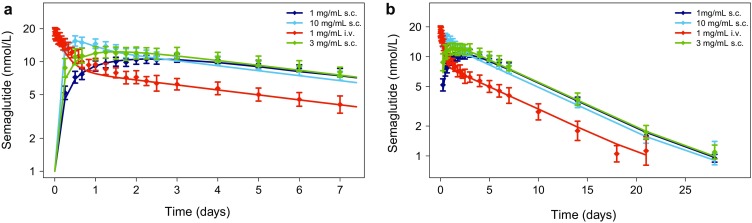
The aim of the present analysis was to characterise the absorption, distribution and elimination of semaglutide by means of population pharmacokinetic (PK) models using data from nine clinical pharmacology trials conducted in both healthy subjects and those with type 2 diabetes.
Data were obtained from trials with subcutaneous and intravenous administration of semaglutide that utilised frequent PK sampling and included a total of 353 subjects with 10,573 concentration values.
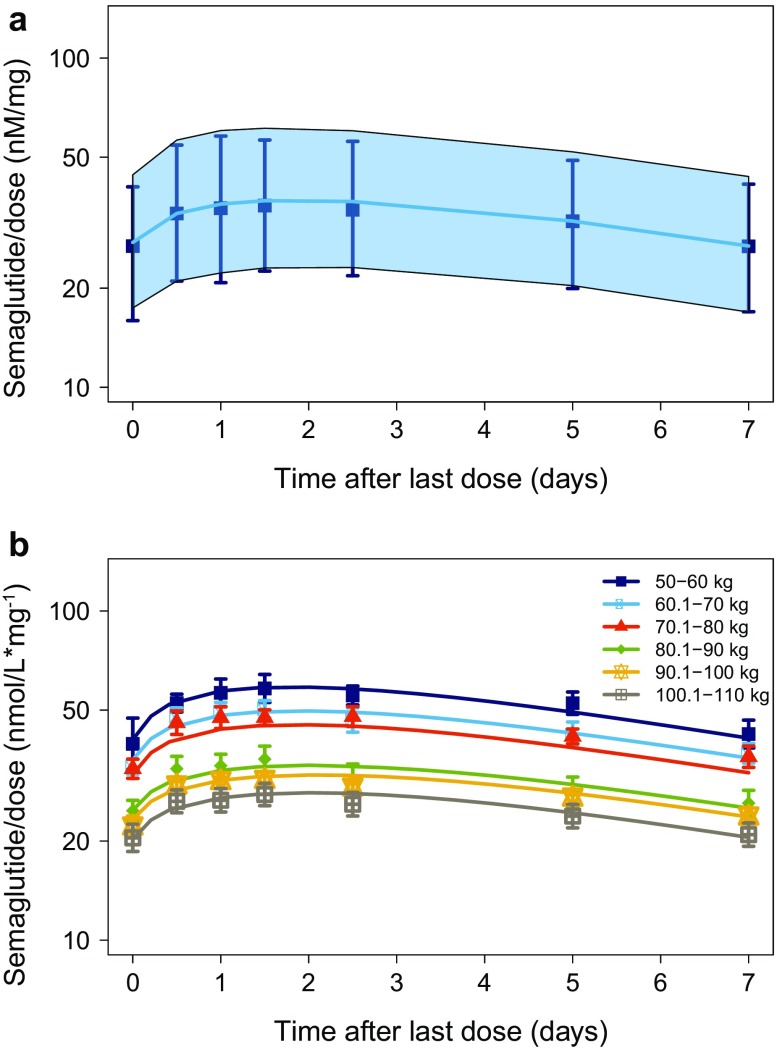
Semaglutide PK properties across trials, drug product strengths and populations were well characterised by a two-compartment model with first-order absorption and elimination. For a typical subject with type 2 diabetes, clearance was estimated to be 0.0348 L/h [95% confidence interval (CI) 0.0327-0.0369 L/h], and the central and peripheral volumes were estimated to be 3.59 L (95% CI 3.28-3.90 L) and 4.10 L (95% CI 3.78-4.42 L), respectively (i.e. a total volume of distribution of 7.7 L). Interindividual variation was low (~ 15%) for both clearance and volumes of distribution, with low residual error (< 5%). Clearance and the total volume of distribution were approximately proportional to body weight. Minor differences were identified between healthy subjects and subjects with type 2 diabetes with respect to clearance and absorption rate, and between injection sites with respect to bioavailability.
A novel two-compartment model was developed to provide the general characteristics of semaglutide absorption following subcutaneous administration, and of distribution and elimination across administration routes. Semaglutide PK was shown to be predictable across populations and administration routes and within subjects, and was primarily influenced by body weight.
Novo Nordisk, Bagsværd, Denmark.
本分析的目的是通过群体药代动力学(PK)模型,利用在健康受试者和2型糖尿病患者中进行的9项临床药理学试验的数据,来描述司美格鲁肽的吸收、分布和消除特征。
数据来自司美格鲁肽皮下和静脉给药试验,这些试验采用了频繁的PK采样,共纳入353名受试者,获得了10573个浓度值。
采用具有一级吸收和消除的二室模型,很好地描述了司美格鲁肽在不同试验、药品规格和人群中的PK特性。对于典型的2型糖尿病受试者,清除率估计为0.0348 L/h [95%置信区间(CI)0.0327 - 0.0369 L/h],中央室和外周室体积分别估计为3.59 L(95% CI 3.28 - 3.90 L)和4.10 L(95% CI 3.78 - 4.42 L)(即分布总体积为7.7 L)。清除率和分布体积的个体间变异较低(约15%),残留误差较低(<5%)。清除率和分布总体积与体重大致成正比。在清除率和吸收率方面,健康受试者与2型糖尿病受试者之间以及在生物利用度方面,不同注射部位之间存在细微差异。
开发了一种新型二室模型,以提供皮下给药后司美格鲁肽吸收以及跨给药途径的分布和消除的一般特征。结果表明,司美格鲁肽的PK在不同人群、给药途径和个体内是可预测的,并且主要受体重影响。
丹麦 Bagsværd 的诺和诺德公司。