Huang Yung-Hsing, Vakili Mohammad Reza, Molavi Ommoleila, Morrissey Yuen, Wu Chengsheng, Paiva Igor, Soleimani Amir Hasan, Sanaee Forugh, Lavasanifar Afsaneh, Lai Raymond
Department of Laboratory Medicine and Pathology, University of Alberta, Edmonton, AB T6G 2R3, Canada.
Faculty of Pharmacy and Pharmaceutical Sciences, University of Alberta, Edmonton, AB T6G 2H7, Canada.
Cancers (Basel). 2019 Feb 20;11(2):248. doi: 10.3390/cancers11020248.
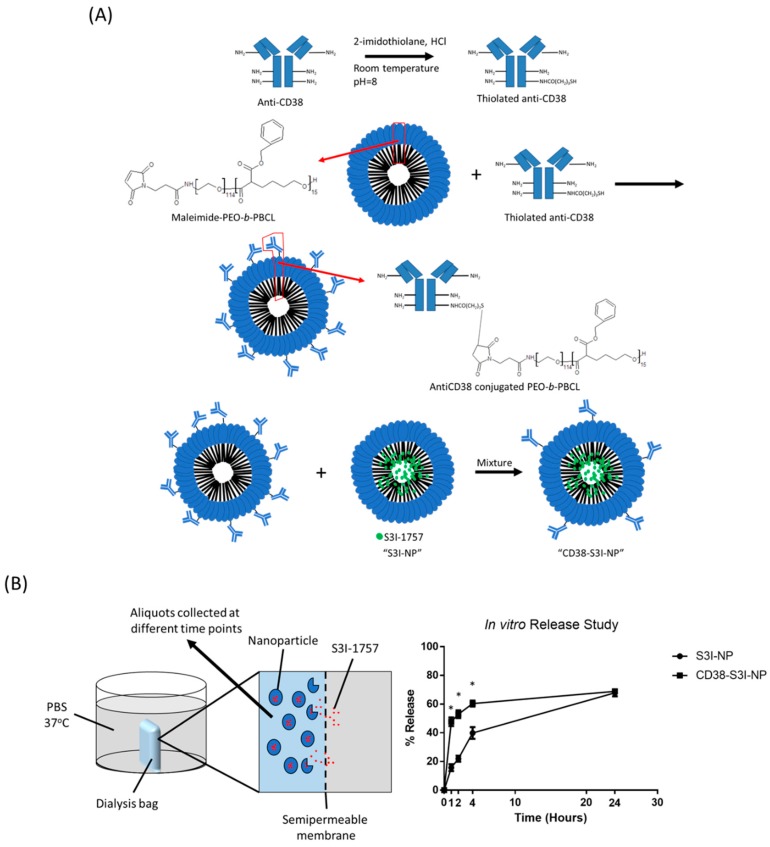
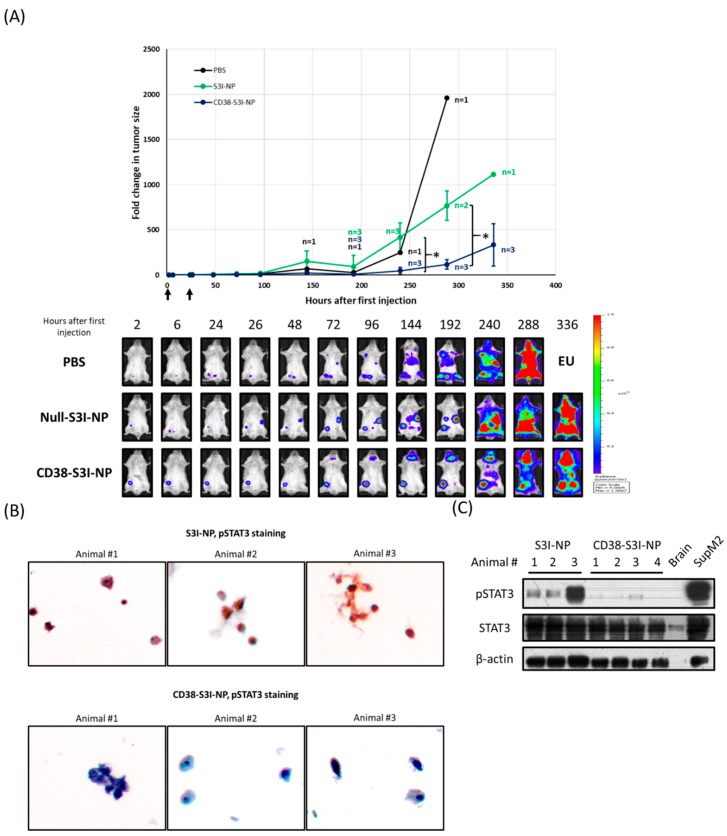
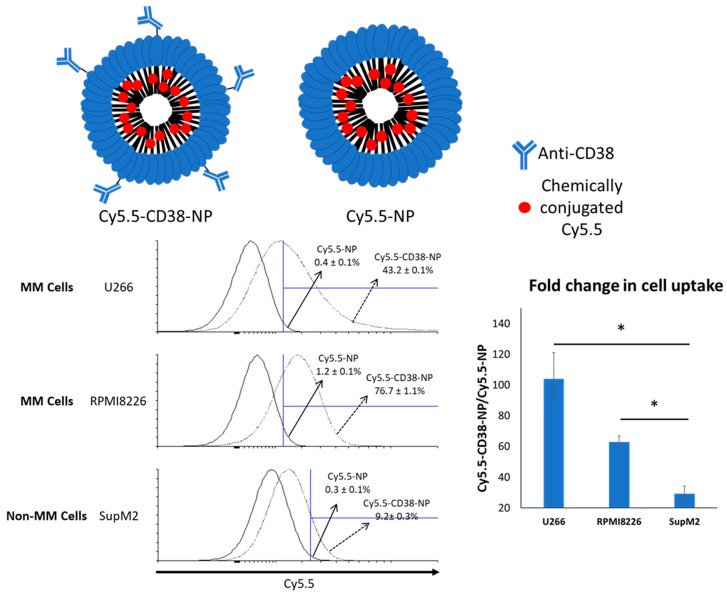
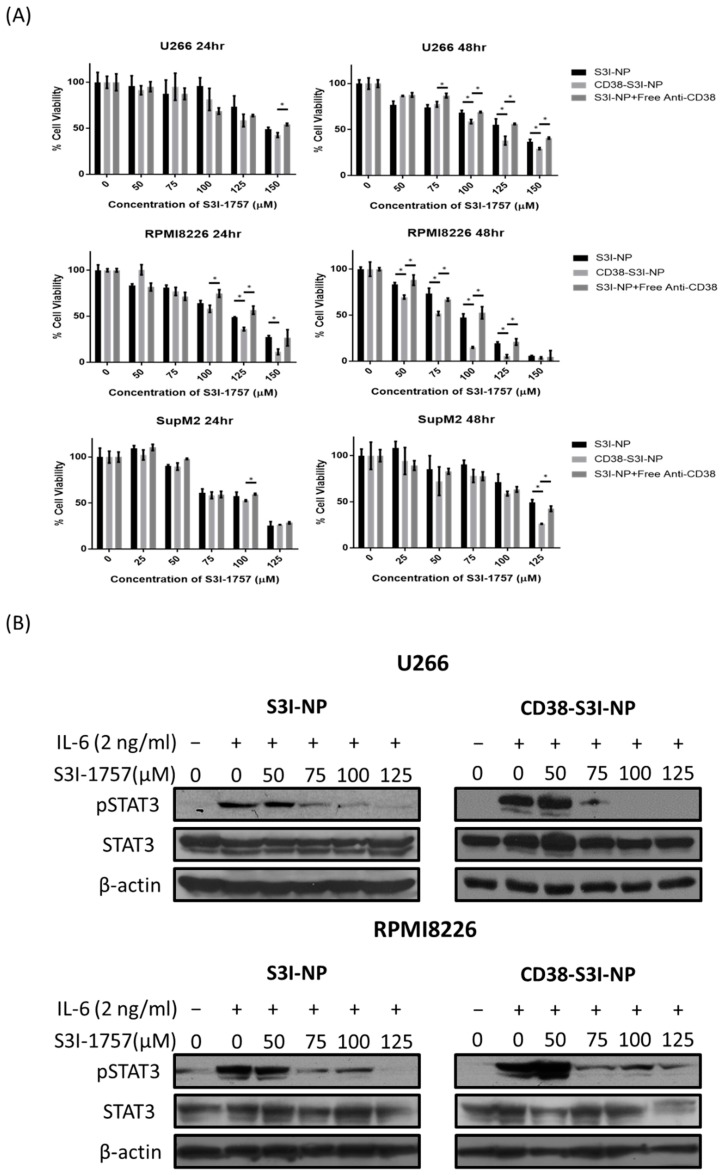
STAT3 is an oncoprotein which has been shown to contribute to drug resistance in multiple myeloma (MM). Nonetheless, the clinical utility of STAT3 inhibitors in treating MM has been limited, partly related to some of their pharmacologic properties. To overcome these challenges, our group had previously packaged STAT3 inhibitors using a novel formulation of nanoparticles (NP) and found encouraging results. In this study, we aimed to further improve the pharmacologic properties of these NP by decorating them with monoclonal anti-CD38 antibodies. NP loaded with S3I-1757 (a STAT3 inhibitor), labeled as S3I-NP, were generated. S3I-NP decorated with anti-CD38 (labeled as CD38-S3I-NP) were found to have a similar nanoparticular size, drug encapsulation, and loading as S3I-NP. The release of S3I-1757 at 24 h was also similar between the two formulations. Using Cy5.5 labeling of the NP, we found that the decoration of anti-CD38 on these NP significantly increased the cellular uptake by two MM cell lines ( < 0.001). Accordingly, CD38-S3I-NP showed a significantly lower inhibitory concentration at 50% (IC50) compared to S3I-NP in two IL6-stimulated MM cell lines ( < 0.001). In a xenograft mouse model, CD38-S3I-NP significantly reduced the tumor size by 4-fold compared to S3I-NP on day 12 after drug administration ( = 0.006). The efficacy of CD38-S3I-NP in suppressing STAT3 phosphorylation in the xenografts was confirmed by using immunocytochemistry and Western blot analysis. In conclusion, our study suggests that the decoration of anti-CD38 on NP loaded with STAT3 inhibitors can further improve their therapeutic effects against MM.
信号转导和转录激活因子3(STAT3)是一种癌蛋白,已被证明与多发性骨髓瘤(MM)的耐药性有关。尽管如此,STAT3抑制剂在治疗MM中的临床应用一直有限,部分原因与它们的一些药理特性有关。为了克服这些挑战,我们小组之前使用一种新型纳米颗粒(NP)制剂包装了STAT3抑制剂,并取得了令人鼓舞的结果。在本研究中,我们旨在通过用单克隆抗CD38抗体修饰这些NP来进一步改善它们的药理特性。制备了负载S3I-1757(一种STAT3抑制剂)的NP,标记为S3I-NP。发现用抗CD38修饰的S3I-NP(标记为CD38-S3I-NP)与S3I-NP具有相似的纳米颗粒大小、药物包封率和载药量。两种制剂在24小时时S3I-1757的释放情况也相似。通过对NP进行Cy5.5标记,我们发现这些NP上抗CD38的修饰显著增加了两种MM细胞系的细胞摄取(P<0.001)。因此,在两种白细胞介素6刺激的MM细胞系中,与S3I-NP相比,CD38-S3I-NP的50%抑制浓度(IC50)显著更低(P<0.001)。在异种移植小鼠模型中,给药后第12天,与S3I-NP相比,CD38-S3I-NP使肿瘤大小显著缩小了4倍(P=0.006)。通过免疫细胞化学和蛋白质印迹分析证实了CD38-S3I-NP在异种移植瘤中抑制STAT3磷酸化的疗效。总之,我们的研究表明,在负载STAT3抑制剂的NP上修饰抗CD38可以进一步提高它们对MM的治疗效果。