Centre for Health and Development (CHAD), Staffordshire University, Brindley Building, Leek Road, Stoke-on-Trent, ST4 2DF, England.
Public Health England, Skipton House, 80 London Road, London, SE1 6LH, England.
BMC Public Health. 2019 Feb 21;19(1):224. doi: 10.1186/s12889-019-6540-8.
NHS Health Check is a primary prevention programme offering cardiovascular disease (CVD) risk assessment to adults in England aged 40-74. Uptake remains a challenge and invitation method is a strong predictor of uptake. There is evidence of low uptake when using invitation letters. Telephone invitations might increase uptake, but are not widely used. We explored the potential to improve uptake through personalising letters to patient's CVD risk, and to compare this with generic letters and telephone invitations.
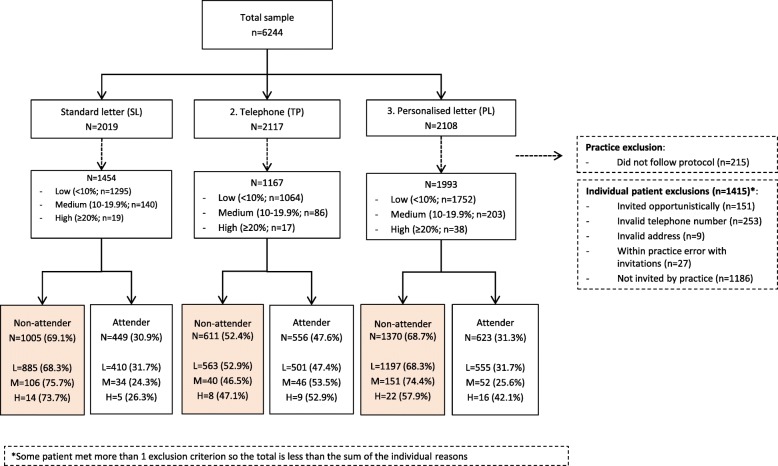
HEalth Check TRial (HECTR) was a three-arm randomised controlled trial in nine general practices in Staffordshire (UK). Eligible patients were randomised to be invited to a NHS Health Check using one of three methods: standard letter (control); telephone invitation; letter personalised to the patient's CVD risk. The primary outcome was attendance/non-attendance. Data were collected on a range of patient- and practice-level factors (e.g., patient socio-demographics, CVD risk, practice size, Health Checks outside usual working hours). Multi-level logistic regression estimated the marginal effects to explore whether invitation method predicted attendance. Invitation costs were collated from practices to estimate cost benefit.
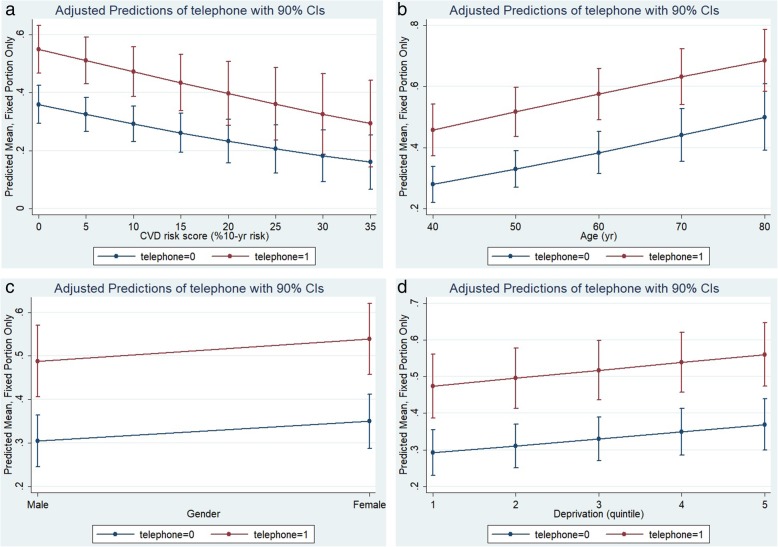
In total, 4614 patients were included in analysis (mean age 50.2 ± 8.0 yr.; 52.4% female). Compared with patients invited by standard letter (30.9%), uptake was significantly higher in those invited by telephone (47.6%, P < .001), but not personalised letter (31.3%, p = .812). In multi-level analysis, compared with the standard letter arm, likelihood of attendance was 18 percentage points higher in the telephone arm and 4 percentage points higher in the personalised letter arm. The effect of telephone calls appeared strongest in patients who were younger and had lower CVD risk. We estimated per 1000 patients invited, risk-personalised letters could result in 40 additional attended Health Checks (at no extra cost) and telephone invitations could result in 180 additional Health Checks at an additional cost of £240.
Telephone invitations should be advocated to address the substantial deficit between current and required levels of NHS uptake, and could be targeted at younger and lower CVD risk adults. Risk-personalised letters should be explored further in a larger sample of high risk individuals.
Registration number: ISRCTN15840751 date of registration: 24/10/2017.
NHS 健康检查是一项针对英格兰 40-74 岁成年人的心血管疾病(CVD)风险评估的初级预防计划。参与率仍然是一个挑战,邀请方式是参与率的一个强有力的预测指标。使用邀请函时,参与率较低。电话邀请可能会增加参与率,但尚未广泛使用。我们探讨了通过针对患者的 CVD 风险个性化信函来提高参与率的潜力,并将其与通用信函和电话邀请进行比较。
HEalth Check TRial(HECTR)是在英国斯塔福德郡的九家全科医生诊所进行的一项三臂随机对照试验。符合条件的患者被随机邀请参加 NHS 健康检查,使用以下三种方法之一:标准信函(对照);电话邀请;根据患者的 CVD 风险个性化的信函。主要结果是出席/未出席。收集了一系列患者和实践层面的因素(例如,患者社会人口统计学,CVD 风险,实践规模,非工作时间的健康检查)的数据。多水平逻辑回归估计了边缘效应,以探讨邀请方法是否可以预测参与率。从实践中收集邀请成本以估算成本效益。
共有 4614 名患者纳入分析(平均年龄 50.2±8.0 岁;52.4%为女性)。与标准信函邀请的患者(30.9%)相比,电话邀请的患者(47.6%,P<.001)和个性化信函邀请的患者(31.3%,p=.812)的参与率明显更高。在多水平分析中,与标准信函组相比,电话组的就诊可能性高 18 个百分点,个性化信函组高 4 个百分点。电话的效果在年龄较小和 CVD 风险较低的患者中似乎更强。我们估计,每邀请 1000 名患者,风险个性化信函可额外增加 40 次参加健康检查(无额外费用),而电话邀请则需额外花费 240 英镑,可额外增加 180 次健康检查。
应提倡使用电话邀请来解决 NHS 参与率与实际所需水平之间存在的巨大差距,并且可以针对年龄较小和 CVD 风险较低的成年人。应在更大的高危人群样本中进一步探讨个性化信函。
注册号:ISRCTN85104614,注册日期:2017 年 10 月 24 日。