Department of Nephrology, Puai Hospital, Tongji Medical College, Huazhong University of Science and Technology, Wuhan, Hubei, 430033, People's Republic of China.
BMC Nephrol. 2019 Feb 21;20(1):63. doi: 10.1186/s12882-019-1232-2.
Hemodialysis patients suffer from a serious threat of cerebrovascular disease. Klotho, as an aging-suppressor gene, contributes to protect on vascular calcification and oxidative stress, which are the risk factors of cerebrovascular disease. The purpose of the present study is to determine the relationship between serum klotho and cerebrovascular disease in patients receiving hemodialysis.
Serum klotho levels of hemodialysis patients were measured by ELISA. Cerebrovascular diseases were diagnosed by CT or MRI scans. The cognitive function of hemodialysis patients with cerebrovascular disease were evaluated with a neuropsychological battery assessing domains of global cognition verbal memory, spatial memory, executive function and verbal fluency.
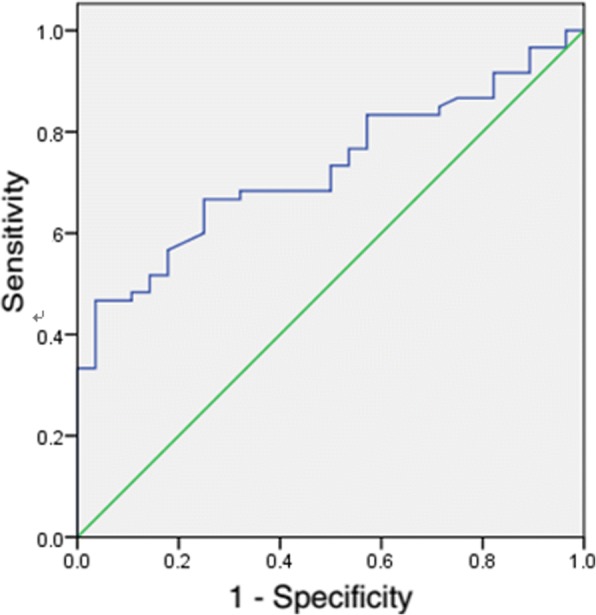
Eighty-eight patients were included, 57 ± 14 years, 63.64% male, 52.27% older than 60 years. Twenty-eight participants had cerebrovascular disease (23 cases had cerebral infarction, 5 cases had cerebral hemorrhage). The average level of serum klotho of all participants was 119.10 ± 47.29 pg/ml. The serum klotho level was significantly associated with cerebrovascular disease in hemodialysis patients (HR(95%CI) = 0.975(0.960-0.990), p = 0.001). The optimal cut-off value of serum klotho for predicting cerebrovascular disease in hemodialysis patients was 137.22 pg/ml, with a specificity of 96.4% and a sensitivity of 46.7%. But serum klotho was not an independent risk factor of cognitive impairment for hemodialysis patients with cerebrovascular disease (HR((95%CI) = 1.002(0.986-1.018), p = 0.776) or with cerebral infarction (HR(95%CI) = 1.005(0.987-1.023), p = 0.576).
The serum klotho level is a potential predictor of cerebrovascular disease in hemodialysis patients, but it is not an independent risk factor of cognitive impairment for hemodialysis patients with cerebrovascular disease.
血液透析患者面临严重的脑血管疾病威胁。Klotho 作为一种衰老抑制基因,有助于保护血管钙化和氧化应激,这是脑血管疾病的危险因素。本研究旨在确定血液透析患者血清 Klotho 与脑血管疾病之间的关系。
采用 ELISA 法测定血液透析患者血清 Klotho 水平。脑血管疾病通过 CT 或 MRI 扫描诊断。采用神经心理学成套测验评估脑血管疾病血液透析患者的认知功能,评估领域包括整体认知、言语记忆、空间记忆、执行功能和言语流畅性。
共纳入 88 例患者,年龄 57±14 岁,63.64%为男性,52.27%年龄大于 60 岁。28 例患者患有脑血管疾病(23 例脑梗死,5 例脑出血)。所有参与者的血清 Klotho 平均水平为 119.10±47.29pg/ml。血清 Klotho 水平与血液透析患者的脑血管疾病显著相关(HR(95%CI)=0.975(0.960-0.990),p=0.001)。血清 Klotho 预测血液透析患者脑血管疾病的最佳截断值为 137.22pg/ml,特异性为 96.4%,敏感性为 46.7%。但血清 Klotho 不是血液透析并发脑血管疾病患者认知障碍的独立危险因素(HR(95%CI)=1.002(0.986-1.018),p=0.776)或脑梗死患者(HR(95%CI)=1.005(0.987-1.023),p=0.576)。
血清 Klotho 水平是血液透析患者脑血管疾病的潜在预测指标,但不是血液透析并发脑血管疾病患者认知障碍的独立危险因素。