Wu Cheng-Hsi, Ko Jiunn-Liang, Liao Jiuan-Miaw, Huang Shiang-Suo, Lin Meei-Yn, Lee Ling-Hui, Chang Li-Yu, Ou Chu-Chyn
Department of Family Medicine, Jen-Ai Hospital, Dali, Taichung, Taiwan.
Institute of Medicine, Chung Shan Medical University, Taichung, Taiwan.
Ther Adv Med Oncol. 2019 Feb 12;11:1758835918821021. doi: 10.1177/1758835918821021. eCollection 2019.
There are close links between chemotherapy-induced intestinal mucositis and microbiota dysbiosis. Previous studies indicated that D-methionine was an excellent candidate for a chemopreventive agent. Here, we investigated the effects of D-methionine on cisplatin-induced mucositis.
Male Wistar rats (176-200 g, 6 weeks old) were given cisplatin (5 mg/kg) and treated with D-methionine (300 mg/kg). Histopathological, digestive enzymes activity, oxidative/antioxidant status, proinflammatory/anti-inflammatory cytokines in intestinal tissues were measured. Next-generation sequencing technologies were also performed to investigate the gut microbial ecology.
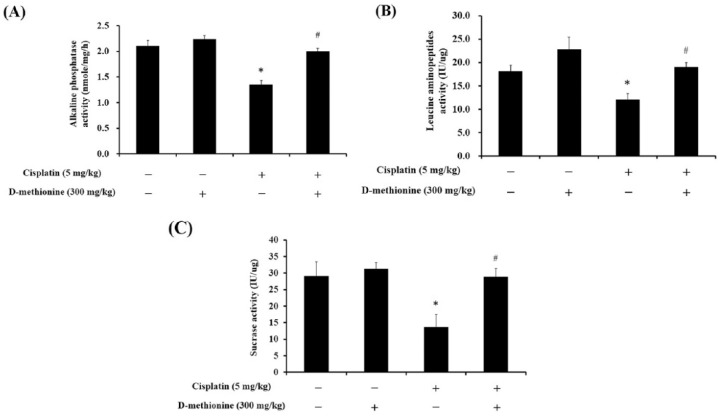
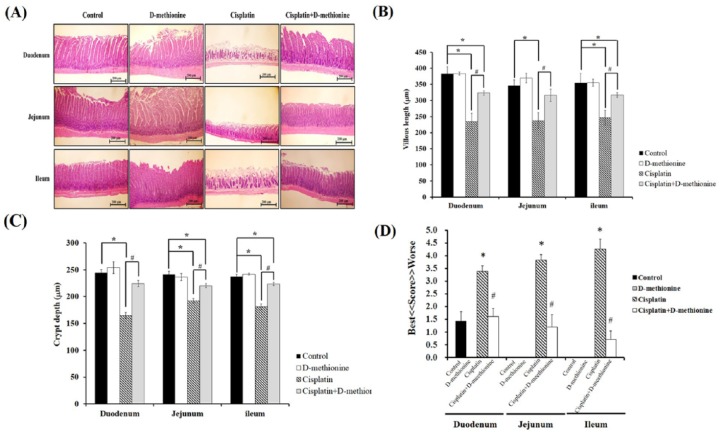
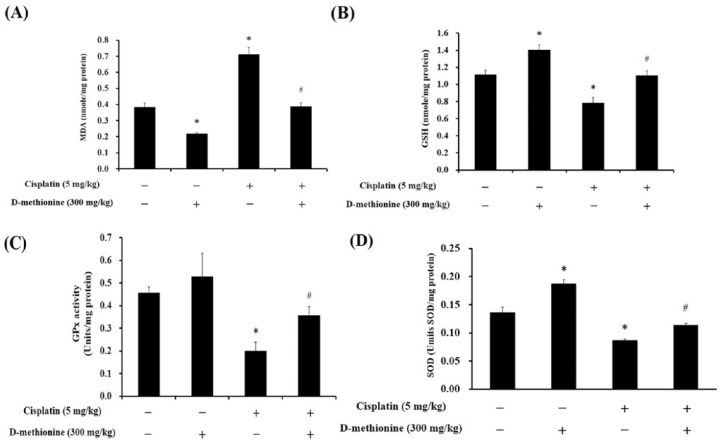
D-methionine administration increased villus length and crypt depth and improved digestive enzyme (leucine aminopeptidase, sucrose and alkaline phosphatase) activities in the brush-border membrane of cisplatin-treated rats ( < 0.05). Furthermore, D-methionine significantly attenuated oxidative stress and inflammatory reaction and increased interleukin-10 levels in cisplatin-induced intestinal mucositis ( < 0.05). Cisplatin administration resulted in high relative abundances of Deferribacteres and Proteobacteria and a low diversity of the microbiota when compared with control groups, D-methionine only and cisplatin plus D-methionine. Cisplatin markedly increased comparative abundances of and , while was almost completely depleted, compared with the control group. There were higher abundances of , Lachnospiraceae, and in cisplatin plus D-methionine rats than in cisplatin rats. D-methionine treatment alone significantly increased the number of .
D-methionine protects against cisplatin-induced intestinal damage through antioxidative and anti-inflammatory effects. By enhancing growth of beneficial bacteria (Lachnospiraceae and ), D-methionine attenuates gut microbiome imbalance caused by cisplatin and maintains gut homeostasis.
化疗诱导的肠道黏膜炎与微生物群失调之间存在密切联系。先前的研究表明,D-蛋氨酸是一种优秀的化学预防剂候选物。在此,我们研究了D-蛋氨酸对顺铂诱导的黏膜炎的影响。
给雄性Wistar大鼠(176 - 200 g,6周龄)注射顺铂(5 mg/kg),并用D-蛋氨酸(300 mg/kg)进行治疗。测量肠道组织的组织病理学、消化酶活性、氧化/抗氧化状态、促炎/抗炎细胞因子。还采用下一代测序技术研究肠道微生物生态学。
给予D-蛋氨酸可增加顺铂处理大鼠刷状缘膜中的绒毛长度和隐窝深度,并改善消化酶(亮氨酸氨肽酶、蔗糖酶和碱性磷酸酶)活性(<0.05)。此外,D-蛋氨酸显著减轻了顺铂诱导的肠道黏膜炎中的氧化应激和炎症反应,并提高了白细胞介素-10水平(<0.05)。与对照组、单独使用D-蛋氨酸组和顺铂加D-蛋氨酸组相比,给予顺铂导致脱铁杆菌门和变形菌门的相对丰度较高,微生物群多样性较低。与对照组相比,顺铂显著增加了[具体菌属1]和[具体菌属2]的相对丰度,而[具体菌属3]几乎完全耗尽。顺铂加D-蛋氨酸组大鼠中的[具体菌属4]、毛螺菌科和[具体菌属5]的丰度高于顺铂组大鼠。单独使用D-蛋氨酸治疗显著增加了[具体菌属6]的数量。
D-蛋氨酸通过抗氧化和抗炎作用预防顺铂诱导的肠道损伤。通过促进有益细菌(毛螺菌科和[具体菌属5])的生长,D-蛋氨酸减轻了顺铂引起的肠道微生物群失衡并维持肠道稳态。