Dermatology Research Centre, The University of Queensland Diamantina Institute, Translational Research Institute, Brisbane, Queensland, Australia.
Centenary Institute of Cancer Medicine and Cell Biology, Camperdown, New South Wales, Australia.
Cancer Med. 2019 Mar;8(3):1186-1196. doi: 10.1002/cam4.1978. Epub 2019 Feb 21.
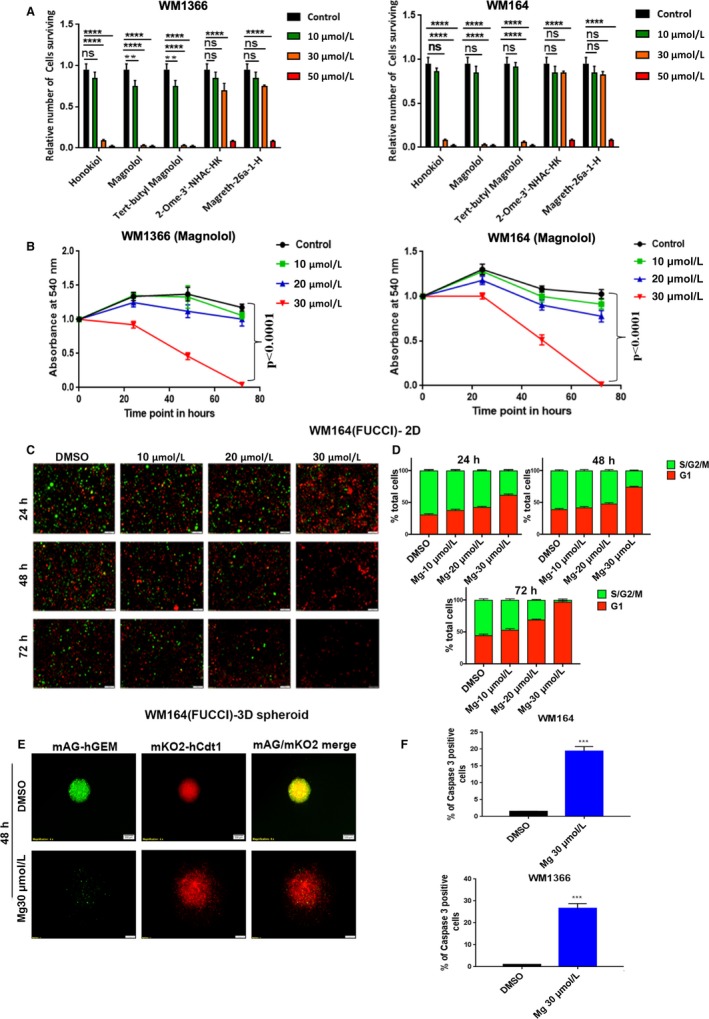
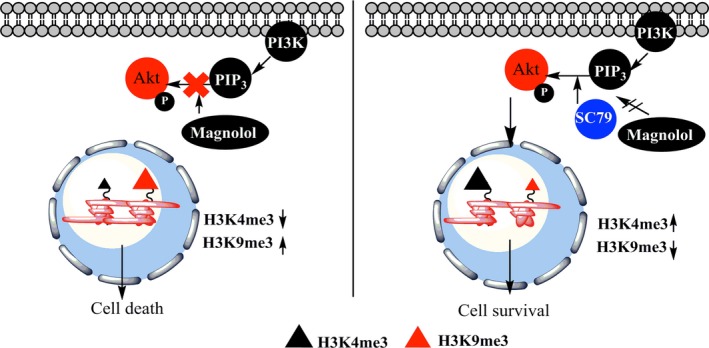
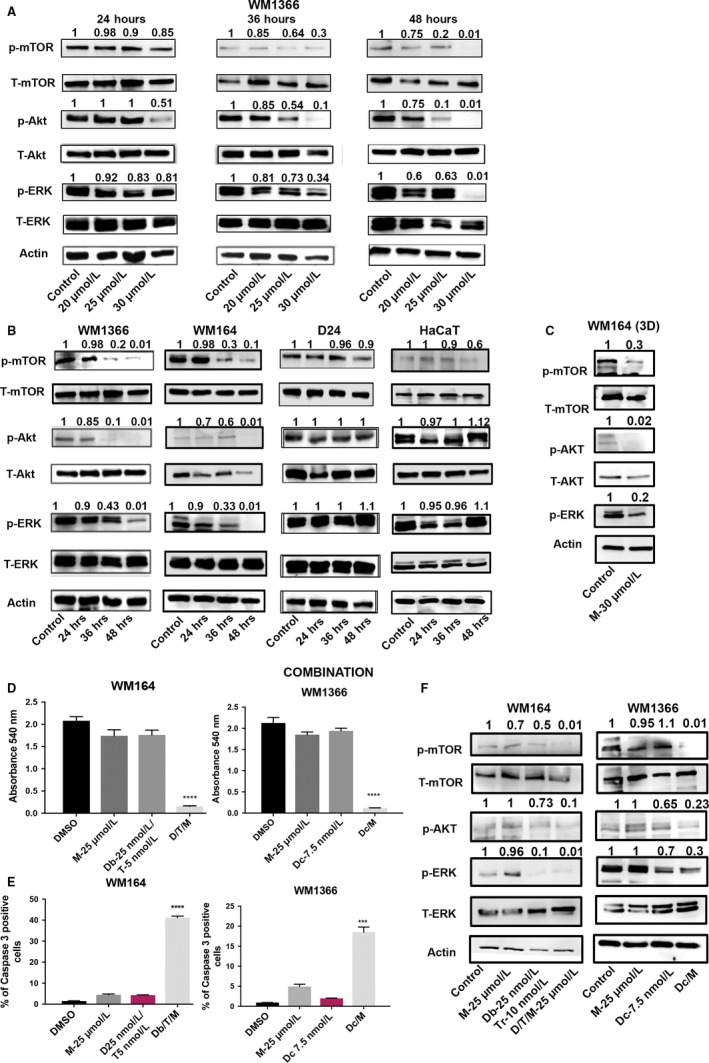
Most BRAF-mutant melanoma patients experience a fulminate relapse after several months of treatment with BRAF/MEK inhibitors. To improve therapeutic efficacy, natural plant-derived compounds might be considered as potent additives. Here, we show that magnolol, a constituent of Magnolia officinalis, induced G1 arrest, apoptosis and cell death in BRAF- and NRAS-mutant melanoma cells at low concentration, with no effect in BRAF- and NRAS wild-type melanoma cells and human keratinocytes. This was confirmed in a 3D spheroid model. The apoptosis-inducing effect of magnolol was completely rescued by activating Akt suggesting a mechanism relying primarily on Akt signaling. Magnolol significantly downregulated the PI3K/Akt pathway which led to a global decrease of the active histone mark H3K4me3. Alongside, the repressive histone mark H3K9me3 was increased as a response to DNA damage. Magnolol-induced alterations of histone modifications are reversible upon activation of the Akt pathway. Magnolol-induced a synergistic effect in combination with either BRAF/MEK inhibitors dabrafenib/trametinib or docetaxel at a lower concentration than usually applied in melanoma patients. Combination of magnolol with targeted therapy or chemotherapy also led to analogous effects on histone marks, which was rescued by Akt pathway activation. Our study revealed a novel epigenetic mechanism of magnolol-induced cell death in melanoma. Magnolol might therefore be a clinically useful addition to BRAF/MEK inhibitors with enhanced efficacy delaying or preventing disease recurrence.
大多数 BRAF 突变型黑色素瘤患者在接受 BRAF/MEK 抑制剂治疗数月后会出现爆发性疾病复发。为了提高治疗效果,可以考虑将天然植物衍生化合物作为有效的添加剂。在这里,我们发现厚朴酚(Magnolia officinalis 的一种成分)在低浓度下可诱导 BRAF 和 NRAS 突变型黑色素瘤细胞发生 G1 期阻滞、凋亡和细胞死亡,而对 BRAF 和 NRAS 野生型黑色素瘤细胞和人角质形成细胞没有影响。这在 3D 球体模型中得到了证实。激活 Akt 可完全挽救厚朴酚诱导的细胞凋亡,这表明其主要依赖 Akt 信号传导。厚朴酚显著下调 PI3K/Akt 通路,导致活性组蛋白标记 H3K4me3 全面减少。与此同时,作为对 DNA 损伤的反应,抑制性组蛋白标记 H3K9me3 增加。在激活 Akt 通路后,厚朴酚诱导的组蛋白修饰改变是可逆的。与 BRAF/MEK 抑制剂 dabrafenib/trametinib 或 docetaxel 联合使用时,厚朴酚在比黑色素瘤患者通常应用的浓度更低的情况下表现出协同作用。厚朴酚与靶向治疗或化疗联合使用也会导致组蛋白标记类似的变化,而这种变化可通过激活 Akt 通路来挽救。我们的研究揭示了厚朴酚诱导黑色素瘤细胞死亡的一种新的表观遗传机制。因此,厚朴酚可能是一种具有增强疗效的临床有用的 BRAF/MEK 抑制剂附加物,可延迟或预防疾病复发。