Department of Nursing and Midwifery, University of the West of England Bristol, Bristol, UK
Department of Nursing and Midwifery, University of the West of England Bristol, Bristol, UK.
Ann Rheum Dis. 2019 Apr;78(4):465-472. doi: 10.1136/annrheumdis-2018-214469. Epub 2019 Feb 6.
To see if a group course delivered by rheumatology teams using cognitive-behavioural approaches, plus usual care, reduced RA fatigue impact more than usual care alone.
Multicentre, 2-year randomised controlled trial in RA adults (fatigue severity6/10, no recent major medication changes). RAFT (Reducing Arthritis Fatigue: clinical Teams using CB approaches) comprises seven sessions, codelivered by pairs of trained rheumatology occupational therapists/nurses. Usual care was Arthritis Research UK fatigue booklet. Primary 26-week outcome fatigue impact (Bristol RA Fatigue Effect Numerical Rating Scale, BRAF-NRS 0-10). Intention-to-treat regression analysis adjusted for baseline scores and centre.
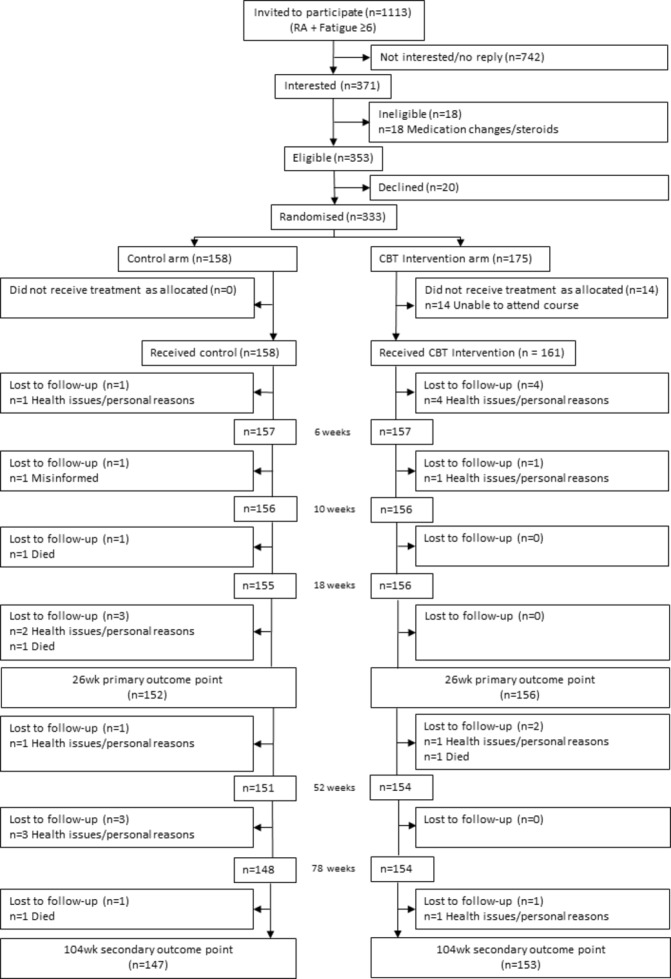
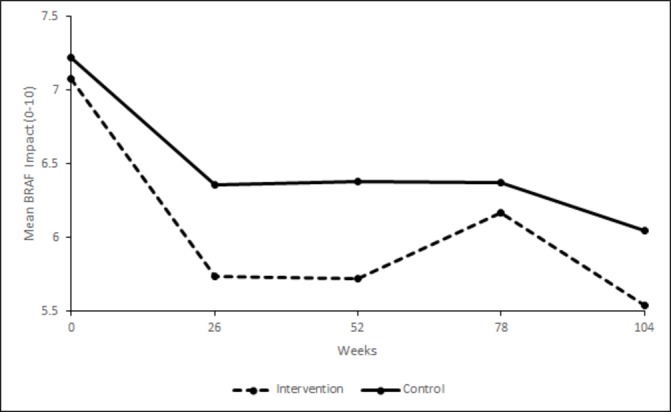
308/333 randomised patients completed 26 week data (156/175 RAFT, 152/158 Control). Mean baseline variables were similar. At 26 weeks, the adjusted difference between arms for fatigue impact change favoured RAFT (BRAF-NRS Effect -0.59, 95% CI -1.11 to -0.06), BRAF Multidimensional Questionnaire (MDQ) Total -3.42 (95% CI -6.44 to -0.39), Living with Fatigue -1.19 (95% CI -2.17 to -0.21), Emotional Fatigue -0.91 (95% CI -1.58 to -0.23); RA Self-Efficacy (RASE, +3.05, 95% CI 0.43 to 5.66) (14 secondary outcomes unchanged). Effects persisted at 2 years: BRAF-NRS Effect -0.49 (95% CI -0.83 to -0.14), BRAF MDQ Total -2.98 (95% CI -5.39 to -0.57), Living with Fatigue -0.93 (95% CI -1.75 to -0.10), Emotional Fatigue -0.90 (95% CI -1.44, to -0.37); BRAF-NRS Coping +0.42 (95% CI 0.08 to 0.77) (relevance of fatigue impact improvement uncertain). RAFT satisfaction: 89% scored 8/10 vs 54% controls rating usual care booklet (p<0.0001).
Multiple RA fatigue impacts can be improved for 2 years by rheumatology teams delivering a group programme using cognitive behavioural approaches.
ISRCTN52709998.
观察由风湿病团队采用认知行为方法提供的团体课程,加上常规护理,是否比单纯常规护理更能减轻类风湿关节炎患者的疲劳影响。
这是一项多中心、为期 2 年的类风湿关节炎成人(疲劳严重程度为 6/10,近期无重大药物变化)随机对照试验。RAFT(减轻关节炎疲劳:临床团队采用 CB 方法)包括 7 个疗程,由经过培训的风湿病作业治疗师/护士二人一组共同提供。常规护理为关节炎研究英国疲劳手册。主要 26 周结局为疲劳影响(布里斯托关节炎疲劳效应数字评定量表,BRAF-NRS 0-10)。意向治疗回归分析调整了基线评分和中心。
308/333 名随机患者完成了 26 周的数据(156/175 RAFT,152/158 对照组)。基线变量的平均值相似。在 26 周时,手臂之间疲劳影响变化的调整差异有利于 RAFT(BRAF-NRS 效应-0.59,95%CI-1.11 至-0.06),BRAF 多维问卷(MDQ)总分-3.42(95%CI-6.44 至-0.39),疲劳生活-1.19(95%CI-2.17 至-0.21),情绪疲劳-0.91(95%CI-1.58 至-0.23);类风湿关节炎自我效能(RASE,+3.05,95%CI 0.43 至 5.66)(14 项次要结局不变)。这些效果在 2 年内持续存在:BRAF-NRS 效应-0.49(95%CI-0.83 至-0.14),BRAF MDQ 总分-2.98(95%CI-5.39 至-0.57),疲劳生活-0.93(95%CI-1.75 至-0.10),情绪疲劳-0.90(95%CI-1.44,至-0.37);BRAF-NRS 应对+0.42(95%CI 0.08 至 0.77)(疲劳影响改善的相关性不确定)。RAFT 满意度:89%的患者评分 8/10,而对照组 54%的患者对常规护理手册评分(p<0.0001)。
风湿病团队提供的团体方案采用认知行为方法,可在 2 年内改善多种类风湿关节炎疲劳影响。
ISRCTN52709998。