Department of Hand Surgery, The First Affiliated Hospital, College of Medicine, Zhejiang University, Hangzhou, Zhejiang, China (mainland).
Department of Rehabilitation, The First Affiliated Hospital, College of Medicine, Zhejiang University, Hangzhou, Zhejiang, China (mainland).
Med Sci Monit. 2019 Feb 22;25:1410-1422. doi: 10.12659/MSM.912703.
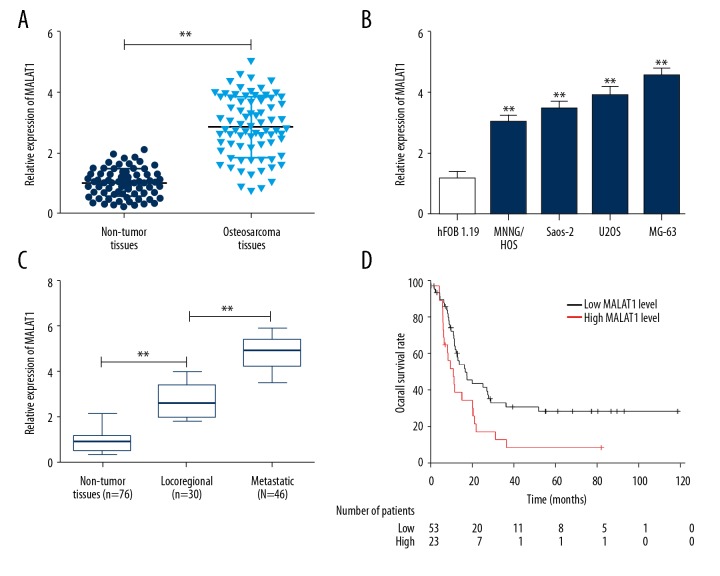
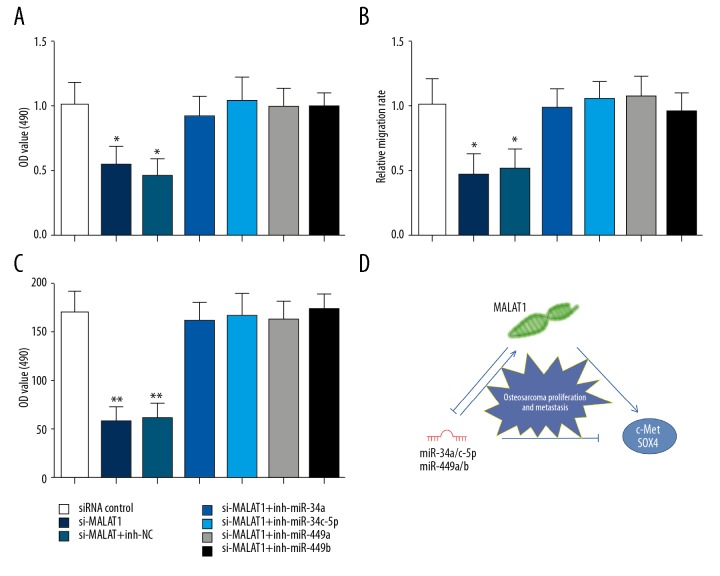
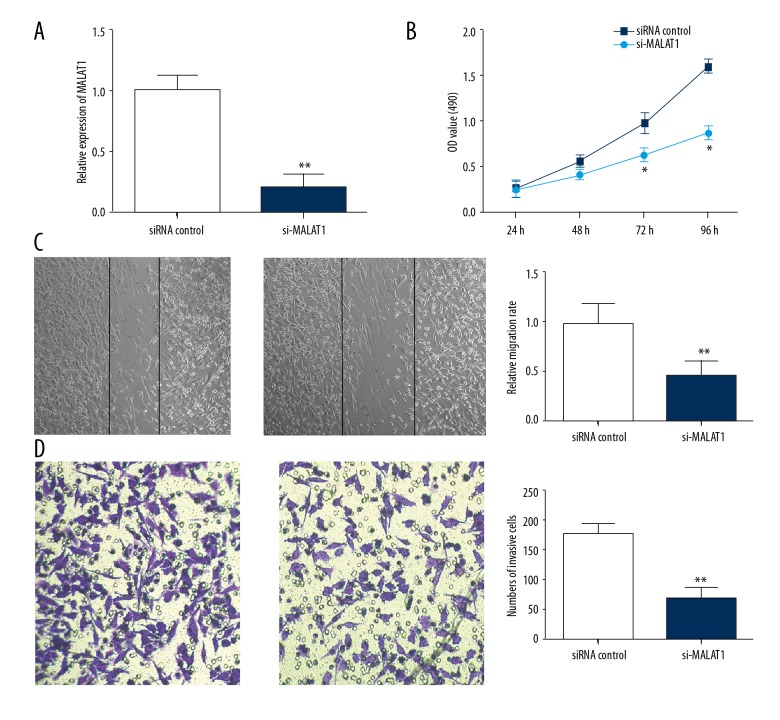
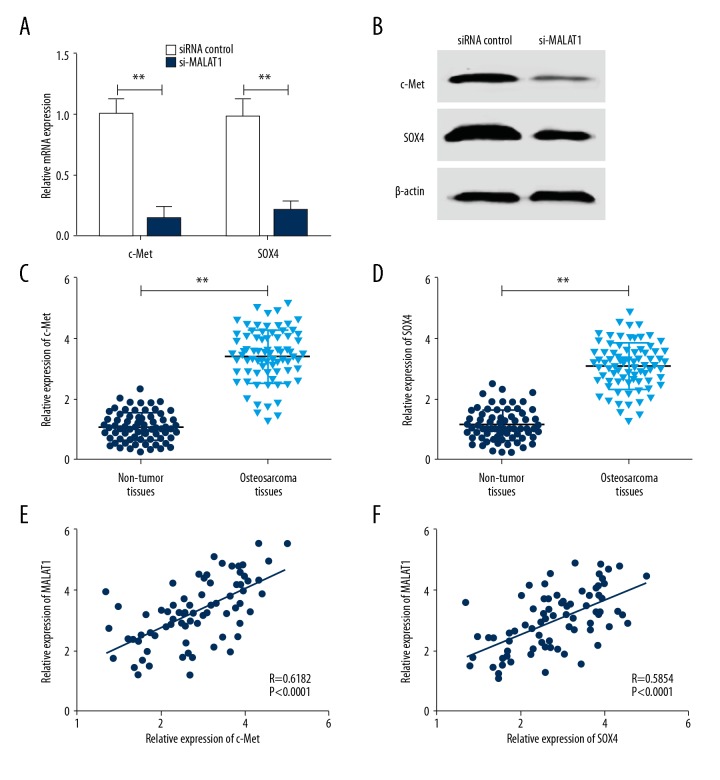
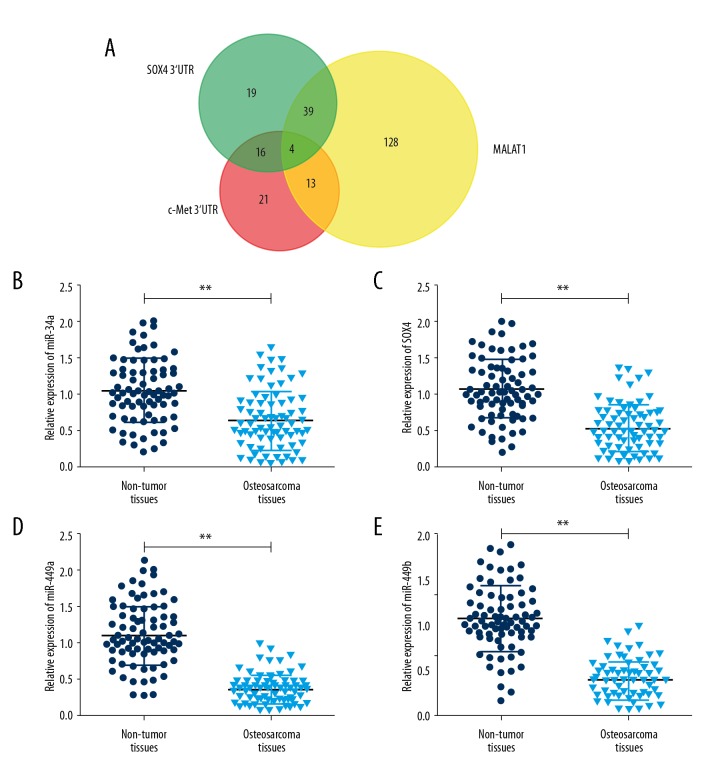
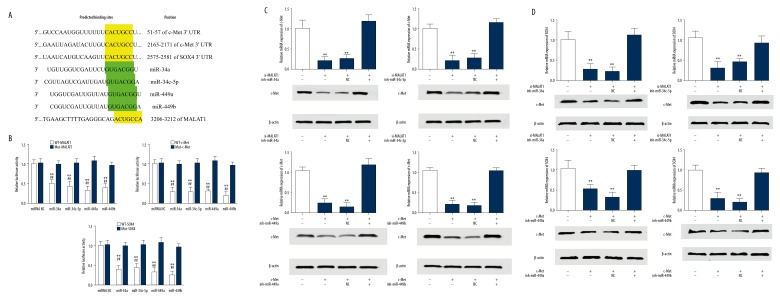
BACKGROUND Metastasis-associated lung adenocarcinoma transcript 1 (MALAT1) is a functional long non-coding RNA involved in many biologic processes. The study was aimed to explore the functional roles of MALAT1 in osteosarcoma progression. MATERIAL AND METHODS A total of 76 osteosarcoma tissues and paired adjacent non-tumor tissues were collected from surgical resection. MALAT1, miRNAs, and genes mRNA expression levels were detected using quantitative real-time PCR (qRT-PCR). Protein expression level, cell proliferation, migration, and invasion were assessed using western blot, Cell Counting Kit-8 (CCK-8), wound-healing assay, and Matrigel invasion assay respectively. The target relationships among miRNAs, MALAT1, and mRNA were detected via dual-luciferase reporter assay. RESULTS We found that MALAT1 was frequently upregulated in osteosarcoma samples and cell lines and a high level of MALAT1 predicted poor overall survival in osteosarcoma patients. Knockdown of MALAT1 inhibited proliferation, migration, and invasion of osteosarcoma cells. Further study showed a positive correlation between MALAT1 and c-Met or SOX4 expression. Mechanistic investigations demonstrated that MALAT1, as a competing endogenous RNA (ceRNA), regulated osteosarcoma proliferation and metastasis through competitively binding to miR-34a/c-5p and miR-449a/b. CONCLUSIONS Taken together, our study illustrates a new regulatory mechanism for MALAT1 and may provide a novel therapeutic strategy for the treatment of osteosarcoma.
转移相关肺腺癌转录本 1(MALAT1)是一种参与多种生物学过程的功能性长非编码 RNA。本研究旨在探讨 MALAT1 在骨肉瘤进展中的功能作用。
共收集 76 例骨肉瘤组织及配对的相邻非肿瘤组织,采用实时定量 PCR(qRT-PCR)检测 MALAT1、miRNAs 和基因 mRNA 表达水平。采用 Western blot 检测蛋白表达水平,采用细胞计数试剂盒-8(CCK-8)、划痕愈合实验和 Matrigel 侵袭实验分别评估细胞增殖、迁移和侵袭能力。采用双荧光素酶报告基因实验检测 miRNA、MALAT1 和 mRNA 之间的靶关系。
我们发现 MALAT1 在骨肉瘤样本和细胞系中频繁上调,高水平的 MALAT1 预示着骨肉瘤患者总体生存率差。MALAT1 敲低抑制了骨肉瘤细胞的增殖、迁移和侵袭。进一步的研究表明,MALAT1 与 c-Met 或 SOX4 表达呈正相关。机制研究表明,MALAT1 作为竞争性内源 RNA(ceRNA),通过竞争性结合 miR-34a/c-5p 和 miR-449a/b 调节骨肉瘤的增殖和转移。
综上所述,我们的研究说明了 MALAT1 的一个新的调控机制,并可能为骨肉瘤的治疗提供新的治疗策略。