Departamento de Genética e Evolução, Centro de Ciências Biológicas e da Saúde,Universidade Federal de São Carlos, São Carlos, SP, Brazil.
Percy FitzPatrick Institute, DST/NRF Centre of Excellence, University of Cape Town, Cape Town, South Africa.
PLoS One. 2019 Feb 22;14(2):e0212425. doi: 10.1371/journal.pone.0212425. eCollection 2019.
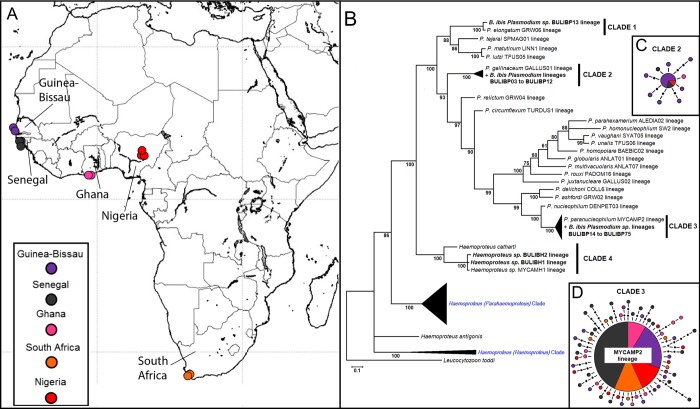
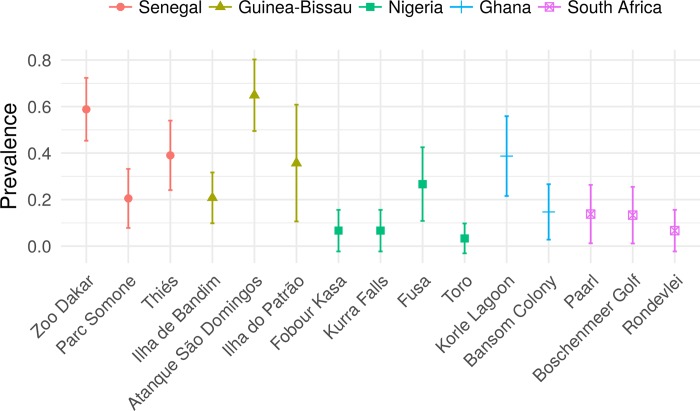
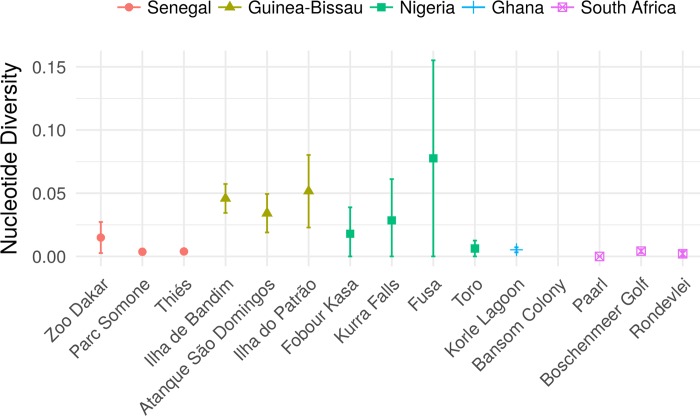
We described the geographic distribution of 82 haemosporidian lineages (Plasmodium, Haemoproteus, and Leucocytozoon) in the cattle egret sampled in five countries in central-western and southern Africa. Seventy-three lineages have not previously been reported. We determined the prevalence of three haemosporidians in the samples. We investigated the influence of the internal environment of the host and environmental variables on the Plasmodium diversity and whether environmental variables may explain spatial variations in the prevalence of Plasmodium. We screened DNA from 509 blood samples from nestlings in 15 African colonies for infection by sequencing the cytochrome b gene of parasites. The molecular phylogenetic analysis was performed using Bayesian methods and including sequences from the MalAvi and GeneBank databases. We found 62 new Plasmodium lineages in a clade with MYCAME02, which is a lineage described in waterbirds and recently identified in birds of prey as Plasmodium paranucleophilum. Two Haemoproteus lineages identified in cattle egret formed a distinct group with Haemoproteus catharti and MYCAMH1 (Haemoproteus spp.). Seven Leucocytozoon lineages found in the cattle egret clustered with Leucocytozoon californicus. We found different Plasmodium diversities among the colonies sampled, demonstrating that the internal environment of the host is not the primary determinant of diversity. A linear mixed-effects multivariate model showed that precipitation was positively associated with Plasmodium diversity when controlling for the effects of temperature, colony composition (mixed and non-mixed species) and country. Moreover, a generalized mixed model showed that temperature was positively associated with the prevalence of Plasmodium when controlling for precipitation, elevation and country. We conclude that the cattle egret is a good model for future haemosporidian studies, as we found a significant number of new lineages in this host, which occupies regions with different climate characteristics where environmental variables exert an influence on the diversity and prevalence of Plasmodium.
我们描述了在非洲中西部和南部五个国家采样的牛背鹭中 82 种血孢子虫(疟原虫、血鞭毛体和白细胞原生动物)的地理分布。其中 73 种谱系以前没有报道过。我们确定了样本中三种血孢子虫的流行率。我们调查了宿主内部环境和环境变量对疟原虫多样性的影响,以及环境变量是否可以解释疟原虫流行率的空间变化。我们从 15 个非洲殖民地的 509 份雏鸟血液样本中筛选了寄生虫细胞色素 b 基因的 DNA,通过贝叶斯方法进行了分子系统发育分析,并包括了来自 MalAvi 和 GeneBank 数据库的序列。我们在一个与 MYCAME02 相关的分支中发现了 62 种新的疟原虫谱系,这是一种在水鸟中描述的谱系,最近在猛禽中被确定为 Plasmodium paranucleophilum。在牛背鹭中鉴定的两种血鞭毛体形成了一个与 Haemoproteus catharti 和 MYCAMH1(血鞭毛体属)不同的群体。在牛背鹭中发现的七种白细胞原生动物谱系与 Leucocytozoon californicus 聚类。我们发现,不同殖民地的疟原虫多样性不同,表明宿主的内部环境不是多样性的主要决定因素。线性混合效应多变量模型表明,在控制温度、殖民地组成(混合和非混合物种)和国家的影响后,降水与疟原虫多样性呈正相关。此外,广义混合模型表明,在控制降水、海拔和国家的影响后,温度与疟原虫的流行率呈正相关。我们得出的结论是,牛背鹭是未来血孢子虫研究的一个很好的模型,因为我们在这种宿主中发现了大量的新谱系,它占据了具有不同气候特征的地区,环境变量对疟原虫的多样性和流行率有影响。