Departamento de Genética e Evolução, Universidade Federal de São Carlos, Rodovia Washington Luís, km 235 SP-310, São Carlos, SP, 13565-905, Brazil.
Centro de Engenharia, Modelagem e Ciências Aplicadas Universidade Federal do ABC, Avenida dos Estados 5001, Santo André, São Paulo, 09210-580, Brazil.
Parasit Vectors. 2018 May 2;11(1):276. doi: 10.1186/s13071-018-2847-z.
Wetlands are ecosystems in which vectors of avian haemosporidians live and reproduce and where waterbirds join to breed in colonies. Brazil has wetlands at different latitudes, which enables testing the influence of the ecological factors on the prevalence and diversity of haemosporidians. We identified avian haemosporidians in waterbird species in three wetlands and investigated the effects of vector habitat suitability, landscape and host characteristics on the diversity and prevalence of these parasites.
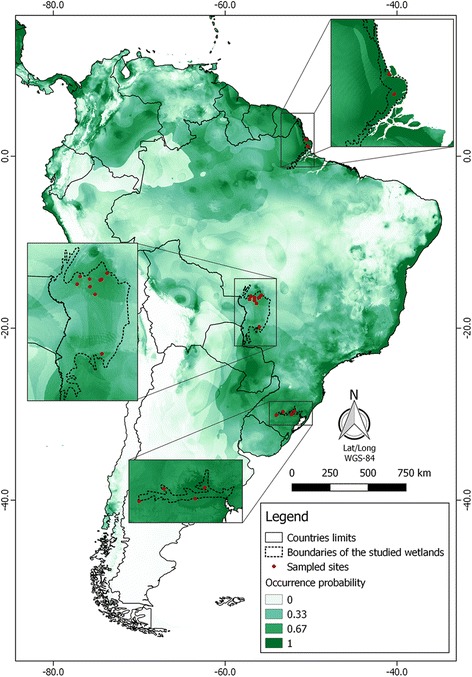
We created a map with the probability of occurrence of avian haemosporidian vectors using maximum-entropy modelling based on references addressing species known to be vectors of haemosporidians in birds in Brazil. We determined the prevalence and diversity index of haemosporidians in the great egret (Ardea alba) (n = 129) and roseate spoonbill (Platalea ajaja) (n = 180) and compared the findings to data for the wood stork (Mycteria americana) (n = 199).
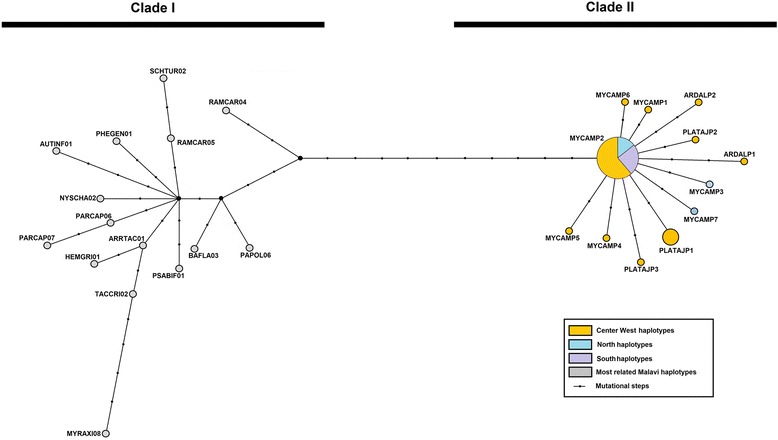
We report the first record of Plasmodium in the family Threskiornithidae: four lineages in the roseate spoonbill, which also presented one lineage of Haemoproteus. In the family Ardeidae, we found three Plasmodium lineages in the great egret. The similar habitat suitability for vectors found in three wetlands explains the pattern of haemosporidian diversity determined for great egret and wood stork populations. Comparisons of haemosporidian diversity within each waterbird species and between regions showed a higher level in the central-western roseate spoonbill population than in the northern population (P = 0.021). Removing the host effect, we discussed the results obtained in terms of characteristics of the Pantanal region. Comparisons of Plasmodium spp. prevalence among waterbird species within the same wetland showed higher level in roseate spoonbill (74%) than those found in the great egret (21%) and wood stork (11%). Excluding the environmental effect, we interpreted result focusing host characteristics that favour infection: time required for nestlings to be covered by feathers and migratory behaviour.
The map of habitat suitability showed that wetlands located in a 30° latitudinal range offer similar conditions for avian vectors species and diversity of haemosporidians. The lineages described in waterbirds were previously identified in birds of prey as Plasmodium paranucleophilum.
湿地是血孢子虫病病媒的栖息地和繁殖地,水鸟也在那里成群结队地繁殖。巴西拥有不同纬度的湿地,这使得我们能够测试生态因素对血孢子虫病的流行和多样性的影响。我们在三个湿地的水鸟物种中发现了鸟类血孢子虫,并调查了病媒栖息地适宜性、景观和宿主特征对这些寄生虫多样性和流行的影响。
我们使用最大熵模型创建了一张血孢子虫病病媒出现概率的地图,该模型基于巴西鸟类血孢子虫病病媒已知物种的参考文献。我们确定了大白鹭(Ardea alba)(n = 129)和粉红琵鹭(Platalea ajaja)(n = 180)的血孢子虫病的流行率和多样性指数,并将结果与木鹳(Mycteria americana)(n = 199)的数据进行了比较。
我们报告了在鹳形目家族中发现疟原虫的第一个记录:在粉红琵鹭中有四个疟原虫谱系,也有一个血吸虫谱系。在鹳科中,我们在大白鹭中发现了三个疟原虫谱系。在三个湿地中发现的病媒具有相似的栖息地适宜性,这解释了大白鹭和木鹳种群的血孢子虫多样性模式。对每个水鸟物种内和不同地区之间的血孢子虫多样性进行比较,发现中西部粉红琵鹭种群的水平高于北部种群(P = 0.021)。在去除宿主效应后,我们根据潘塔纳尔地区的特点讨论了结果。在同一湿地的水鸟物种中比较疟原虫病的流行率,发现粉红琵鹭(74%)高于大白鹭(21%)和木鹳(11%)。在排除环境影响后,我们从有利于感染的宿主特征的角度解释结果:雏鸟被羽毛覆盖所需的时间和迁徙行为。
栖息地适宜性地图显示,位于 30°纬度范围内的湿地为鸟类病媒和血孢子虫病的多样性提供了相似的条件。在水鸟中描述的谱系以前在猛禽中被鉴定为疟原虫 paranucleophilum。