Breast and Endocrine Surgery Unit, Maroondah Hospital, Eastern Health, Davey Drive, Ringwood East, Melbourne, VIC, 3135, Australia.
Faculty of Medicine, Nursing and Health Sciences, Monash University, Melbourne, Australia.
World J Surg Oncol. 2019 Feb 23;17(1):40. doi: 10.1186/s12957-019-1584-x.
Chest computed tomography (CTC) has now replaced chest X-ray (CXR) as the first choice of investigation to stage breast cancers in most centers in Australia. Routine staging is not recommended in early breast cancers (EBCs). This recommendation is based largely on the use of conventional tests like CXR as staging investigations (SIs). We looked at our experience with CTC in detecting asymptomatic synchronous distant metastasis (ASM) in new and recurrent breast cancers (RBCs).
Breast cancer patients from Eastern Health Breast Unit during the period from January 2012 to March 2016 were included in the study. Cases were grouped into early, advanced, and recurrent breast cancers, and outcome of CTC was assessed in each group. Relative risk of potential risk factors (tumor size, axillary nodal status, presence of lymphovascular invasion and estrogen, and HER2 receptor status) with a positive result in CTC was determined.
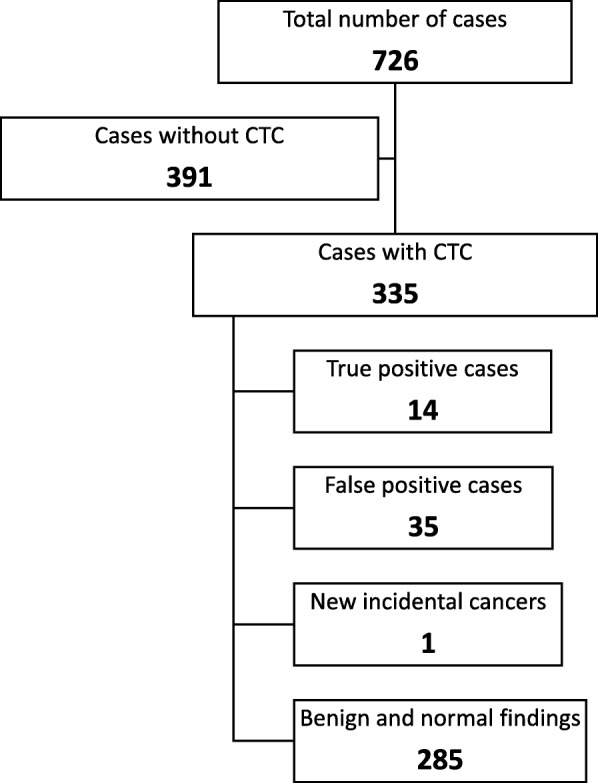
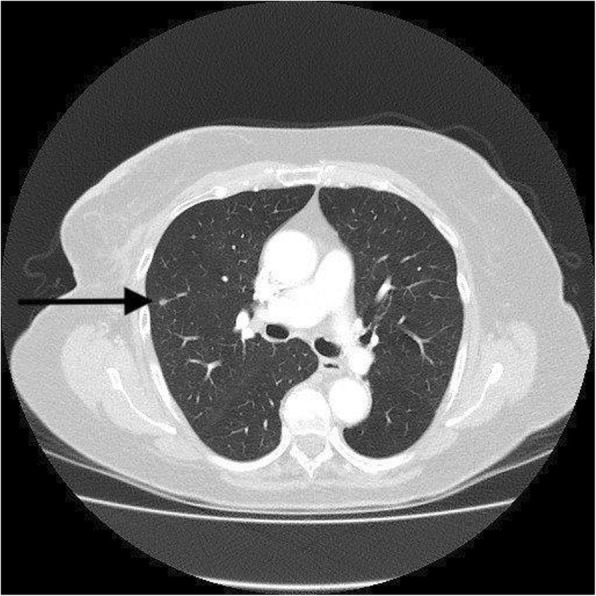
Fourteen ASMs were detected from 335 CTCs giving an overall yield of 4% (95% CI 1.89-6.47). The overall false-positive rate was 10% due to 35 indeterminate findings that were found not to be metastases after further tests or observation. Even with selective use, CTCs have a low yield of 2% (95% CI - 0.19-4.19) in EBCs. Advanced breast cancers have a 9% incidence of ASMs. None of the clinically isolated locoregionally recurrent diseases were associated with detectable distant metastasis in CTC. The most common cause of indeterminate findings was small pulmonary nodules.
Even with selective use, CTC has a very low yield in EBCs. Advanced breast cancers can benefit from CTC in their initial evaluation due to the higher yield. Locoregional RBCs were not usually associated with detectable metastasis on CTC. The usefulness of CTC in all stages of breast cancer is further reduced by its high rate of false-positive results.
在澳大利亚的大多数中心,胸部计算机断层扫描(CTC)现已取代胸部 X 光(CXR)成为乳腺癌分期的首选检查方法。不建议对早期乳腺癌(EBC)进行常规分期。这一建议主要基于使用常规测试(如 CXR)作为分期检查(SIs)。我们研究了 CTC 在检测新发性和复发性乳腺癌(RBC)中无症状性同步远处转移(ASM)的经验。
本研究纳入了 2012 年 1 月至 2016 年 3 月期间来自东健康乳腺科的乳腺癌患者。病例分为早期、晚期和复发性乳腺癌,并评估了 CTC 在每组中的结果。确定 CTC 阳性结果中潜在危险因素(肿瘤大小、腋窝淋巴结状态、淋巴管侵犯和雌激素、HER2 受体状态)的相对风险。
335 例 CTC 中检出 14 例 ASM,总检出率为 4%(95%CI 1.89-6.47)。由于 35 例不确定发现经过进一步检查或观察未发现转移,总假阳性率为 10%。即使选择性使用,EBC 中 CTC 的检出率也仅为 2%(95%CI -0.19-4.19)。晚期乳腺癌的 ASM 发生率为 9%。在 CTC 中,无临床孤立的局部复发性疾病与可检测到的远处转移相关。不确定发现最常见的原因是小结节。
即使选择性使用,EBC 中 CTC 的检出率也非常低。由于更高的检出率,晚期乳腺癌可从初始评估中受益。局部复发性 RBC 通常与 CTC 上可检测到的转移无关。CTC 高假阳性率进一步降低了其在乳腺癌各阶段的有用性。