a ENT Institute and Otorhinolaryngology Department of Affiliated Eye and ENT Hospital , Key Laboratory of Hearing Medicine of NHFPC, Shanghai Engineering Research Centre of Cochlear Implant, State Key Laboratory of Medical Neurobiology, Fudan University , Shanghai , China.
b Department of Otorhinolaryngology Head and Neck Surgery , Affiliated Drum Tower Hospital of Nanjing University Medical School, Research Institution of Otorhinolaryngology, Jiangsu Provincial Key Medical Discipline (Laboratory) , Nanjing , China.
Drug Deliv. 2018 Nov;25(1):1033-1043. doi: 10.1080/10717544.2018.1461277.
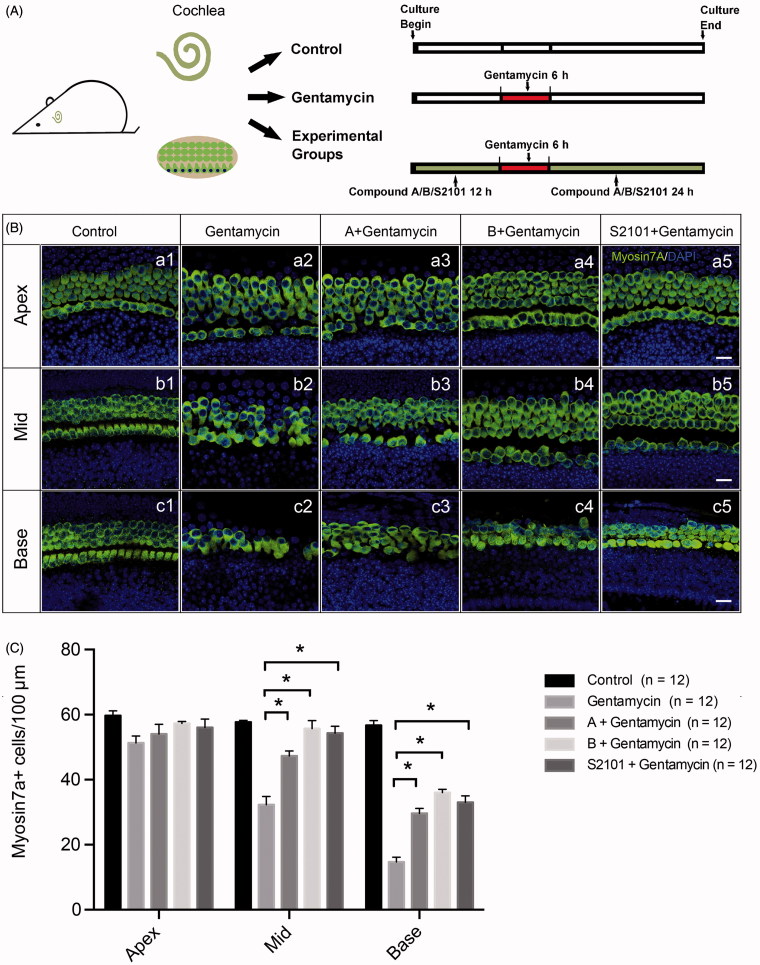
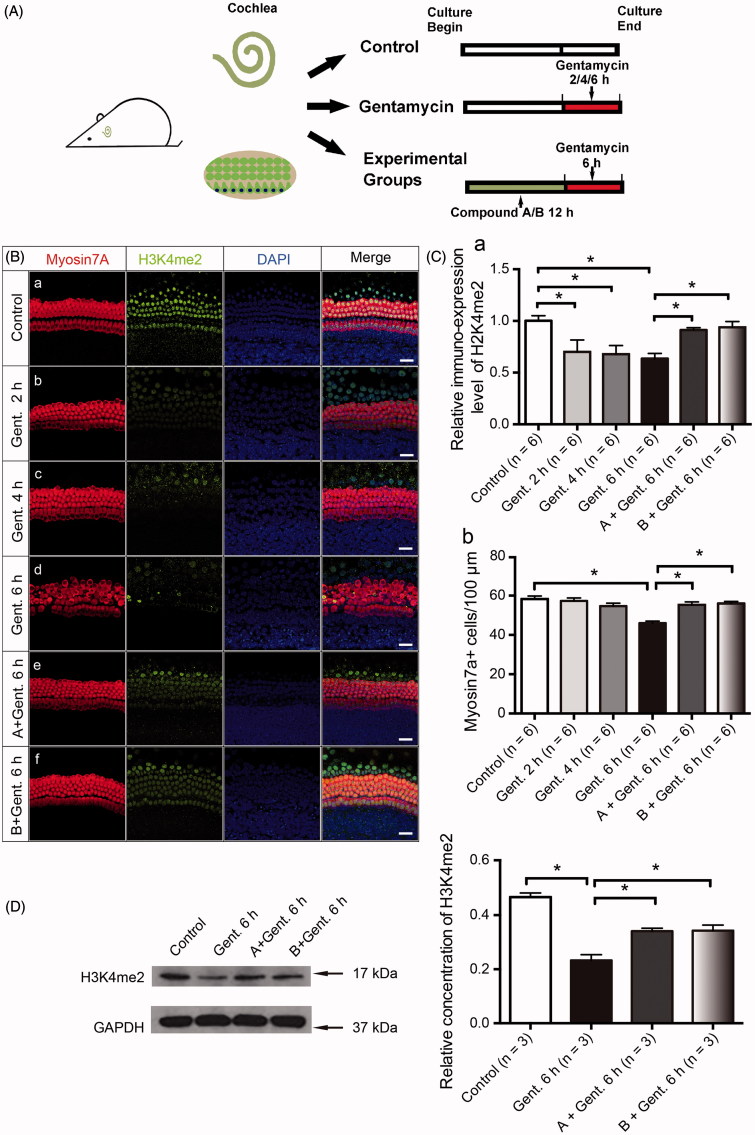
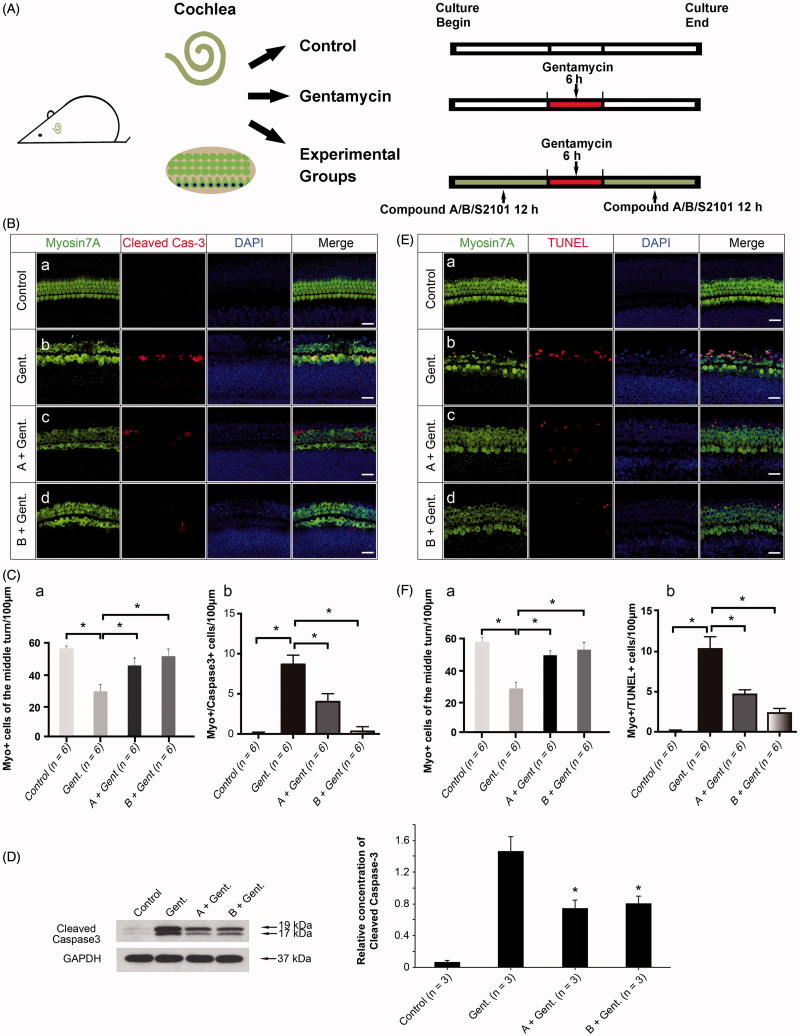
Aminoglycoside-induced hair cell (HC) loss is a major cause of hearing impairment, and the effective prevention of HC loss remains an unmet medical need. Epigenetic mechanisms have been reported to be involved in protecting cochlear cells against ototoxic drug injury, and in this study we developed new bioactive compounds that have similar chemical structures as the epigenetics-related lysine-specific demethylase 1 (LSD1) inhibitors. LSD1 inhibitors have been reported to protect cochlear cells by preventing demethylation of dimethylated histone H3K4 (H3K4me2). To determine whether these new compounds exert similar protective effects on HCs, we treated mouse cochlear explant cultures with the new compounds together with gentamycin. There was a severe loss of HCs in the organ of Corti after gentamycin exposure, while co-treatment with the new compounds significantly protected against gentamycin-induced HC loss. H3K4me2 levels in the nuclei of HCs decreased after exposure to gentamycin, but H3K4me2 levels were maintained in the presence of the new compounds. Apoptosis is also involved in the injury process, and the new compounds protected the inner ear HCs against apoptosis by reducing caspase-3 activation. Together, our findings demonstrate that our new compounds prevent gentamycin-induced HC loss by preventing the demethylation of H3K4me2 and by inhibiting apoptosis, and these results might provide the theoretical basis for novel drug development for hearing protection.
氨基糖苷类诱导的毛细胞(HC)损失是听力损伤的主要原因,有效预防 HC 损失仍然是未满足的医疗需求。表观遗传机制已被报道可用于保护耳蜗细胞免受耳毒性药物损伤,在这项研究中,我们开发了具有与表观遗传学相关的赖氨酸特异性去甲基化酶 1(LSD1)抑制剂相似化学结构的新型生物活性化合物。LSD1 抑制剂已被报道可通过防止二甲基化组蛋白 H3K4(H3K4me2)去甲基化来保护耳蜗细胞。为了确定这些新化合物是否对 HC 具有相似的保护作用,我们用新化合物与庆大霉素一起处理小鼠耳蜗离体培养物。庆大霉素暴露后,耳蜗组织中的 HC 严重丢失,而新化合物的共同处理可显著防止庆大霉素诱导的 HC 丢失。庆大霉素暴露后 HC 细胞核中的 H3K4me2 水平下降,但新化合物存在时 H3K4me2 水平保持不变。细胞凋亡也参与损伤过程,新化合物通过减少 caspase-3 激活来保护内耳 HC 免受细胞凋亡。总之,我们的研究结果表明,我们的新型化合物通过防止 H3K4me2 的去甲基化和抑制细胞凋亡来预防庆大霉素诱导的 HC 损失,这些结果可能为听力保护的新型药物开发提供理论基础。