Mahesha Ninganayaka, Sagar Belakavadi K, Yathirajan Hemmige S, Furuya Tetsundo, Haraguchi Tomoyuki, Akitsu Takashiro, Glidewell Christopher
Department of Studies in Chemistry, University of Mysore, Manasagangotri, Mysuru-570 006, India.
Department of Chemistry, Faculty of Science, Tokyo University of Science, 1-3 Kagurazaka, Shinjuku-ku, Tokyo 162-8601, Japan.
Acta Crystallogr E Crystallogr Commun. 2019 Jan 11;75(Pt 2):202-207. doi: 10.1107/S2056989019000458. eCollection 2019 Feb 1.
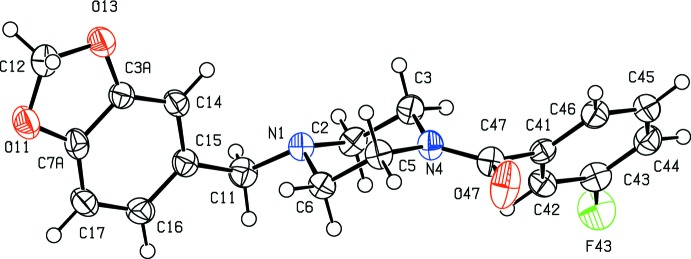
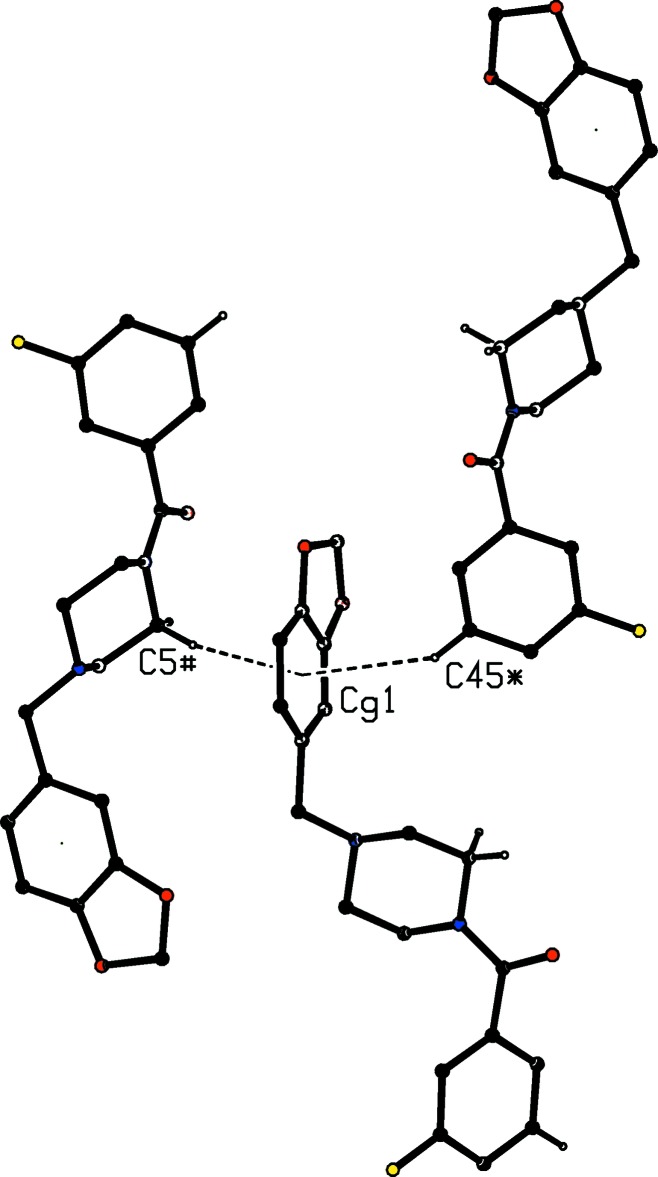
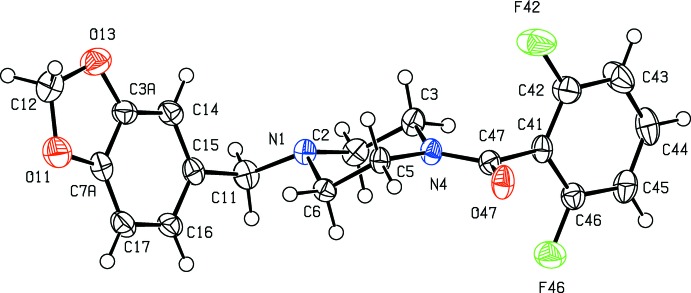
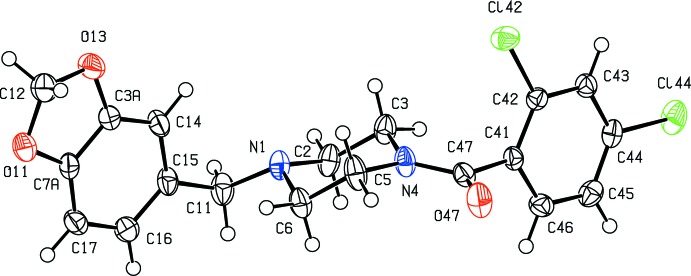
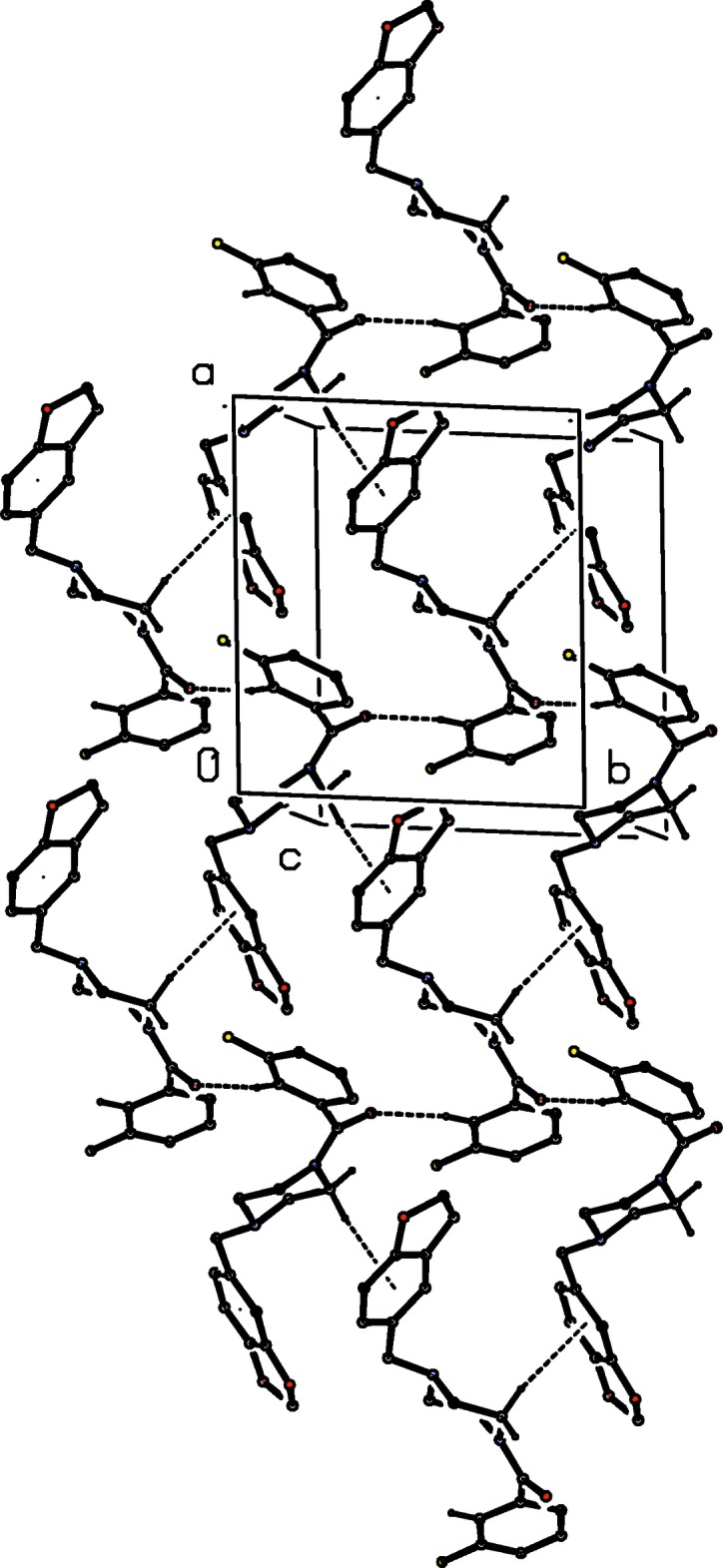
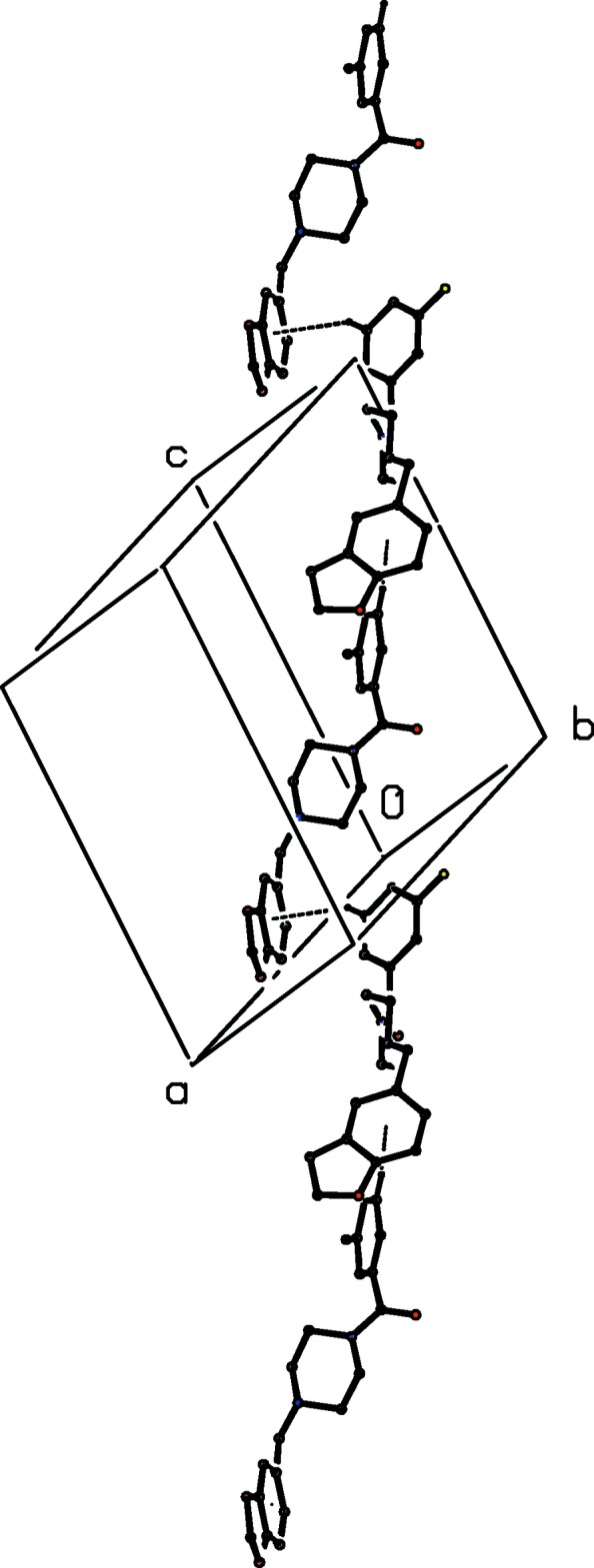
In each of the compounds 1-[(1,3-benzodioxol-5-yl)methyl]-4-(3-fluoro-benzo-yl)piperazine, CHFNO (I), 1-[(1,3-benzodioxol-5-yl)methyl]-4-(2,6-di-fluoro-benzo-yl)piperazine, CHFNO (II), and 1-[(1,3-benzodioxol-5-yl)methyl]-4-(2,4-di-chloro-benzo-yl)piperazine, CHClNO (III), the piperazine rings adopt a chair conformation with the (1,3-benzodioxol-5-yl)methyl substituent occupying an equatorial site: the five-membered rings are all slightly folded across the O⋯O line leading to envelope conformations. The dihedral angle between the planar amidic fragment and the haloaryl ring is 62.97 (5)° in (I) but 77.72 (12)° and 75.50 (5)° in (II) and (III), respectively. Despite their similarity in constitution and conformation, the supra-molecular inter-actions in (I)-(III) differ: in (I), a combination of C-H⋯O and C-H⋯π(arene) hydrogen bonds links the mol-ecules into a three-dimensional framework structure, but there are no hydrogen bonds of any sort in either (II) or (III), although the structure of (III) contains a short Cl⋯Cl contact between inversion-related pairs of mol-ecules.
在化合物1-[(1,3-苯并二氧杂环戊烯-5-基)甲基]-4-(3-氟苯甲酰基)哌嗪(CHFNO,I)、1-[(1,3-苯并二氧杂环戊烯-5-基)甲基]-4-(2,6-二氟苯甲酰基)哌嗪(CHFNO,II)和1-[(1,3-苯并二氧杂环戊烯-5-基)甲基]-氯苯甲酰基)哌嗪(CHClNO,III)中,哌嗪环均呈椅式构象,(1,3-苯并二氧杂环戊烯-5-基)甲基取代基占据赤道位置:五元环均沿O⋯O线略有折叠,形成信封式构象。在(I)中,平面酰胺片段与卤代芳基环之间的二面角为62.97 (5)°,而在(II)和(III)中分别为77.72 (12)°和75.50 (5)°。尽管它们在结构和构象上相似,但(I)-(III)中的超分子相互作用不同:在(I)中,C-H⋯O和C-H⋯π(芳烃)氢键的组合将分子连接成三维骨架结构,但在(II)或(III)中均不存在任何类型 的氢键,尽管(III)的结构在分子的反演相关对之间包含短的Cl⋯Cl接触。