Mangla Mahima, Bedair Hany, Dwyer Maureen, Freiberg Andrew, Sepucha Karen
Health Decision Sciences Center, Division of General Internal Medicine, Massachusetts General Hospital, Boston.
Department of Orthopaedics, Massachusetts General Hospital, Boston.
MDM Policy Pract. 2019 Feb 12;4(1):2381468319827278. doi: 10.1177/2381468319827278. eCollection 2019 Jan-Jun.
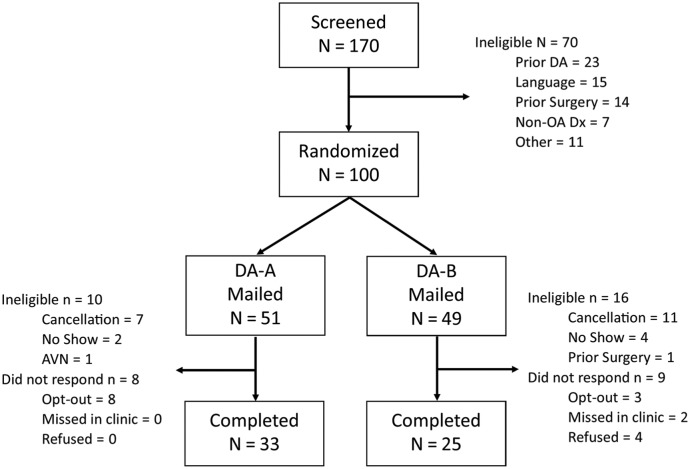
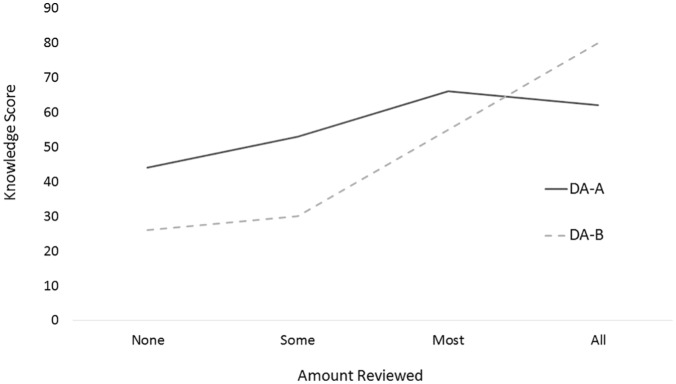
There are many patient decision aids (DAs) available, yet there is limited evidence on comparative effectiveness of different tools. To examine feasibility of a study protocol and gather preliminary data on comparative effectiveness. Adult patients seeing a surgeon to discuss treatment for hip or knee osteoarthritis were randomized to hip and knee DAs from two vendors. Pre-visit survey included Hip/Knee Decision Quality Instrument, DA usage, health literacy, and quality of life (EQ-5D). Surgical status was ascertained 6 months post-visit. We examined response rates, eligibility, and compared the two DAs on amount of use, knowledge scores, and receipt of preferred treatment. Overall response rate was 58/74 (78%) and did not differ by study arm. More patients in DA-A group reported reviewing all the DAs (64.5% DA-A v. 24.0% DA-B, = 0.003). Knowledge scores were similar across arms (55.2% DA-A v. 48.8% DA-B, = 0.4). For DA-B, knowledge scores were higher for those who reviewed all the DAs compared with those who did not (80% knowledge v. 39% knowledge, respectively, = 0.004), while scores for DA-A did not vary by usage (62% knowledge v. 53% knowledge, respectively, = 0.3). A similar percentage of each group received their preferred treatment (77% v. 73%, = 0.8). Patients who were unsure about preferred treatment at baseline were more likely to have surgery in the DA-A arm compared with the DA-B arm (55% v. 20%, = 0.1). Small sample; patients were only surveyed pre-visit. Despite having different content and formats, the two DAs had similar overall effectiveness. Patients were more likely to review all of DA-A; however, patients who reviewed all of DA-B had the highest knowledge scores.
现有许多患者决策辅助工具(DA),但关于不同工具的比较效果的证据有限。为了检验一项研究方案的可行性并收集关于比较效果的初步数据,让因髋或膝骨关节炎而看外科医生讨论治疗方案的成年患者随机使用来自两家供应商的髋部和膝部DA。访视前调查包括髋/膝决策质量工具、DA使用情况、健康素养和生活质量(EQ-5D)。在访视后6个月确定手术状态。我们检查了回复率、合格性,并比较了两种DA在使用量、知识得分和接受首选治疗方面的情况。总体回复率为58/74(78%),各研究组之间无差异。DA-A组中更多患者报告查看了所有DA(DA-A组为64.5%,DA-B组为24.0%,P = 0.003)。各研究组的知识得分相似(DA-A组为55.2%,DA-B组为48.8%,P = 0.4)。对于DA-B,查看了所有DA的患者的知识得分高于未查看所有DA的患者(分别为80%的知识得分对39%的知识得分,P = 0.004),而DA-A的得分并未因使用情况而有所不同(分别为62%的知识得分对53%的知识得分,P = 0.3)。每组中接受首选治疗的比例相似(77%对73%,P = 0.8)。与DA-B组相比,基线时不确定首选治疗方案的患者在DA-A组中更有可能接受手术(55%对20%,P = 0.1)。样本量小;仅在访视前对患者进行了调查。尽管两种DA的内容和形式不同,但总体效果相似。患者更有可能查看所有的DA-A;然而,查看了所有DA-B的患者知识得分最高。