Dowsey Michelle M, Spelman Tim, Choong Peter F M
Department of Surgery, The University of Melbourne, St. Vincent's Hospital Melbourne, Fitzroy, VIC 3065, Australia.
Department of Orthopaedics, St. Vincent's Hospital Melbourne, Fitzroy, VIC 3065, Australia.
J Clin Med. 2022 Mar 16;11(6):1649. doi: 10.3390/jcm11061649.
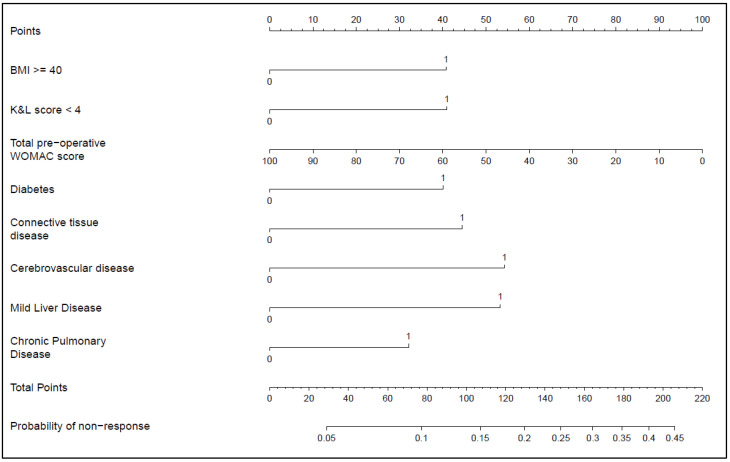
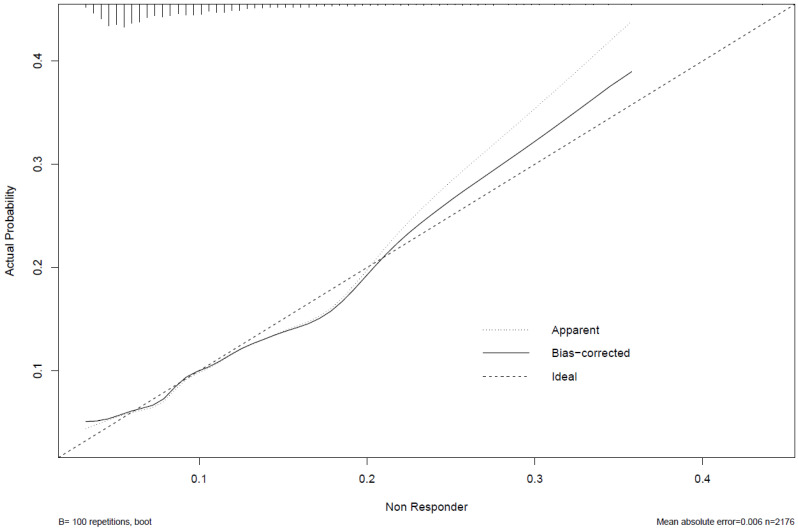
Background: Total hip replacement (THR) is a common and cost-effective procedure for end-stage osteoarthritis, but inappropriate utilization may be devaluing its true impact. The purpose of this study was to develop and test the internal validity of a prognostic algorithm for predicting the probability of non-response to THR surgery at 1 year. Methods: Analysis of outcome data extracted from an institutional registry of individuals (N = 2177) following elective THR performed between January 2012 and December 2019. OMERACT-OARSI responder criteria were applied to Western Ontario and McMaster Universities Arthritis Index (WOMAC) pain and function scores at pre- and 1 year post-THR, to determine non-response to surgery. Independent prognostic correlates of post-operative non-response observed in adjusted modelling were then used to develop a nomogram. Results: A total of 194 (8.9%) cases were deemed non-responders to THR. The degree of contribution (OR, 95% CI) of each explanatory factor to non-response on the nomogram was, morbid obesity (1.88, 1.16, 3.05), Kellgren−Lawrence grade <4 (1.89, 1.39, 2.56), WOMAC Global rating per 10 units (0.86, 0.79, 0.94) and the following co-morbidities: cerebrovascular disease (2.39, 1.33, 4.30), chronic pulmonary disease (1.64; 1.00, 2.71), connective tissue disease (1.99, 1.17, 3.39), diabetes (1.86, 1.26, 2.75) and liver disease (2.28, 0.99, 5.27). The concordance index for the nomogram was 0.70. Conclusion: We have developed a prognostic nomogram to calculate the probability of non-response to THR surgery. In doing so, we determined that both the probability of and predictive prognostic factors for non-response to THR differed from a previously developed nomogram for total knee replacement (TKR), confirming the benefit of designing decision support tools that are both condition and surgery site specific. Future external validation of the nomogram is required to confirm its generalisability.
全髋关节置换术(THR)是治疗终末期骨关节炎的一种常见且具有成本效益的手术,但不恰当的应用可能会降低其实际效果。本研究的目的是开发并测试一种预后算法的内部有效性,该算法用于预测THR手术后1年无反应的概率。方法:对从2012年1月至2019年12月期间接受择期THR手术的个体机构登记处提取的结局数据进行分析(N = 2177)。将OMERACT - OARSI反应标准应用于THR术前和术后1年的西安大略和麦克马斯特大学骨关节炎指数(WOMAC)疼痛和功能评分,以确定手术无反应情况。然后,在调整模型中观察到的术后无反应的独立预后相关因素被用于开发列线图。结果:共有194例(8.9%)病例被视为THR手术无反应者。列线图上每个解释因素对无反应的贡献程度(OR,95%CI)分别为,病态肥胖(1.88,1.16,3.05),Kellgren - Lawrence分级<4(1.89,1.39,2.56),每10个单位的WOMAC总体评分(0.86,0.79,0.94)以及以下合并症:脑血管疾病(2.39,1.33,4.30),慢性肺病(1.64;1.00,2.71),结缔组织病(1.99,1.17,3.39),糖尿病(1.86,1.26,2.75)和肝病(2.28,0.99,5.27)。列线图的一致性指数为0.70。结论:我们开发了一种预后列线图来计算THR手术无反应的概率。在此过程中,我们确定THR手术无反应的概率和预测性预后因素与先前开发的全膝关节置换术(TKR)列线图不同,并证实了设计针对特定病情和手术部位的决策支持工具的益处。需要对列线图进行未来的外部验证以确认其普遍性。