Baptista Abrahão Fontes, Fernandes Ana Mércia B L, Sá Katia Nunes, Okano Alexandre Hideki, Brunoni André Russowsky, Lara-Solares Argelia, Jreige Iskandar Aziza, Guerrero Carlos, Amescua-García César, Kraychete Durval Campos, Caparelli-Daquer Egas, Atencio Elias, Piedimonte Fabián, Colimon Frantz, Hazime Fuad Ahmed, Garcia João Batista S, Hernández-Castro John Jairo, Cantisani José Alberto Flores, Karina do Monte-Silva Kátia, Lemos Correia Luis Claudio, Gallegos Manuel Sempértegui, Marcolin Marco Antonio, Ricco María Antonieta, Cook María Berenguel, Bonilla Patricia, Schestatsky Pedro, Galhardoni Ricardo, Silva Valquíria, Delgado Barrera William, Caumo Wolnei, Bouhassira Didier, Chipchase Lucy S, Lefaucheur Jean-Pascal, Teixeira Manoel Jacobsen, de Andrade Daniel Ciampi
Universidade Federal do ABC, Centro de Matemática, Computação e Cognição, São Bernardo do Campo, São Paulo, Brazil.
Departamento de Pós-graduação, Escola Bahiana de Medicina e Saúde Pública, Salvador, Bahia, Brazil.
Pain Rep. 2019 Jan 9;4(1):e692. doi: 10.1097/PR9.0000000000000692. eCollection 2019 Jan-Feb.
Chronic pain (CP) is highly prevalent and generally undertreated health condition. Noninvasive brain stimulation may contribute to decrease pain intensity and influence other aspects related to CP.
To provide consensus-based recommendations for the use of noninvasive brain stimulation in clinical practice.
Systematic review of the literature searching for randomized clinical trials followed by consensus panel. Recommendations also involved a cost-estimation study.
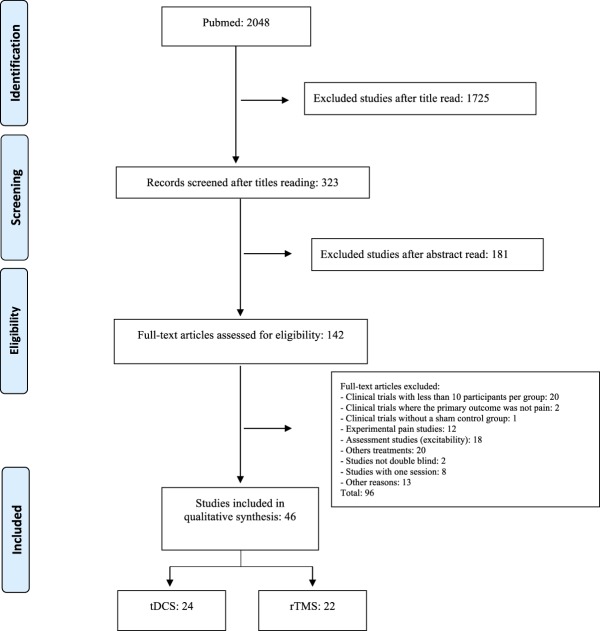
The systematic review wielded 24 transcranial direct current stimulation (tDCS) and 22 repetitive transcranial magnetic stimulation (rTMS) studies. The following recommendations were provided: (1) Level A for anodal tDCS over the primary motor cortex (M1) in fibromyalgia, and level B for peripheral neuropathic pain, abdominal pain, and migraine; bifrontal (F3/F4) tDCS and M1 high-definition (HD)-tDCS for fibromyalgia; Oz/Cz tDCS for migraine and for secondary benefits such as improvement in quality of life, decrease in anxiety, and increase in pressure pain threshold; (2) level A recommendation for high-frequency (HF) rTMS over M1 for fibromyalgia and neuropathic pain, and level B for myofascial or musculoskeletal pain, complex regional pain syndrome, and migraine; (3) level A recommendation against the use of anodal M1 tDCS for low back pain; and (4) level B recommendation against the use of HF rTMS over the left dorsolateral prefrontal cortex in the control of pain.
Transcranial DCS and rTMS are recommended techniques to be used in the control of CP conditions, with low to moderate analgesic effects, and no severe adverse events. These recommendations are based on a systematic review of the literature and a consensus made by experts in the field. Readers should use it as part of the resources available to decision-making.
慢性疼痛(CP)是一种普遍存在且治疗普遍不足的健康状况。非侵入性脑刺激可能有助于减轻疼痛强度并影响与慢性疼痛相关的其他方面。
为临床实践中使用非侵入性脑刺激提供基于共识的建议。
对文献进行系统回顾,检索随机临床试验,随后进行共识小组讨论。建议还涉及成本估算研究。
系统回顾产生了24项经颅直流电刺激(tDCS)研究和22项重复经颅磁刺激(rTMS)研究。提供了以下建议:(1)对于纤维肌痛患者,在初级运动皮层(M1)进行阳极tDCS为A级推荐,对于周围神经性疼痛、腹痛和偏头痛为B级推荐;双额叶(F3/F4)tDCS和M1高清(HD)-tDCS用于纤维肌痛;Oz/Cz tDCS用于偏头痛以及改善生活质量、减轻焦虑和提高压力痛阈等次要益处;(2)对于纤维肌痛和神经性疼痛,在M1进行高频(HF)rTMS为A级推荐,对于肌筋膜或肌肉骨骼疼痛、复杂性区域疼痛综合征和偏头痛为B级推荐;(3)A级推荐不使用阳极M1 tDCS治疗腰痛;(4)B级推荐不使用HF rTMS刺激左侧背外侧前额叶皮层来控制疼痛。
经颅直流电刺激和重复经颅磁刺激是推荐用于控制慢性疼痛状况的技术,具有低至中度的镇痛效果,且无严重不良事件。这些建议基于对文献的系统回顾和该领域专家达成的共识。读者应将其作为决策可用资源的一部分加以使用。