Manchester Institute of Biotechnology and School of Chemistry, Faculty of Science and Engineering , The University of Manchester , Manchester M1 7DN , United Kingdom.
Dosage Form Design & Development , AstraZeneca plc , Granta Park , Cambridge CB21 6GH , United Kingdom.
Anal Chem. 2019 Apr 2;91(7):4702-4708. doi: 10.1021/acs.analchem.9b00143. Epub 2019 Mar 23.
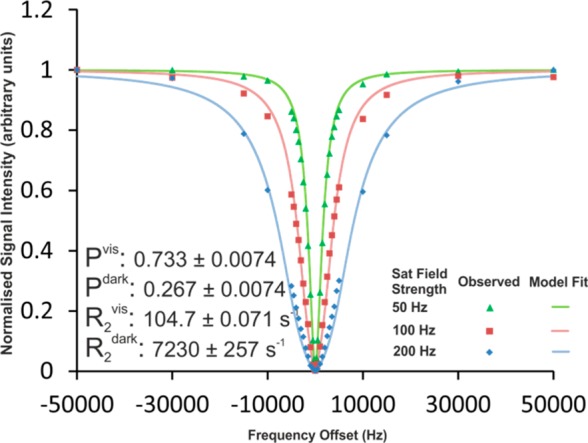
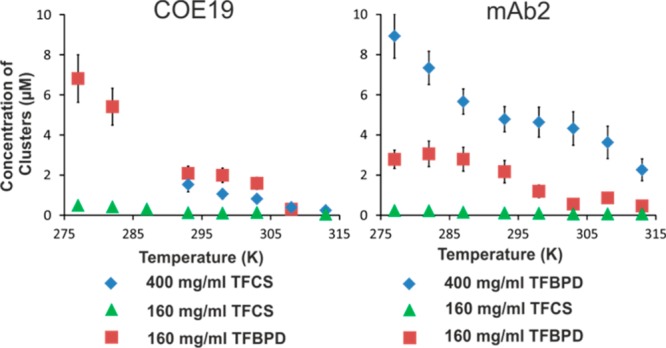
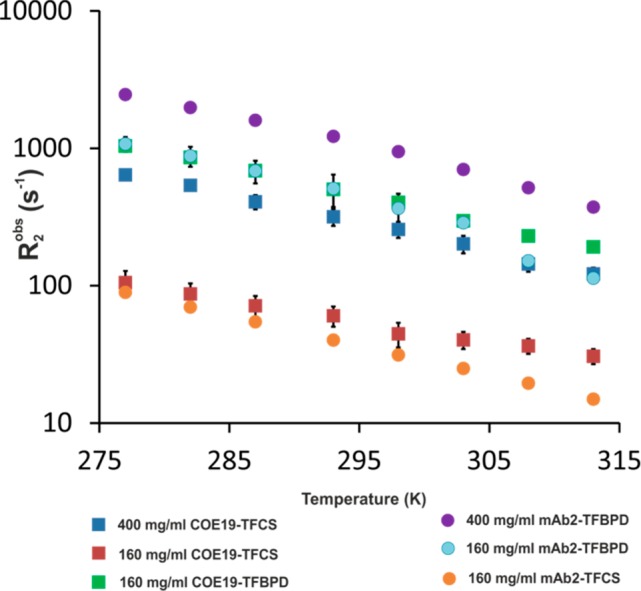
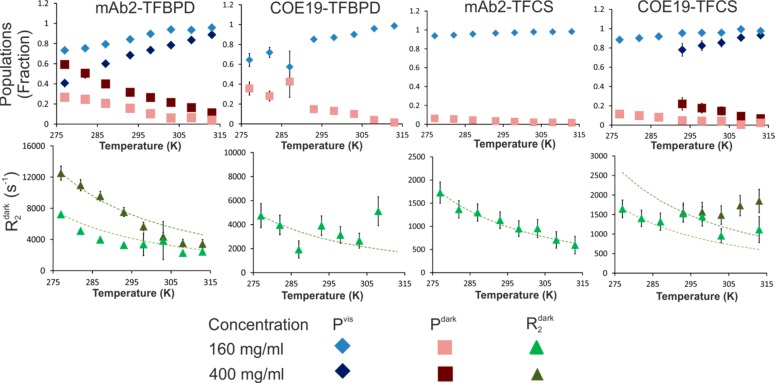
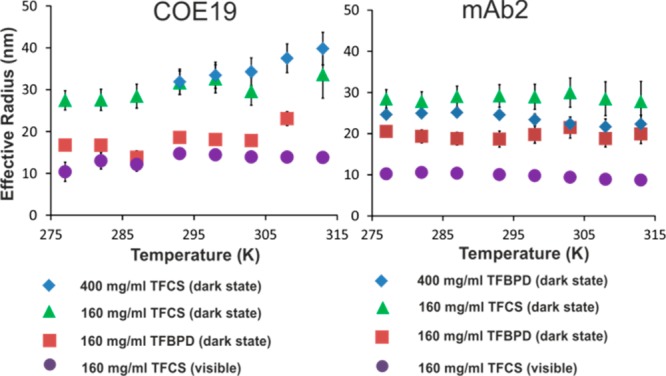
Proteins frequently exist as high-concentration mixtures, both in biological environments and increasingly in biopharmaceutical co-formulations. Such crowded conditions promote protein-protein interactions, potentially leading to formation of protein clusters, aggregation, and phase separation. Characterizing these interactions and processes in situ in high-concentration mixtures is challenging due to the complexity and heterogeneity of such systems. Here we demonstrate the application of the dark-state exchange saturation transfer (DEST) NMR technique to a mixture of two differentially F-labeled 145 kDa monoclonal antibodies (mAbs) to assess reversible temperature-dependent formation of small and large protein-specific clusters at concentrations up to 400 mg/mL. F DEST allowed quantitative protein-specific characterization of the cluster populations and sizes for both mAbs in the mixture under a range of conditions. Additives such as arginine glutamate and NaCl also had protein-specific effects on the dark-state populations and cluster characteristics. Notably, both mAbs appear to largely exist as separate self-associated clusters, which mechanistically respond differently to changes in solution conditions. We show that for mixtures of differentially F-labeled proteins DEST NMR can characterize clustering in a protein-specific manner, offering unique tracking of clustering pathways and a means to understand and control them.
蛋白质通常以高浓度的混合物形式存在,无论是在生物环境中还是在日益增多的生物制药共制剂中。这种拥挤的条件促进了蛋白质-蛋白质相互作用,可能导致蛋白质簇的形成、聚集和相分离。由于这些系统的复杂性和异质性,在高浓度混合物中对这些相互作用和过程进行原位表征具有挑战性。在这里,我们展示了暗态交换饱和转移(DEST)NMR 技术在两种不同 F 标记的 145 kDa 单克隆抗体(mAb)混合物中的应用,以评估在高达 400mg/mL 的浓度下,小的和大的蛋白质特异性簇在可逆温度依赖性下的形成。F DEST 允许在一系列条件下对混合物中两种 mAb 的簇群体和大小进行定量的蛋白质特异性表征。添加剂,如精氨酸谷氨酸和 NaCl,对暗态群体和簇特征也有蛋白质特异性影响。值得注意的是,两种 mAb 似乎主要以单独的自我相关簇的形式存在,其对溶液条件变化的机械响应方式不同。我们表明,对于不同 F 标记的蛋白质混合物,DEST NMR 可以以蛋白质特异性的方式对聚集进行表征,为跟踪聚集途径提供了独特的方法,并为理解和控制聚集途径提供了手段。